BILBILIS AUGUSTA IN THE ANCIENT SOURCES

|
|
BILBILIS AUGUSTA IN THE ANCIENT SOURCES |
|
|
Although there are only few bibliographical references in the Antiquity, probably together with Caesar Augusta, Bilbilis is the Roman city in our modern Aragon that have more quotations in the Greek and Roman literature, partly due to the fact that one of the best Latin poets, Marcus Valerius Martial, was born in Bilbilis. However, the first quotations are not referred to the Roman Bilbilis, but the Celtiberian: Strabo III 4, 13, quoted it when he wrote about the Celtiberian nations and tribes. We find two quotations about the city in Pliny III 2, 24 and XXXIV 144, where he wrote also about political aspects of the Celtiberians and about the good quality of the swords and the iron worked by them. Finally, Ptolomaeus, Geography II 6, 57, quoted again Bilbilis as a Celtiberian nation. |
|
Portrait of Strabo. |
|
|
|
|
|
Undoubtedly, the many epigrams where Martial quoted its natal city are the large group of quotations about Bilbilis in the classical literature, although in some of them he does not give information about his city: Epigrams I 49 y 61, IV 55, X 13, 103 y 104, XII 18. Marcus Valerius Martial –so called because he was born the 1st march, i. e., the day of the kalendas Martias- was born in Bilbilis in the year 40 d. C., he moved to Rome when he was twenty four years old; he stayed in Rome more than thirty four years; when he was old, he came back to Bilbilis for three years. Finally, he came back again to Rome where he died in the year 104 d. C. In the correspondence between Ausonius, Epistles X, 223-4 and Epistles XXIX 56-59, and Paulinus of Nola in the years 390-394 d. C., it is mentioned the city of Bilbilis. Justin XLV 3, 8, quoted it also, as Saint Isidorus of Sevilla, Etymologies XVI 21, following the text of Pliny. |
|
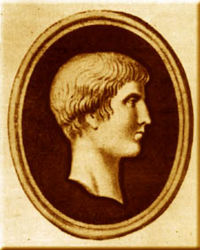
Portrait of Martial. |
|
|
|
|
|
In the Itinerarium Antoninum, probably made in the III century a. C., but modified en the IV century, under the emperor Diocletian, is a private text, but it is based on official text, where there were indicated the main Roman roads and the cities or mansiones –breeding establishments to post and to have a rest- that existed between one point and another in a certain itinerary. In the case of Bilbilis, the city is located on the way that connected Emerita Augusta (now Mérida, Badajoz) and Caesar Augusta (Zaragoza). |
||
|
|
|
|
|
The last quotation of Bilbilis is offered by the Anonymous of Ravenna IV 43 in the VII century; he related Bilbilis with other Roman cities in a Roman way, although in this period the city was practically abandoned; so, he could make a reference to a mansion that existed in the way and not to the city. |
||
|
|
|
|
|
|
|
Sources: - MARTÍN BUENO, Manuel y SÁENZ PRECIADO, Juan Carlos: Bilbilis, Calatayud, Zaragoza, 2005 - MARTÍN BUENO, Manuel y MAGALLÓN BOTAYA, M.ª Ángeles: Cuaderno de campo Grupo URBS: Bilbilis y Labitolosa, Zaragoza, 2006 |