Nam quod in eversis habitacula ponis Hibera
urbibus et deserta tuo legis oppida versu
montanamque mihi Calagorrim et Birbilim acutis
pendentem scopulis collemque iacentis Hilerdae
exprobras, velut his habitem laris exul et urbis
extra hominum tecta atque vias; - an credis Hiberae
has telluris opes, Hispani nescius orbis,
quo gravis ille poli sub pondere constitit Atlans,
ultima nunc eius mons portio metaque terrae,
discludit bimarem celso qui vertice Calpen?
Birbilis huic tantum, Calagorris, Hilerda notantur,
Caesarea est Augusta cui, Barcinus amoena
et capite insigni despectans Tarraco pontum?
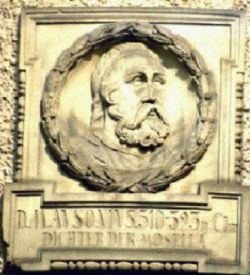
Décimo Magno Ausonio, Epístolas XXXI 221-233
Traducción
Decimus Magnus Ausonius, Epistles XXXI 221-233
Translation
“Así pues, puesto que pones las viviendas íberas en ciudades destruidas y lees fortalezas desiertas en tu verso y me reprochas la montañosa Calahorra y Bilbilis, colgada en agudos peñascos y la colina de la yaciente Lérida, como si yo, un exiliado de mi casa y de mi ciudad, habitara en estos lugares fuera de los techos y caminos de los hombres; ¿acaso crees, desconocedor del mundo íbero, que estas son las riquezas de la tierra donde aquel poderoso Atlas se detuvo bajo el peso y ahora la última porción y límite de la tierra es su monte que separa con su elevada cima Calpe la de los dos mares? ¿Sólo Bilbilis, Calahorra y Lérida son anotadas por este que tiene Cesar Augusta, la agradable Barcelona y Tarragona que desde su insigne cabeza mira el mar?”.
“For whereas thou dost fix my Spanish dwelling-place in ruined cities, traversing in thy verse desolate towns, and castest in my teeth mountain Calahorra, Bambola handing from its jagged crags, and Lerida prostrate on its hill-side –as though, an exile from home and city, I were dwelling in these far from the dwellings and highways of men; dost thou believe these are the resources of the Iberian land, ignorant of the Spanish world where laden Atlas took his stand beneath the load of Heaven, he whose mountain, now the furthest fragment and boundary of the earth, shuts out with its lofty peak Calpe that lies betwixt two seas? Are only Bambola, Calahorra, Lerida, placed to the credit of this land which has its Saragossa, pleasant Barcelona, and Tarragona looking from majestic heights down to the sea?”
Traducción Roberto Lérida Lafarga
Translation by H. G. Evelyn White in Ausonius, Works vol II, Cambridge (Massachusetts)-London, 1967