THE CHRISTIANITY
|
|
THE CHRISTIANITY |
|
|
Nevertheless, the most important foreign cult among the cults introduced in Rome and, finally, the cult that finished imposing itself was the Christianity. The novelties of the Christianity were based in the belief in an only god, perfect, fair and good, whose doctrine was developed by his incarnation, his son, Jesus Christ; the Christianity defended the equality of all the men with regard to his god and they based their way of life on the mutual love among the men because the men are loved by their god; finally, their belief supposed that for the good and fair men, who have practise the virtue, there was after the death an eternal blessedness. As religion, the Christianity was extended very quickly, reaching at first and especially to the humble people and to the slaves, although the Roman elites were convinced also by its precepts. So, we know that since the II century a. C. in every important city along the Empire there were Christian nuclei, although it seems that the first testimonies of Christian communities in Rome are dated under the empire of Claudius. |
|
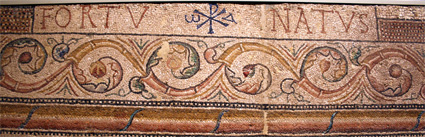
Chrismon with the alph and the omega in a mosaic of the Villa Fortunatus in Fraga (Huesca) dated about 375 a. C. Museo Provincial de Zaragoza. (Photo: Roberto Lérida Lafarga 03/01/2008) |
|
|
|
|
|
The ample Jewish community installed in Rome from the times of Julius Caesar could be the origin of the first Christians in Rome, although, alter the destruction of the temple of Jerusalem in the year 70, under the Antoninian emperors, Christians and Jews struggled to differentiate clearly the synagogue from the church and not to confuse their cults. However, the belief in an only god made the Christians dangerous and public enemies, because they refused to take part in the rites and ceremonies of other religions, included the imperial cult; due to the fact that they did not integrate in the imperial unity and they did not accomplish the traditional religious practices, they suffered sometimes prosecutions up to the end of the III century, normally in a local scale; in some way, these new Christians forgot their Roman origin and their obligations as Romans, considering themselves only Christians; this fact supposed that the people considered them something like deserters and public enemies. The most important or most transcendent prosecution of Christians by the Romans was, no doubt, the accusation made by Nero; according to him the Christians were responsible of the fire in Rome in the year 64, so that the rage of the Roman population turned against them. Under the emperor Decius, in the years 250-251, and Diocletian, in the years 303-305, took place the last prosecutions of Christians. In addition, the prosecutions had a counter-productive effect: the Christians accepted their destiny with courage and heroism, so that this fact converted them into martyrs, (from the Greek μάρτυς, “witness (of the faith)”) and example of the good Christian, the strength of their belief and of the Gospel; the number of adepts was multiplied for this reason. |
|
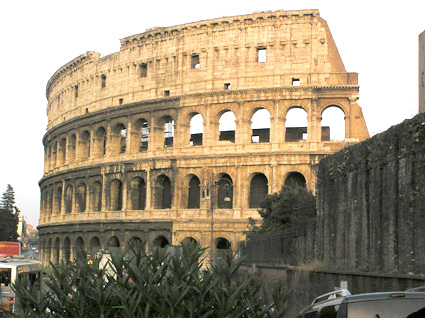
Coliseum in Rome, where a large number of followers of the Christian faith died. (Photo: Javier J. Boix Feced 01/08/2005) |
|
|
|
|
|
From very early the Christianity was based on the propagation of its doctrine; at first thanks to the apostles and their disciples, who were the first itinerant missioners who evangelized and Christianized people; afterwards, a regular and fix clergy was established that clandestinely organized the first Christian communities in every Roman circumscription, giving way still in the imperial age to the creation of dioceses and bishoprics. |
|
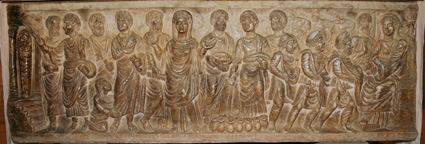
Paleochristian sarcophagus of Castiliscar (Zaragoza), dated in 340-350, is a testimony of the expansion of the Christianity along the Roman empire (Photo: Roberto Lérida Lafarga 3/11/2007) |
|
|
|
|
|
As in other eastern religions, the Christians had also ceremonies of initiation: the believer had to be instructed in the precepts of the Christian faith and only then he was baptized and confirmed in the faith. Their ceremonies were accompanied by prayers and fasting, and the most important rite was the imitation of the last supper of Jesus with his apostles through the consecration of the bread and the wine as his body and his blood. Based on the love to the fellow men, this human and pure religion guarantied the live after the death and promised the resurrection, as those of their god. They obliged their faithful to accomplish some precepts that could be completed with the contemplation, the asceticism and the ecstasy and they transmitted and shared their advices and their teaching to the rest of the Christian communities. Their novelty was based on the fact that, as religion, the Christianity was devoid of astrological aberrations, bloody sacrifices and initiations with doubtful character; the community of faithful was open, neither secret nor hysteric, all the members was equal, brothers, and their reunions was called agapes (from the Greek ἀγάπη, “love”). |
|
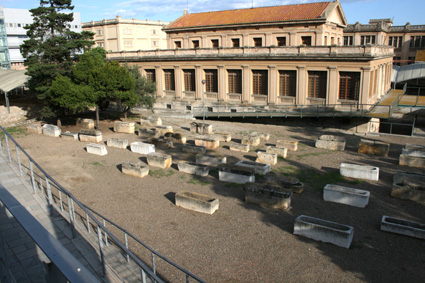
Sarcophagi in the gardens of the Museo y Necrópolis Paleocristianos de Tarragona, the bigger paleochristian necropolis in the western Roman Empire. (Photo: Roberto Lérida Lafarga 06/06/2008) |
|
|
|
|
|
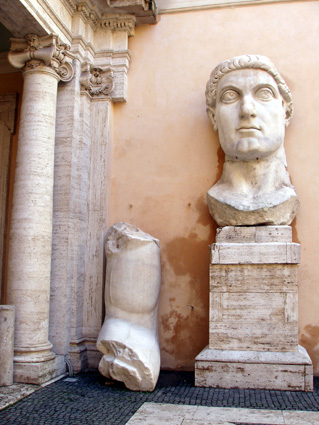
The Edict of Milan in the year 313, promulgated by the emperor Constantine –who had him baptized in the Christian faith in his deathbed- supposed at least the equality of the Christianity respect of the other eastern cults in Rome and in an effective way it supposed that the pagan cults were every time less tolerated and considered, so that they were disappearing progressively along the IV century, included the domestic cults, being active only among the farmers (from the Latin word pagus “farmer” > paganus “pagan”). In the year 382 the pagan cults were prohibited and the Roman priest associations were dissolved, closing the temples and taking away the statues of all the gods. Since then the Christianity was reorganized under the name of Church (in Latin ecclesia, from the Greek ἐκκλησία, “assembly”), imitating the political organization of the Roman Empire; every city had an ecclesiastic diocesan see directed by a supervisor, the bishop (from the Greek ἐπίσκοπος, “guard, protector”); the bishop nominated priests for the cult who were helped by deacons (from the Greek διάκονος, “servant”); the head of all the Church was the bishop of Rome, the Pope, the Pontifex Maximus, saint Peter’s successor. The bishops of every province met in Councils and since the IV century the bishops of all the Christianity met in Ecumenical Councils (from the Greek οἰκουμένη, “the inhabited earth, the Roman Empire, the world”). |
|
Estatua del emperador Constantino de tamaño colosal. Museos Capitolinos de Roma. (Photo: Roberto Lérida Lafarga 28/12/2004) |
|
|
|
|
|
|
|
SOURCES: - CARCOPINO, Jerôme: La vida cotidiana en Roma en el apogeo del Imperio, Madrid, 1993 - ESPINÓS, Josefa et alii, Así vivían los romanos, Madrid, 1987 - GARCÍA GUAL, Carlos: La Mitología: Interpretaciones del Pensamiento Mítico, Barcelona, 1987 - GARDNER, Jane F.: Mitos Romanos, Madrid, 1995 - GRIMAL, Pierre: Diccionario de Mitología Griega y Romana, Barcelona, 1981 - HACQUARD, Georges: Guía de la Roma Antigua, Madrid, 2003 - PAOLI, Ugo Enrico: URBS. La vida en la Roma Antigua, Barcelona, 1990 |