PALEOCHRISTIAN SARCOPHAGUS OF CASTILISCAR
|
|
PALEOCHRISTIAN SARCOPHAGUS OF CASTILISCAR |
|
|
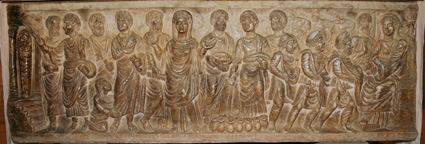
A special work in the late Roman age in Aragon is the paleochristian sarcophagus of Castiliscar, where some evangelic stories are represented in a peculiar way: the personages are devoid of their mystic nature and, at the same time, they have features similar to the pagan canons; that could be an evidence of some archaism in the Christian religiosity. In general these sarcophaguses are used to shelter the dead bodies of Christians with enough wealth to be buried in these more or less sumptuous tombs. However, due to the existence of pagan rites in the IV century a. C. in the Ebro Valley, some researchers think that, although this sarcophagus had Christian scenes, it would belong to a member of the aristocratic elites with pagan religion, but he only could buy the only type of available sarcophaguses, i. e., a sarcophagus decorated with Christian scenes, according to the fashion in the rest of Empire; so, the sarcophagus would mean the social status of the dead more than his religious believes. This sarcophagus in located in Castilliscar, beside the Roman way that joined Caesar Augusta (now Zaragoza) and Pompaelo (now Pamplona), 15 kms. far from the village of Sos del Rey Catolico in the region of the Cinco Villas. The sarcophagus is made in a marble block from Carrara (Italy) –one of the marbles more appreciated in the Antiquity and in the present; it seems to be carved –only in one of its faces- in Rome between 340 and 350 a. C. It is 2,24 metres long, 0,75 metres high and 0,72 metres wide; now it is located in the church of Saint John the Baptist of Castiliscar, where it is used as altar. |
||
|
|
|
|
|
|
||
|
Paleochristian sarcophagus of Castiliscar (340-350 d. C.). (Photo: Roberto Lérida Lafarga 3/11/2007) |
||
|
|
|
|
|
The sarcophagus was found in that village between 1850 and 1860 and it was related to the remains of Saint Valerus, bishop and patron saint of Zaragoza. It was discovered near the hermitage of Saint Roman or near the medieval castle of Saint Raymond. The archaeological studies seem to mean that beside the Roman way there was a Roman township occupied from the I century a. C. until the first half of the V century. |
||
|
|
|
|
|
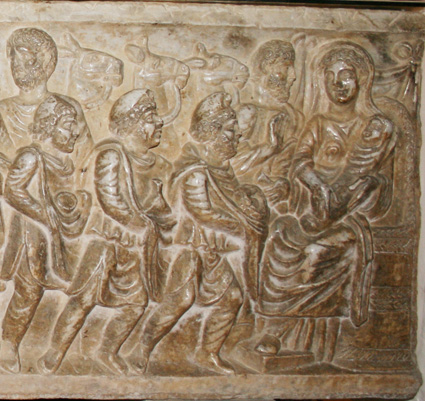
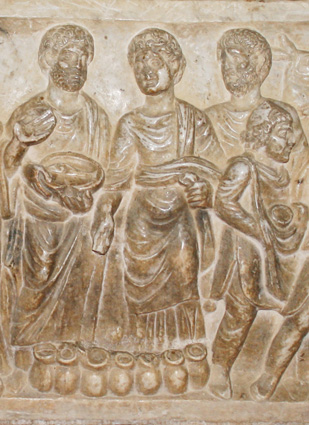
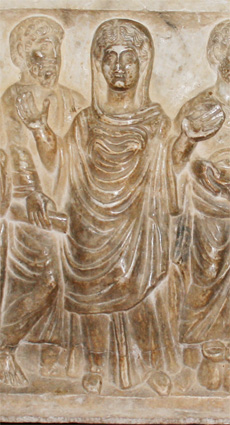
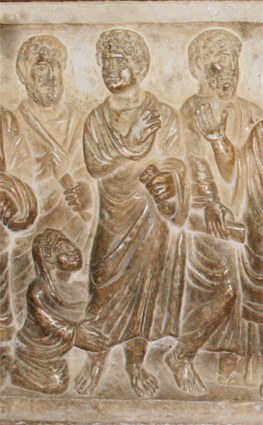
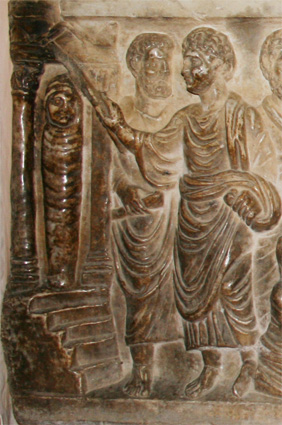
Iconographically different scenes from Jesus’ life can be seen in the sarcophagus; from right to left: the Epiphany, the multiplication of the bread and the fishes with the conversion of water into wine, a praying woman (she is the symmetrical axe of the sarcophagus between the scenes from Jesus’ life), the cure of the haemorrhoisa –“the woman who bleeds”- and the resurrection of Lazarus. Symbolically, the Epiphany would mean the promise; the multiplication of bread and fishes with the conversion of water into wine and the cure of the haemorrhoisa would mean the faith and the resurrection of Lazarus would mean the immortality. The praying woman should be the symbol of the hope. On the other hand, the two personages who appear with Jesus, dressed in tunics and bearded, with a piece of parchment, should be some of the apostles, probably Peter and Paul.
|
|
|
|
|
|
The Epiphany: the Three Wise Men with their camels and the Virgin represented like a Roman matrona; at the back a man, probably Saint Joseph. (Photo: Roberto Lérida Lafarga 3/11/2007) |
|
|
|
|
|
The multiplication of bread and fishes. Probably the two figures that appear behind Jesus were the apostles Peter and Paul. (Photo: Roberto Lérida Lafarga 3/11/2007) |
|
The praying woman, represented like a Roman matrona too. (Photo: Roberto Lérida Lafarga 3/11/2007) |
|
|
|
|
|
The cure of the haemorrhoisa. (Photo: Roberto Lérida Lafarga 3/11/2007) |
|
The Lazarus' resurrection. (Photo: Roberto Lérida Lafarga 3/11/2007) |
|
|
|
|
|
The scenes come from the New Testament, although the personages are featured as contemporaneous Romans: the Virgin seems a Roman matrona, the hair styles and the tunics –some time held up by the left hand of the personage- respond to the Roman fashion in the age of the manufacture of the sarcophagus. |
||
|
|
|
|
|
|
|
SOURCES: - PAZ PERALTA, Juan Ángel: “La Antigüedad tardía en las Cinco Villas”, en AA. VV.: ArquEJEAlogía. Ejea de los Caballeros y las Cinco Villas, de la Prehistoria a la Antigüedad Tardía, Zaragoza, 2006 |