PROVINCIAL MUSEUM OF ZARAGOZA
|
|
PROVINCIAL MUSEUM OF ZARAGOZA |
|
|
The Provincial Museum of Zaragoza had its origin in the ecclesiastic disentailment, i. e., the sale of Churh lands in the XIX century, that affected to the convents and monasteries and to the works of art that were sheltered in them. In order to their custody and their exposition the Spanish government created the Provincial Museums, among them the Provincial Museum of Zaragoza. Its opening date was 1848, although since 1835 two commissions –the Artistic Commission of the Royal Academy of Nobles and Fine Arts of Saint Louis and the Scientific and Artistic Commission of the Province of Zaragoza- made the works that managed it opening and its foundation. |
|
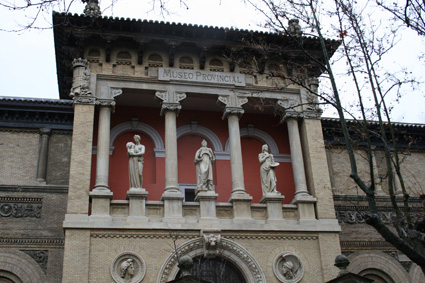
Façade of the Provincial Museum of Zaragoza (Photo: Roberto Lérida Lafarga 03/01/2008) |
|
|
|
|
|
After it occupied different buildings, since 1910 the Museum occupied a modernist building, a work by Ricardo Magdalena and Julio Bravo, built to shelter the Hispanic-French Exhibition in 1909 that commemorated the first centenary of the “Sitios” of Zaragoza –the siege of the city by the Napoleonic French army, in the so called Sitios Square in the Aragonese capital. The building, in bricks and melted iron, followed to its square court the structure of the Renaissance court of a Palace of the city, the Zaporta’s House. After the exhibition, the works of art were taken to the building where they keep until the present time. |
|
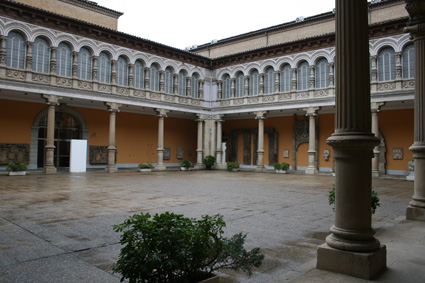
Court of the Provincial Museum of Zaragoza (Photo: Roberto Lérida Lafarga 03/01/2008) |
|
|
|
|
|
In this building there are preserved the collection of Fine Arts and Antiquity, while the section of Ethnology and Natural Sciences are located in another building in the Parque Grande of Zaragoza; another section of the Museum is the Museum of the Colonia Celsa, but it is located not in Zaragoza, but in Velilla de Ebro. |
||
|
|
|
|
|
Among the section of Antiquity there are hundreds of pieces from the Roman age that are exhibited in different halls. These works belonged to all the areas of the Roman life: decorative mosaics and frescos from domus and villae, public and private statues, domestic households furnishings with all kind of objects (vessels, glass bottles and flasks, plates, earrings, furniture, combs, lamps and chandelier, etc.), public and private inscriptions, bronzes with laws, coins from different ages, places and values. |
|
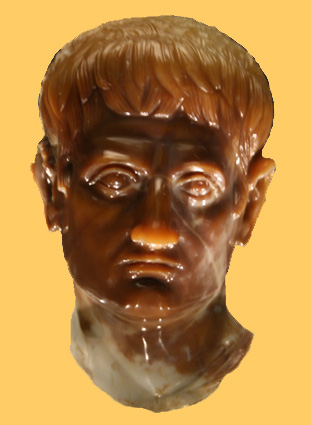
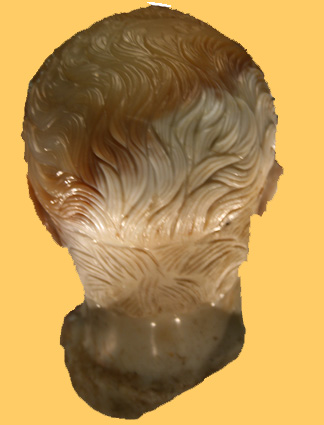
Augustus portrait en red agate found in Turiaso -nowadays Tarazona- (16 cms. high; dated in 98-117 d.C.). The bust was made on another previous bust of the emperor Domitian, changing some details like the hair style and the face. Provincial Museum of Zaragoza (Photo: Roberto Lérida Lafarga 03/01/2008) |
|
|
|
|
|
The exhibited archaeological pieces come from the province of Zaragoza in a high degree, especially from the finding in Zaragoza (the ancient Caesar Augusta), but we must add also the find things from other places in the province like Fuentes de Ebro, Velilla de Ebro (the ancient Colonia Celsa), La Almunia de Doña Godina (the ancient Nertobriga), Botorrita (the ancient Contrebia Belaisca), Borja (the ancient Bursao), Uncastillo (the ancient Tarraca), etc. There is a section dedicated to the Roman municipality of Turiaso (nowadays Tarazona); most of the related pieces to the Colonia Celsa are preserved in a different section of the Museum in Velilla de Ebro. The mosaics from the Villa Fortunatus (Fraga, Huesca) make stand out among the collection of mosaics. |
|
Two mosaics from the agricultural calendar of the Villa Fortunatus (nowadays Fraga, Huesca): the horse, which evoked the games, and the eatable thistle like symbols of September, and the bear and the arbutus, evokers of the nature, like symbols of November. Provincial Museum of Zaragoza (Photo: Roberto Lérida Lafarga 03/01/2008) |
|
|
|
|
|
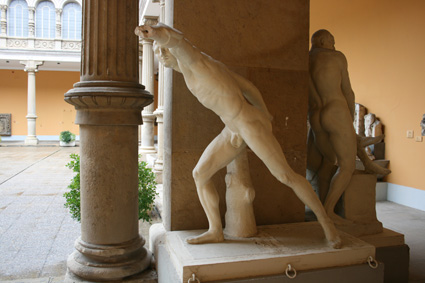
Finally, in the court we can see copies of famous classical statues. |
|
Provincial Museum of Zaragoza (Photo: Roberto Lérida Lafarga 03/01/2008) |
|
|
|
|
|
|
|
FUENTES: - AA. VV.: Museo de Zaragoza. Guía, Zaragoza, 2003 |
|
PIECES OF THE PROVINCIAL MUSEUM OF ZARAGOZA |
||||
|
|
|
|
||
|
Municipium Turiaso
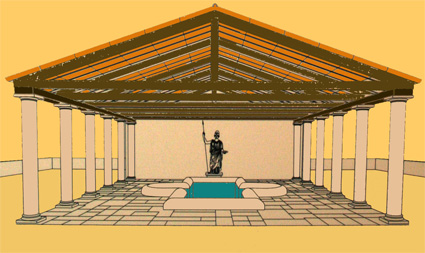
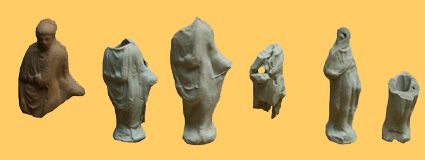
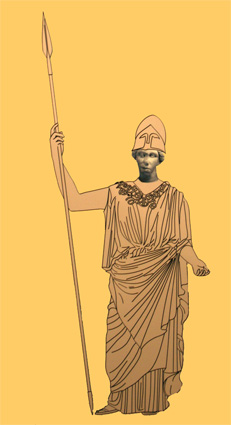
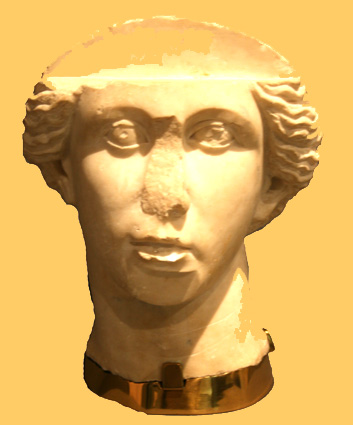
A section of the Provincial Museum of Zaragoza is dedicated to the archaeological discoveries found in Turiaso. In the number 21 of the Navarra avenue in Tarazona, near the Queiles river, there were found the remains of a sacred health resort dedicated first to Silbis (I century b. C.), an indigenous goddess identified with a kind of nymph who protected the water and who appeared in the coins of the city, then to Salus (I century a. C.), the Roman equivalent, goddess of the health and the healing, and, finally, to Minerva Medical (II century a. C.). This resort was used until its destruction in the year 284 a. C. The scholars think that the emperor Augustus was treated in this resort from some illness. From the whole resort it is preserved a stock area in a lacus and a fountain similar to a pool with cross shape, where the offerings were made, and the remains of the hypocaustum of a warm room. Among the offerings of the fountain there were found some terracotta little statues of men and women, votive offerings with the shape of human parts of the body, coins, glasses, chandeliers, medical instruments, antlers to make medicines and recipients to them. In this fountain were found also the Minerva Medical’s head, to whom it was dedicated the sanctuary from the II century a. C., and the sardonyx head of the emperor Augustus, which was an offering for the healing from severe hepatic fluxions that the emperor suffered when he came back from the Cantabric Wars to Tarraco in the year 26 b. C. |
|
Reconstruction of the health resort of Silbis/Salus/Minerva Medical; picture from a panel of the Provincial Museum of Zaragoza. (Photo: Roberto Lérida Lafarga 03/01/2008)
Little satues made of terracotta with the figures of men and women dedicated to the goddess of the health resort. Provincial Museum of Zaragoza. (Photo: Roberto Lérida Lafarga 03/01/2008) |
||
|
The Minerva Medical’s head is 0,35 metres high and 0,26 metres wide and it is made of marble from Carrara (Italy). The head has a rabbet in the front and side perforations that were used to support and hold the metallic helmet of Corinthian type. The chin was arranged in the Antiquity, but this arrangement was lost. The hair style is a topknot gathered in the back of the head and the hair appeared sculptured only en the parts where it was visible, outside the helmet, on the temples. The image shows an idealized air according to the Hellenistic sculptural models and the head is lightly turned on the left.
Reconstruction of the statue of Minerva Medical, pictore from a panel of the Provincial Museum of Zaragoza. (Photo: Roberto Lérida Lafarga 03/01/2008) |
|
Bust of Minerva Medical. Provincial Museum of Zaragoza. (Photo: Roberto Lérida Lafarga 03/01/2008) |
||
|
The Augustus’ head made of sardonyx (red chalcedony, i. e., a kind of semi-precious stone from Eastern or India that is cryptocrystalline quartz, translucent and not stripped) is a bust that belonged to a complete statue that probably was made in precious metal or red porphyry. The head was made over an former bust of the emperor Domitian (or Nerva), modifying some details of the face and the hair style. The modification should take place at the age of the emperor Trajan. The portrait, 16 cm high, is one of the more significant pieces of this style in all Hispania.
|
|
Bust of Augustus. Provincial Museum of Zaragoza. (Photo: Roberto Lérida Lafarga 03/01/2008) |
||
|
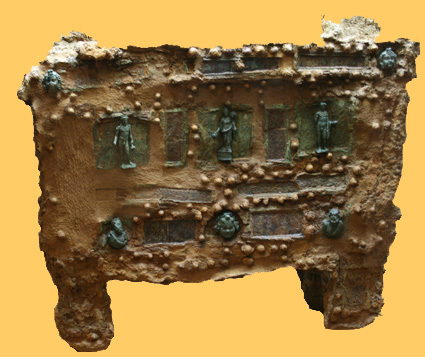
ARCA FERRATA (I century a. C.) from the Municipium Turiaso (Tarazona, Zaragoza).
A wooden bin with prismatic shape and with four legs -0,95 metres wide x 0,89 metres high-; it is completely adorned with iron studs; in its front it is covered by bronze plates –crustae- with figures of gods: in the first level with three rectangular plates flanked by two Eros’ faces; in the second level the figures of Apollo, Abundance y Mercury; in the third level two narrow and enlarged plates; in the fourth level three figures, in the centre Eros and two Sileni in the extremes.
Provincial Museum of Zaragoza (Photo: Roberto Lérida Lafarga 03/01/2008) |
|
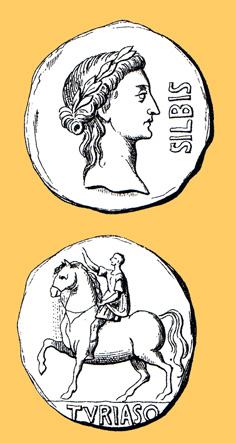
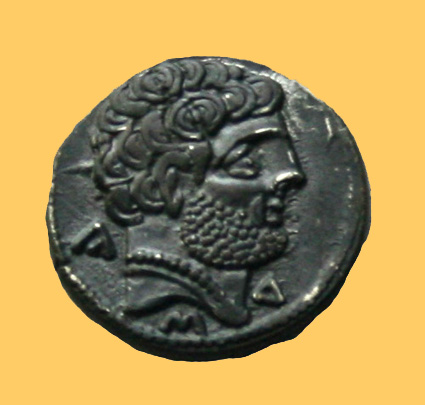
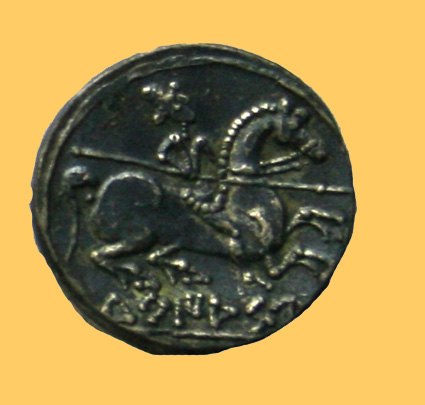
MONEDAS DE TURIASO Finally, we have to mention the coins collection in the Museum, where we can find many coins from Turiaso, with the image of Silbis, with a horsemen in Iberian type, etc.
|
||
|
|
|
|||
|
|
||||
|
Reproduction of an Hispanic Roman as from Turiaso with the bust of the nymph Silbis, from AA. VV.: Museo de Zaragoza. Guía, Zaragoza, 2003 |
Coins from Turiaso Provincial Museum of Zaragoza (Photos: Roberto Lérida Lafarga 03/01/2008) |
|||
|
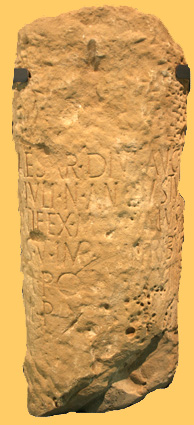
MILIARIUM OF SORA (32 d. C.) from the mountains of Sora, near Castejón de Valdejasa (Zaragoza) |
|
TRICLINIUM (in the middle of the I century a. C.) from de Caesar Augusta (Zaragoza).
Reconstruction of the triclinium of the domus in Añón Street with its correspondent furniture. We can see its fresco and roof decorated in the so called IV style. The pavement is made in opus signinum, with a central polychrome emblem with tesseras. The dimensions of the triclinium were 6,60 metres long x 5,50 metres wide x 3,50 metres high. From the domus there are preserved the atrium and eight rooms open to the atrium. The walls are divided in two zones: at the bottom a baseboard without skirting board that imitated the granite in bluish grey colour and white, while the rest of the wall had panellings and interpanellings in rich colours and framed by borders in black, blue and black. The wall is crowned by a stucco cornice and simple mouldings. The interpanellings represented Corinthian columns with fluting and with base over black background. En the panellings at the back there are animated figures: two flying Eros with the Jupiter’s ray in the centre and a winged genius with thyrsus on the right.
Provincial Museum of Zaragoza (Photo: Roberto Lérida Lafarga 03/01/2008) See Furniture in the Roman houses
|
||
|
|
This Miliarium of Sora was found in the Roman road that communicated Caesar Augusta (nowadays Zaragoza) and Pompaelo (the current Pamplona) in the mile XXVI or XXVII (38 kms. far away from Zaragoza); this road was designed by the emperor Augustus with his legions VI Victrix and X Gemina to to fasten a quick para asegurar una rápida communication with the Ebro valley and Cantabria. The miliarium is dated in the year 32 a. C.; this fact means that the emperor Tiberius took part in the construction of the road. The text says: TIBERIUS CAESAR DIV(I) AUG(USTI) F(ILIUS), DIV(I) IULI N(EPOS), AUGUSTUS, PONTIFEX MAXIMUS, CO(N)S(UL) V, IMPERATOR VIII, TRIBUNICIA POTESTAS XXXIV, MILIA XXVI- (Translation: "Tiberius Caesar Augustus, divine Augustus' son, divine Iulius' grandson, Highest Pontífex, Consul five times, Emperor eight times, having obtained the Power of Tribunus thirty four times, mile XXVI(I)"). |
|||
|
Museo Provincial de Zaragoza. (Photo: Roberto Lérida Lafarga 03/01/2008) Click here to see the Roman Roads |
||||
 8-
8-