FURNITURE

|
|
FURNITURE |
|
|
Furniture is probable one of the less known aspects of Roman houses, because it was scarce and it was made by the materials that were really not very everlasting: wood rots away and wooden furniture had hardly lasted until today and furniture with incrustations of valuable metals–gold, silver, bronze- or stones –ruby, sapphire- were destroyed to exploit these pieces. |
||
|
|
|
|
|
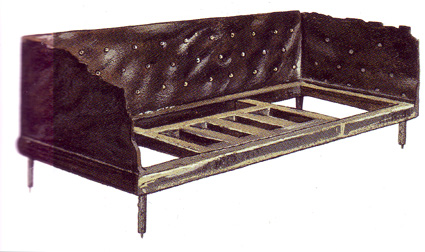
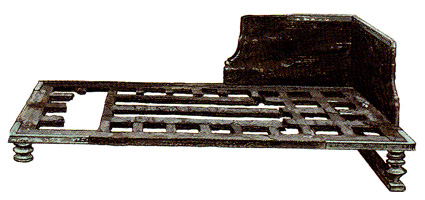
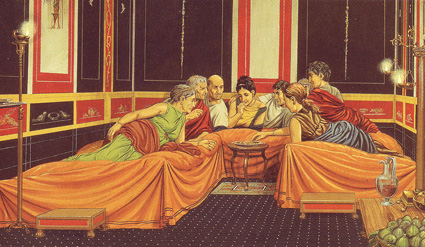
The basic furniture in a Roman house used to consist of a couch to sleep, to eat, to receive visits, to read, to write, etc. The modest couches were simple rickety old beds placed against the wall and covered by a straw mattress; in the other cases the Romans had as many couches as they needed or they could have; these couches could be single –lectuli-, double to a couple –lectus genialis-, triple to the dinning room –triclinia- and even couches for six people; all these couches could be made of bronze, of carved wood, mixed couches with the wooden frame and bronze legs, with incrustations of gold, silver, etc. |
|
Two couches, one in leather and wood and other in wood, found in Herculanus (Italy). Photographies from CONNOLLY, Peter y DODGE, Hazel: La Ciudad Antigua. La vida en la Atenas y Roma clásicas, Madrid, 1998. |
|
|
|
|
|
Reconstruction of the triclinium of the domus found in Añón street (I century a. C.) with its corresponding furniture, from Caesar Augusta. Museo Provincial de Zaragoza. (Photography: Roberto Lérida Lafarga 03/01/2008) |
|
Ideal reconstruction of a dinner in a Roman domus according to CONNOLLY, Peter y DODGE, Hazel: La Ciudad Antigua. La vida en la Atenas y Roma clásicas, Madrid, 1998. |
|
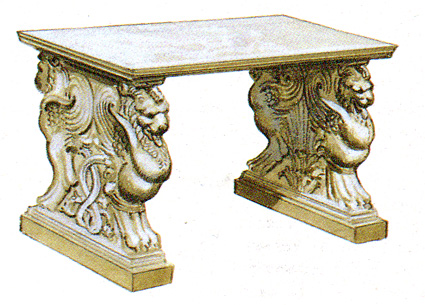
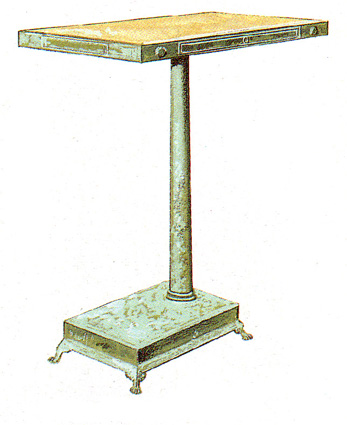
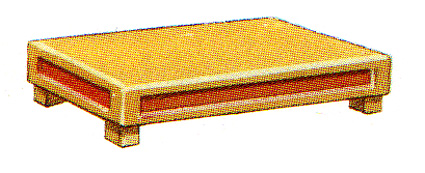
The Romans used tables too, but they were no similar to the modern tables; their mensae used to be marble console tables with an only leg and with different functions. However, we can distinguish up to five types of tables, all of them with Greek origin: rectangular tables with three legs; rectangular tables with four legs; rounded tables with three zoomorphic legs; square or rectangular tables with only one central support; and square or rectangular tables with two supports in the extremes and carved with animal shapes. |
||
|
|
|
|
|
|
|
|
|
Different types of mensae, the two firts found in Pompeii (Italy) and the third found in Herculanus (Italy). Photographies from CONNOLLY, Peter y DODGE, Hazel: La Ciudad Antigua. La vida en la Atenas y Roma clásicas, Madrid, 1998. |
||
|
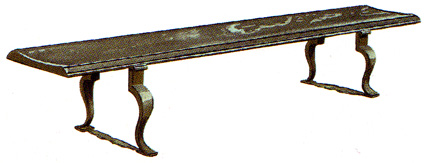
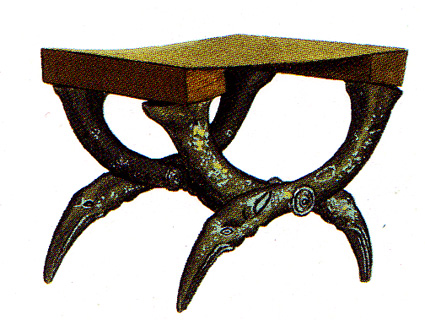
The Romans used chairs –sellae- or seats too, although they preferred to do almost everything reclining; at any case we know chairs with back and arms –thronus-, reserved to the gods; chairs with inclined back –cathedra-; benches were more usual –scamna-; they used stools –subselia- and different types of folding chairs, like the sella curulis, the chair used by the magistrates; this sellae curules could be magnificent, with ivory, gold, etc. |
||
|
|
|
|
|
|
|
|
|
Different types of chairs found in Pompeii (Italy): a stool, a bench and a sella curulis. Photographies from CONNOLLY, Peter y DODGE, Hazel: La Ciudad Antigua. La vida en la Atenas y Roma clásicas, Madrid, 1998. |
||
|
|
|
|
|
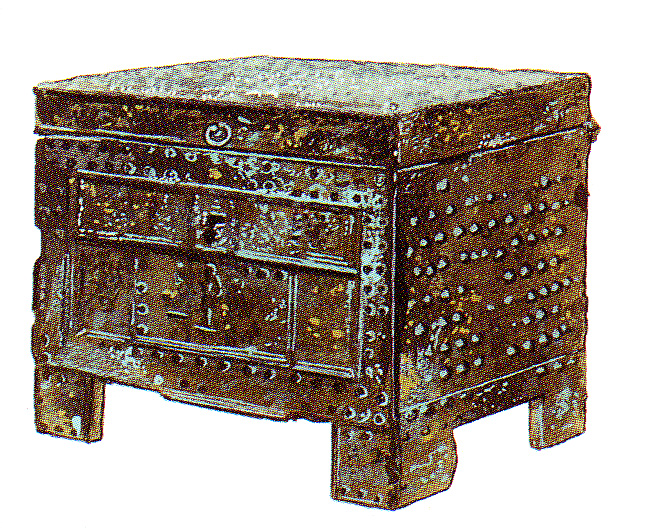
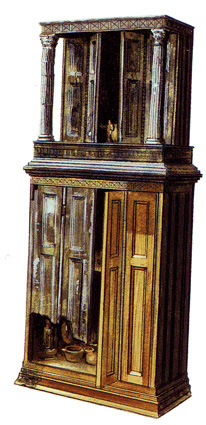
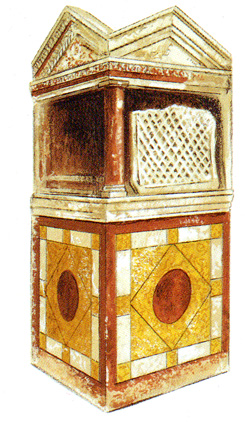
The cupboards, wardrobes, etc., were very simple: a rectangular case with racks in its interior, assembled on legs and with doors with door panels. These large chests were usually fastened on the walls of the house and they were used as wardrobes –arcae vestiariae- or to keep safe money and valuable objects –arcae aeratae-, etc. Another type of furniture, more sophisticated, had columns and pediment, like a temple. |
|
Wooden large chest-strongbox, covered with bronze and iron, found in Pompeii (Italy). Photography from CONNOLLY, Peter y DODGE, Hazel: La Ciudad Antigua. La vida en la Atenas y Roma clásicas, Madrid, 1998. |
|
|
|
|
|
Wooden cupboard with lararium found in Herculanus (Italy) and lararium with wooden lattice from the Menander's House in Pompeii (Italy). Photographies from CONNOLLY, Peter y DODGE, Hazel: La Ciudad Antigua. La vida en la Atenas y Roma clásicas, Madrid, 1998. |
|
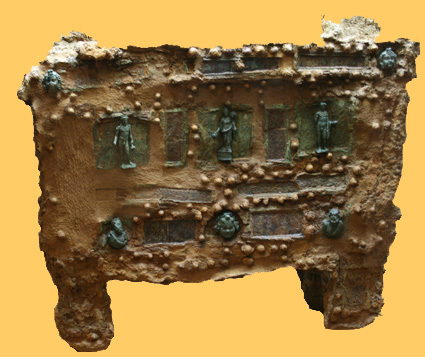
Wooden large chest with prismatic shape and four legs -0,95 m. wide x 0,89 m. high-; in its front it is covered by bronze plates –crustae- with statues of gods –Apollo, Abundance y Mercury at the top and Eros and Sileni at the bottom-; it is adorned with iron studs (I century a. C.); from the Municipium Turiaso (nowadays, Tarazona, Zaragoza). Museo Provincial de Zaragoza (Photography: Roberto Lérida Lafarga 03/01/2008) |
|
|
|
|
|
The remaining furniture consisted of pillowcases or cushions to the different seats and couches, carpets, coverlets, large chests, etc. |
||
|
|
|
|
|
|
|
SOURCES: - AA. VV.: Museo de Zaragoza. Guía, Zaragoza, 2003 - CARCOPINO, Jerôme: La vida cotidiana en Roma en el apogeo del Imperio, Madrid, 1993 - CONNOLLY, Peter y DODGE, Hazel: La Ciudad Antigua. La vida en la Atenas y Roma clásicas, Madrid, 1998 |