CELSA: HISTORICAL CONTEXT

|
|
CELSA: HISTORICAL CONTEXT |
|
|
Historical Context The foundation of the Colonia Celsa can be considered the first step of the effective romanization in the Ebro Valley during the period of Caius Iulius Caesar and put an end to the wars that destroyed part of that Valley before the arrival of the roman dictator. Its foundation can only be understood inside the republican conflicts and crises in the first century b. C. Then the romans saw how they reached the permanent war almost during a century: there were social and political conflicts between the optimates –senatorial oligarchy very conservative and traditional- and the populares –political faction that, satisfying the needs of the people, obtained their support of their policy-. These conflicts not only affected to Rome, but also to its provinces, especially to Hispania. So, the colonization of the Ebro Valley by italic soldiers carried their incorporation and the incorporation of part of the local population into a conflict during almost thirty five years that destroyed the valley. Lucius Cornelius Sulla, a conservative designated as dictator of Rome, removed the popular Quintus Sertorius from his office as governor of Hispania Citerior. Sertorius became a rebel against the optimate government of Rome. With his large army of loyal soldiers, Sertorius faced up Sulla’s supporters during lot of years, especially in the Ebro Valley. |
||
|
|
|
|
|
Sulla died in 78 b. C. and the power in Rome was wielded by a triumvirate: an exceptional system in the Roman Republic where, instead of two consules, the government was constituted by three men with equal authority. This first triumvirate was composed by Cneus Pompeius, Caius Iulius Caesar and Marcus Licinius Crassus. Meanwhile Sertorius conquered Segontia (now Sigüenza) and Bilbilis (now Calatayud) in 77 b. C. and he achieved that most people of the Ebro Valley joined his cause; he made fortified positions in Ilerda (now Lérida), Osca (now Huesca) y Calagurris (now Calahorra). His battles against the general Pompeius destroyed a part of the Hispania Citerior, until the cities dominated by Sertorius were invaded in 73 b. C. When the senate in Rome supported Pompeius (optimate), but the roman people acclaimed Caesar (popular), the existing state of crisis with the conflict between Sulla and Caius Marius was extended and aggravated with a new civil war which also was set in the Ebro Valley. Here the conservative Pompeius had supporters organized around the generals Afranius, Petreius and Varro (cf.. Caesar, Civil War). Then the former supporters of Sertorius joined the popular Caesar. From that moment, a lot of places in the Ebro Valley disappeared, were abandoned and became ruins: e. g., the archaeological sites of Azaila, Fuentes de Ebro, Contrebia Belaisca (now Botorrita), etc. In 49 b. C. the battle of Ilerda took place, where Caesar won the Pompeians. Nevertheless Caesar gave some honourable terms of peace (cf. Caesar, Civil War I 85-97). From this moment the Colonia Celsa, near the river Ebro, obtained a great importance due to its strategical position. |
|
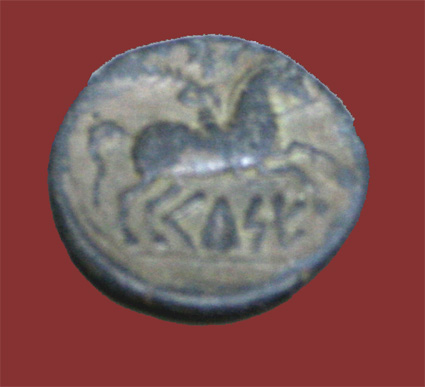
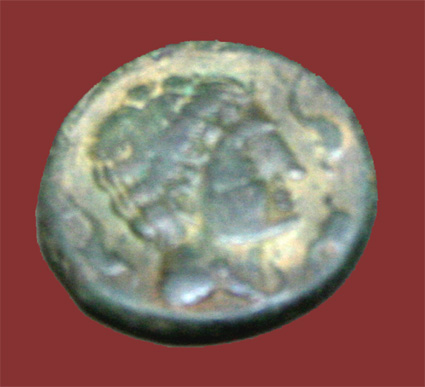
Iberian coins from Celse exposed in the Museum of Celsa that belongs to the Provincial Museum of Saragossa. (Photo: Roberto Lérida Lafarga 21/06/2008) |
|
|
|
|
|
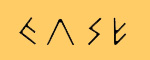
Celsa, an iberian town The site of the iberian town of Celse has not been discovered yet, but we know coins minted in this town with its name in iberian writing (Celse) and with its abbreviated name in Latin (CEL), probably because Caesar had given to the town the latinitas (the honour of being ruled by the roman rights) ca. 48 b. C. in order to draw the support from some places in the Ebro Valley.
Celse written in Iberian signarium. |
||
|
|
|
|
|
Colonia Victrix Iulia Lepida In 44 b. C. Marcus Aemilius Lepidus in his second term of office in Hispania founded a Colonia called Lepida from his own cognomen. Marcus Aemilius Lepidus was a patrician, son of a consul with the same name, but he supported Caesar, filling a charge as praetor urbanus (a magistrate who administered justice to the roman citizens). In 49 b. C. he was designated governor of Hispania Citerior and he was re-elected for the same charge in 47 b. C. When Caesar died, he shared the second triumvirate with Caius Octavius (later Augustus) and Marcus Antonius. In 43 b. C. he was designated summus pontifex (high priest), but in 42 b. C: was accused of negotiating with Sextus Pompeius, son of Cneus Pompeius, the loser in the civil war against Caesar, so he lost the charge of governor of the provinces. Nevertheless Octavius interceded on Lepidus’ behalf to obtain the charge of governor of Africa. Finally, in 36 b. C., Lepidus left the triumvirate y was banished by Octavius to Circei (town in the Latium), where he died in 12 b. C. There were discovered coins from Celsa where the praefecti (magistrates who had their charges on behalf of other superior magistrates) of the duoviri quinquenales (two men elected every five years as rulers of a town; in this cases maybe Caesar, Octavius or Lepidus) are represented. From the coins we can deduce that the primitive Colonia Lepida was governed by a social upper class these magistrates belonged to. The Colonia Lepida lasted with that name hardly ten years, when the most important fact was the building of a bridge over the river Ebro (cf. Strabo, Geography III 4,10-11), the division of the ground and its award to the first colonists. The ground was divided in parts as a chessboard; in the Colonia Lepida, the town was the center of the chessboard, the main axe should be the river Ebro and the secondary axe its perpendicular. From the division, the square portions (centuriae, from 700 m2 to 50 hectare) were assigned in that way: first, to the colonists (reliqua colonia); second, to the veteran soldiers who took part in the foundation of the colonia (ex tributario solo); third, to the roman state (Rei publicae); fourth, to the natives, the original owner of the ground (tricastinis reddita); finally, ground not divided (subcesiva). In the case of the Colonia Lepida, we know that its territory reached to Fuentes de Ebro, 24 kms. away. |
||
|
|
|
|
|
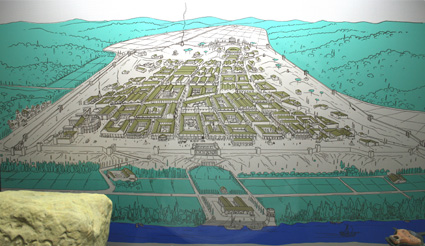
Colonia Victrix Iulia Celsa At first the change in the name did not suppose any essential transformation in the colonia. Lepidus’ misfortune and Octavius’ promotion were extended to the name of the town too, that lost the epithet Lepida and took the name of Celsa, as Latin form from the Iberian Celse. Parallel, in the new coins of the town the new minted motiv was Octavius’ head and later Tiberius’ head. In that period the Hispanic mints disappeared, included Celsa’s mint. Celsa developed considerably in Octavius Augustus’ time: private houses, thermal baths, forum, theatre, road network and shops (tabernae, popina, macellum, etc.) were built in the town and a necropolis by the road Celsa-Ilerda. The town was not walled and we do not know its perimeter. The history of Celsa did not reach beyond Nero’s time. The most important fact that provoked that disappearance was the increase and the prosperity of the neighbour colony Caesaraugusta, chief town of the conventus (roman administrative division in a province, in this case the Tarraconense province). Political, economical and strategic reasons eclipsed Celsa in benefit of Caesaraugusta. |
|
Reconstruction of the view of the Colonia Victrix Iulia Celsa exposed in the Museum of Celsa that belongs to the Provincial Museum of Saragossa. (Photo: Roberto Lérida Lafarga 21/06/2008) |
|
|
|
|
|
When the colony was founded, it dominated a large natural territory with strategical importance and it was the centre of a net of places (villae) in the Ebro Valley (Zaragoza, El Burgo de Ebro, Belmonte, María de Huerva, Cuarte, Fuentes de Ebro, Contrebia Belaisca –now Botorrita-, Azaila, etc. show a strong colonization in which Celsa was an advance party of that Romanization. In the republican time these towns imported oil, wine and ceramic from Italy, but with the foundation of Caesaraugusta and in the Octavius Augustus’ time the trade changes and the Ebro Valley exported its products to the rest of the Roman Empire. So, Caesaraugusta, built with big trade infrastructure, dominated the valley. |
||
|
|
|
|
|
|
|
Source: - BELTRÁN LLORIS, Miguel: Celsa, (Colección Guías Arqueológicas de Aragón 2), Zaragoza, 1991 |