THE ROMAN RELIGION

|
|
THE ROMAN RELIGION |
|
|
The Roman religion was too complex; it was a religion with a large useful sense to the service of the individuals and the Estate. Unlike the big religions that we know in the western culture –Judaism, Christianity and Islamism-, the Roman religion neither was monotheist –“with an only god”- nor had a sacred book that ruled its religious precepts, believes and faith or collected its myths and dogmas –as it happens with the Torah among the Jewish, with the Bible among the Christians or with the Koran among the Muslims-. In addition, lacking of moral, the Roman religion celebrated in general its rites and sacrifices in order to obtain a benefit from the gods and this functional character helped to adopt new deities from other territories. |
|
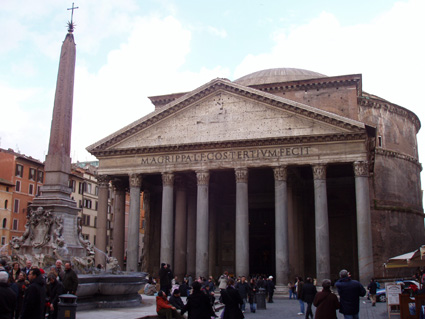
Roman temple: the Pantheon, dedicated to all the gods, built in the age of Augustus by Agrippa and restored in the age of the emperor Hadrian. (Photo: Roberto Lérida Lafarga 27/12/2004) |
|
|
|
|
|
The polytheism of the Romans was in some way exaggerated; they had protective deities for every activity and even for every most important object; scholars have calculated that about 30.000 beings were considered divine among the Romans, most of them were mere personifications of works or other aspects of the daily Roman life. For example, Janus was the god of the gates, Silvanus, the god of the woods and Faunus the god of the wild and natural life; agrarian deities were Consus –“the storage”, Pales –“goddess of the herds and flocks”- or Robigo –“the smut”-; and so on up to lose count of them. |
|
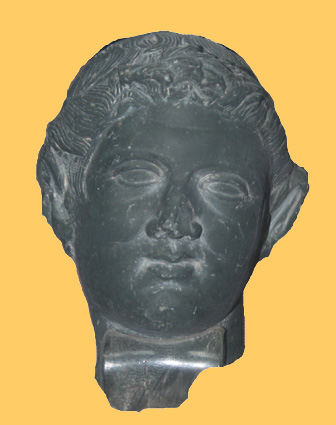
Faunus' head. Museo Arqueológico de Tarazona. (Photo: Roberto Lérida Lafarga 21/03/2008) |
|
|
|
|
|
All these divinities had that which the Romans called numen –“divine power”-, although most of them were not considered individual personalities; in fact, they were almost never represented with a concrete figure or shape. The Romans should attract to them the divine wills -voluntates or numina- in some circumstances of their lives; so, they celebrated complex and meticulous ceremonies that very often they neither implied to their divinities nor explained their origin, their history nor their cult; these religious acts were mere ceremonies, sacrifices and rites that, at the same time, filled their calendar. So, the priests wrote long roles –indigitamenta- with the names of these numina in order that they did not forgot any invocation, rite or ceremony dedicated to every one of them. In this sense we have to say that the Romans had different types of priesthoods and diviners that watched the care and maintenance of the temple, the celebration of rites and sacrifices, the fulfilment of the religious precepts, etc. |
|
Roman temple in Nîmes -ancient Nemausus-, in Francia, known as the Maison Carrée -"Square House"-. (Photo: Roberto Lérida Lafarga 14/08/2007) |
|
|
|
|
|
On the other hand, there are scholars who say that the Romans, unlike the Greeks, never had a mythology or this was lost, in case of this existed once, i. e., there is nor a collection of myths where the gods took part in adventures, in familiar, amorous, personal relationships neither there is a bond between the gods and the mankind. So the Romans did not explain the universe and they did not offer tales with the adventures of their gods that could be used as explanation of natural aspects; so then, due to their lack of mythology, they had neither cosmogonies –“the origin of the universe”- nor theologies –“the origin of the gods”-. In addition, the Romans were always very superstitious and, among other reasons, this fact made that they were very receptive to new religions and cults, so that they religion was a religion in continuous evolution and growth. On the origin of the cults, the deities and the priesthoods in Rome we have only some traces, but it is clear that in the time of the Monarchy, 753-509 b. C., in outline the Roman religion kept completely defined, structured and consolidated. |
|
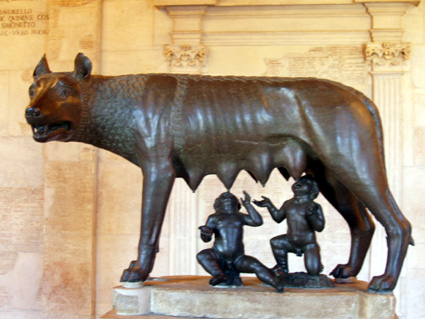
Statue of the Capitoline Wolf suckling the twins Romulus and Remus, a legend between the myth and the history. Musei Capitolini in Rome. (Photo: Roberto Lérida Lafarga 28/12/2004) |
|
|
|
|
|
The cults were divided into three types from very early: popular cults –sacra popularia-, domestic cults –sacra familiaria- and public cults –sacra publica or pro publico-; the latter were considered the big national cults. |
||
|
|
|
|
|
|
|
SOURCES: - CARCOPINO, Jerôme: La vida cotidiana en Roma en el apogeo del Imperio, Madrid, 1993 - ESPINÓS, Josefa et alii, Así vivían los romanos, Madrid, 1987 - HACQUARD, Georges: Guía de la Roma Antigua, Madrid, 2003 - PAOLI, Ugo Enrico: URBS. La vida en la Roma Antigua, Barcelona, 1990 |