DOMESTIC CULTS

|
|
DOMESTIC CULTS |
|
|
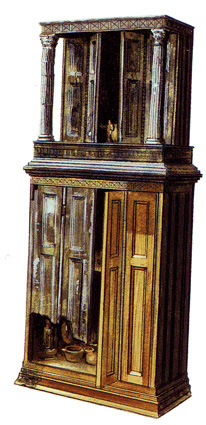
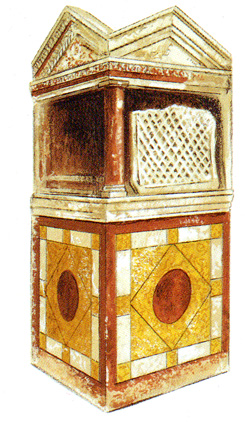
The domestic cults were celebrated basically by the patricians and they were based on the belief in the immortality of the soul. Among these familiar cults there were some groups of divinities. Rome was divided into tribes and gentes –gens is a generic word to designate “family” in a extended sense of this; Ernout and Meillet in their Latin etymological dictionary said that gens was “the group to which belonged all the members linked by male line to a first and common male and free ancestor”-. Well, the first founder of a gens was venerated by all his gens. In a place of the house, generally in the atrium, the Romans built a small chapel called lararium or sacrarium, which used to be an altar –ara- with the home fire, the hearth –focus patrius- that had to keep always burning, and with a niche where they left small clay or wax figures that represented the home god –lar familiaris- and the two gods of the food store and the house in general –Penates-. The offered flowes and sacrifices to the Lares and Penates. The triad formed by the home goddess, Vesta, the Lares and the Penates were called together as Lares Familiares. |
|
Wooden board with lararium found in Herculano (Italy) and lararium with wooden lattice from the Menander's House in Pompei (Italy). Pictures from CONNOLLY, Peter y DODGE, Hazel: La Ciudad Antigua. La vida en la Atenas y Roma clásicas, Madrid, 1998. |
|
|
|
|
|
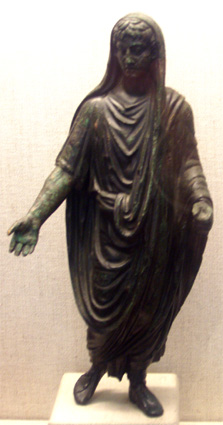
On the other hand, every man, from his birth up to his death, was protected by his Genius, represented by a snake –phallic symbol-; the goddess Iuno was assigned to the women as protective directly.
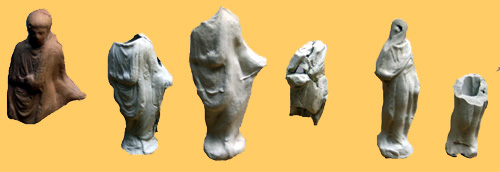
Small statues used as votive offerings to Minerva in her sanctuary in Turiaso (Tarazona). Thel aspect of the statues of a lararium should be very similar to these. Museo Provincial de Zaragoza. (Photo: Roberto Lérida Lafarga 03/01/2008) |
|
Small statue that represents a home genius. Museo Arqueológico Nacional. Madrid. (Photo: Roberto Lérida Lafarga 10/07/2007) |
|
|
|
|
|
Among the domestic cult there was also the cult of the dead; it seems that by Etruscan influence the Romans had some fear of the souls of the dead that they considered dangerous and harmful, so that they made rites to calm them down; at home they honoured to the Manes –the souls of their deceased relatives-, offering them flowers and some food in the birthday of the corresponding dead, in order to their souls did not walk wandering and in uneasiness and they did not become spirits of injurious influence; in fact, in the funerals of the members of a family the relative carried was figures or masks that represented these Manes. Related to the Manes, in a public way, the Romans celebrated the Feralia during nine days when they could not marry and the temples kept closed. In addition, the idus of May -15th May- they celebrated a funeral ceremony –Lemuria- in order to keep away the curses of the spectres, basically two types of spectres: the larvae –the souls of the criminals or their victims- and the lemures –frightful phantoms of the dead; these Lemuria lasted six days with religious practices during three complete nights and they finished the idus of May throwing to the Tiber river from the Sublicius bridge thirty puppets made of wicker that represented to old people and these souls. |
|
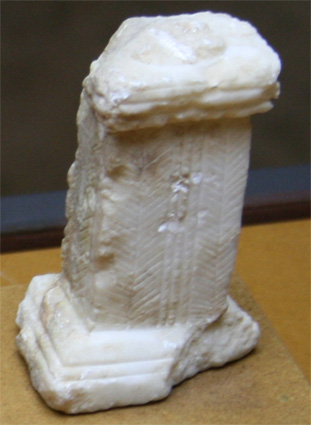
Small altar (about 5 cm high) for domestic cults. Museo Provincial de Zaragoza. (Photo: Roberto Lérida Lafarga 03/01/2008) |
|
|
|
|
|
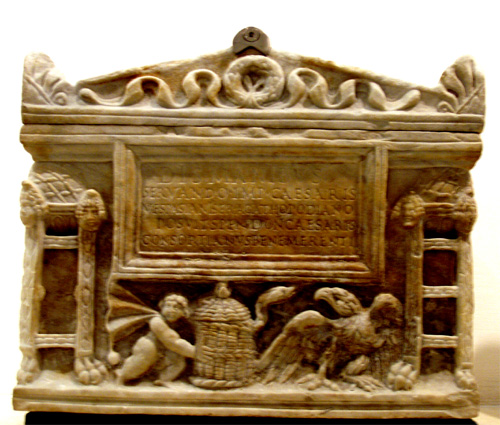
In general, most of the gravestones with funeral inscriptions used to start with the expression Diis Manibus (Sacrum), very often with its correspondane abbreviation D M (S), whose meaning should be "(Tomb) dedicated or consecrated to the Manes gods".
Funeral urn with the expression Dis Manibus. Museum alle Terme in Rome. (Photo: Roberto Lérida Lafarga 31/12/2004) |
|
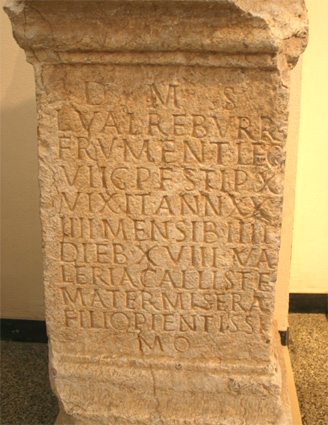
Roman funeral inscription in the Museo Nacional de Arqueología de Tarragona. (Photo: Roberto Lérida Lafarga 06/06/2008) Text: D(iis) M(anibus) S(acrum) L(ucio) VAL(erio) REBURR(o) FRUMENT(ario) LEG(ionis) VII G(eminae) P(iae) F(elicis) STIP(endiorum) X VIXIT ANN(is) XXIIII MENSIB (us) IIII DIEB (us) XVIII VALERIA CALLISTE MATER MISERA FILIO PIENTISSIMO Translation: "Tomb dedicated to the Manes gods. Valeria Caliste, miserable mother, to her piousest son, Lucius Valerius Reburrus, who supplied wheat to the Legio VII Gemina Pía Felix, in his tenth year of military service, who lived 29 years, 4 months and 18 days". |
|
|
|
|
|
In the celebration of all these private and domestic rites any kind of priest intervened; it was the family’s father –paterfamilias- who was in charge of making them and transmitting to his sons the rites; in addition, he showed to the family the prays, the hymns and the ceremonies. |
|
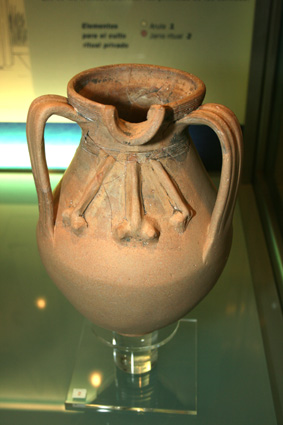
Pottery jar for domestic rites with phalluses as apotropaic signs. Museo del Foro de Cesaraugusta. (Photo: Roberto Lérida Lafarga 28/04/2008) |
|
|
|
|
|
|
|
SOURCES: - CARCOPINO, Jerôme: La vida cotidiana en Roma en el apogeo del Imperio, Madrid, 1993 - ESPINÓS, Josefa et alii, Así vivían los romanos, Madrid, 1987 - HACQUARD, Georges: Guía de la Roma Antigua, Madrid, 2003 - PAOLI, Ugo Enrico: URBS. La vida en la Roma Antigua, Barcelona, 1990 |