EASTERN GODS IN ROME

|
|
EASTERN GODS IN ROME |
|
|
Since their expansion through the Mediterranean sea, the Romans were accepting foreign divinities in their religion. In some way, especially at the end of the Republic and the beginning of the Empire, it was evident that the Romans appeared to be very indifferent with their gods, their religious spirit was empty in some way and the religious histories became mere mythological fables, although they still kept celebrating their festivities, happy and rowdy, so that it was not difficult to understand that the mystic of the eastern cults supposed a calling and an attraction for the religious spirit of the Romans. |
||
|
|
|
|
|
In other words, the faith of the Romans have not disappeared, but the believes of a irrational and fictitious Roman education allowed that the faith increased; the official Roman polytheism did not satisfy this faith, so that the cults of philosophical sects and the mysteries of the eastern gods gave an answer to this faith, because they answered to their questions, they lightened their anxieties, they gave even explanations of the world with their rules of behaviour and some alleviation against the evil and the death. Then, religious believes from the East, but matured during some time in Greece and under the sphere of the Hellenism, were penetrating in the Roman society slowly. In some way, many of these eastern religions were a mix of philosophy and believes, with their dogmas, their prayers, their hymns, their sacrifices, their ceremonies, etc. However, broadly speaking, all these religions shared some characteristics, as the existence of gods who suffered, died and resuscitated, with explanations of the cosmos, protecting gods according to the purity of the man, gods who protected their initiates and the entire universe. |
|
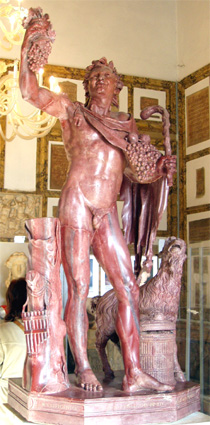
Statue of Dionisos/Bacchus in the Musei Capitolini, Rome. (Photo: Roberto Lérida Lafarga 28/12/2004) |
|
|
|
|
|
So, in the year 204 b. C. the Romans received the Black Stone, the symbol of the goddess Cibeles, sent by the king of Pergamon from Pessinus (in Galatia, in the modern Turkey) at the request of the Roman senate, although they prohibited the cult to Attis, the Cibeles’ lover, because it was bloody and disturb the order. The cult to Bacchus and the mysteries of the Bacchanals that supposed especial ceremonies of initiation for their adepts were the reason of continuous scandals that occasioned that in the year 186 b. C. they were cruelly repressed and suppressed. During the Empire many of these cults, even those prohibited –and although Augustus tried to put the brake on their advance, became more popular, not only among the Roman high classes; this fact supposed a detriment of the national cults; so, the cults of Isis, Serapis, Cibeles, Attis, etc., were very frequent among the Romans and they had their own temples and priesthoods. Claudius authorized the liturgy dedicated to Cibeles and Attis; before, Caligula favoured the Egyptian cults; and Domitian restored with all kind of sumptuousness the temple of Isis destroyed by the fire in the year 80 a. C.; Nero only adored Hadad and his paredrus Artagatis, a Syrian deity. |
|
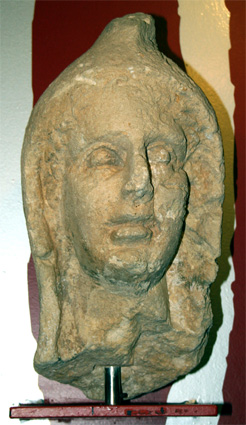
Attis' head in the Museo y Necrópolis Paleocristianos de Tarragona. (Photo: Roberto Lérida Lafarga 06/06/2008) |
|
|
|
|
|
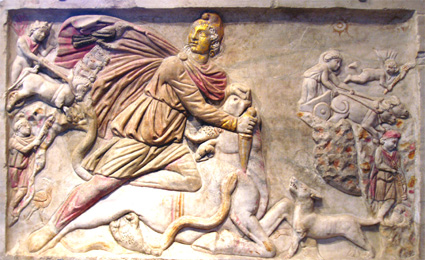
The cult to Mithra was incorporated lately among the Roman, in the age of the Empire in the II century a. C. under the emperors of the Flavian dynasty; she was the Persian goddess of the sky, the earth and the dead. During some time her cult competed with the Christianity; both cults coincided in some aspects like the monotheism and a kind of baptism and, in fact, the Mithraism was one of the reasons of the pagans for fighting against the Christianity; the Mithraism, clandestine during many time, became an official cult until its abolition by the emperor Theodosius, of Hispanic origin. Probably the most known representation of this goddess was the Taurobolium, i. e., the goddess with a knee under a bull whom she is sacrificing, thrusting a knive into him. |
|
Mithra Taurobolium. Museo Nazionale Romano alle Terme. Rome. (Photo: Roberto Lérida Lafarga 31/12/2004) |
|
|
|
|
|
These rites and religions, basically monotheist, were developed with public ceremonies and even with initiated ceremonies, almost always secret and mysteric. Among the adepts the priests of every cult were carefully chosen; all these religions had a doctrine based on the revelation of the mysteries and the faith and on the prestige that their way of life and their clothes gave them. In general, together with the initiation, these religions imposed to their followers some periods of asceticism –religious exercises and practices-. However, among the most traditionalist sectors of the population all these eastern religions were considered as suspect and their priests as chatterboxes, tricksters, shameless people, etc. who got benefit of the people for their own goals and comfort. |
|
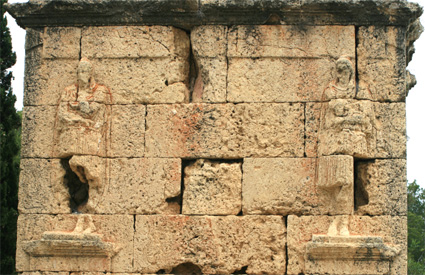
Statues of Attis in the Roman mausoleum known as the Scipiones' Tower, in the province of Tarragona. (Photo: Roberto Lérida Lafarga 09/06/2008) |
|
|
|
|
|
From a theological point of view, the eastern religions supposed a religious superiority on the Roman religion; although the eastern rites could seem barbaric and shameless, they had a positive effect among the people. They dazzled their faithful with the bright of their festivities, the pomp of their processions, their mystic songs and their enchanting music; the obsessive contemplative states and the long mortifications, the dances and some drinks provoked that some cults and ceremonies supposed authentic parties where the faithful reached a state of ecstasy, delirium and comfort where they forgot their sorrows and harms; i. e., through different ways they reached the knowledge, the pure virtue and the victory on the physic pain, the sin and the death. However, we cannot forget that, although these religions were monotheist and their adepts only adored the god of their doctrine, the Roman Estate kept still being polytheist, receiving together with the ancient gods these new gods, without having some pre-eminence on the others. Nevertheless, the most important foreign cult among the cults introduced in Rome and, finally, the cult that finished imposing itself was the Christianity. Click here to know more about another eastern cult: the Christianity. |
||
|
|
|
|
|
|
|
SOURCES: - CARCOPINO, Jerôme: La vida cotidiana en Roma en el apogeo del Imperio, Madrid, 1993 - ESPINÓS, Josefa et alii, Así vivían los romanos, Madrid, 1987 - GARCÍA GUAL, Carlos: La Mitología: Interpretaciones del Pensamiento Mítico, Barcelona, 1987 - GARDNER, Jane F.: Mitos Romanos, Madrid, 1995 - GRIMAL, Pierre: Diccionario de Mitología Griega y Romana, Barcelona, 1981 - HACQUARD, Georges: Guía de la Roma Antigua, Madrid, 2003 - PAOLI, Ugo Enrico: URBS. La vida en la Roma Antigua, Barcelona, 1990 |