MUSEUM OF THE THERMAE OF CAESAR AUGUSTA

|
|
MUSEUM OF THE THERMAE OF CAESAR AUGUSTA |
|
NOTE: THE BUILDING AND THE ARTISTIC PIECES EXPOSED IN IT BELONG TO THE TOWNHALL OF SARAGOSSA (AYUNTAMIENTO DE ZARAGOZA)
|
Probably the specific feature that defines the diary life in a Roman city was the existence of public baths, thermae, where, apart from the hygienic activities belonging to thermal establishments, they had a social function, because they used to be a meeting point, a place for business, for sports, for chatting, for reading, etc, for the Romans. In fact, the existence of these thermal complexes was so important that in the local administration there was a magistrate, the aedilis, who had in charge the supervision of the administration, maintenance and preservation of the public thermae, which were property of the city, and he had in charge the supply of water and wood for their use. Caesar Augusta could not be less than other cities and by the moment the remains of the establishment of public thermae have been found in a setting located between the forum and the theatre of the city. |
|
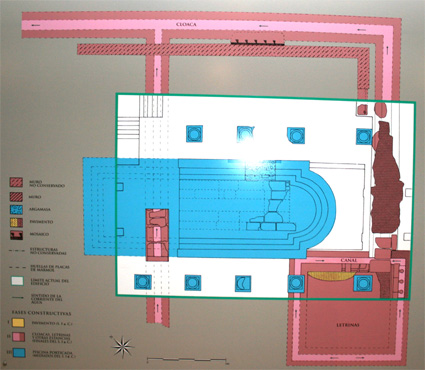
Plan of the thermae of Caesaraugusta, from the explanataory panels in the Museum. |
|
An extended area under the modern San Juan y San Pedro street was filled with land to shelter a thermal complex that suffered along its history many reforms. Related to the date of the construction of the thermae in Caesar Augusta it seems that the works started in the I century b. C., soon after its foundation by Augustus, and they were in use until the IV century a. C. Unfortunately, by the moment, from the whole building of the thermae only a cool water pool for swimming –natatio- is preserved; in both sides of the pool the bases of some columns have been preserved too; it seems to indicate that it was a pool with a porch on the open air. However, there are not remains of the other rooms and we cannot determine the disposition of the caldarium, tepidarium, frigidarium and other rooms inside the thermal complex. |
|
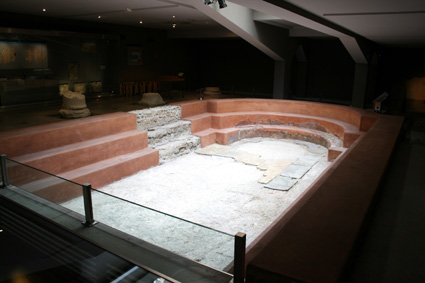
Natatio in the Museum of the Thermae of Caesaraugusta (Photo: Roberto Lérida Lafarga 28/04/2008) |
|
The preserved natatio is dated in the middle of the I century a. C., it has rectangular plan, although one of its sides ends in a lobular apse; there are preserved 9,7 metres from a total calculated of 15,8 metres long. The pool had three steps around all its perimeter and its walls and floor were recovered with marbles that, when the building stopped being used, were partially extracted and reused in other constructions. |
|
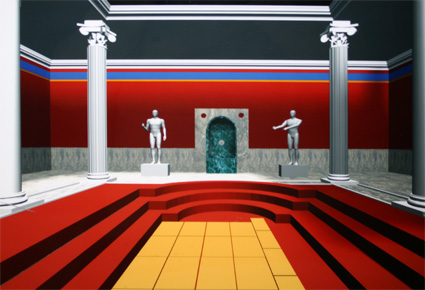
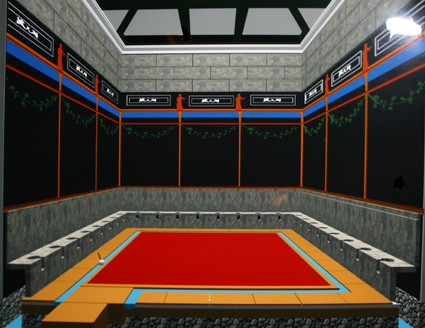
Reconstruction of the natatio and its proch, according to the diorams of the Museum of the Thermae of Caesaraugusta. (Photo: Roberto Lérida Lafarga 28/04/2008) |
|
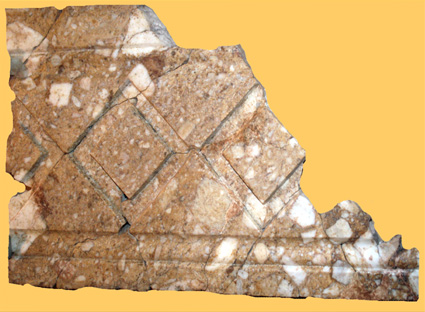
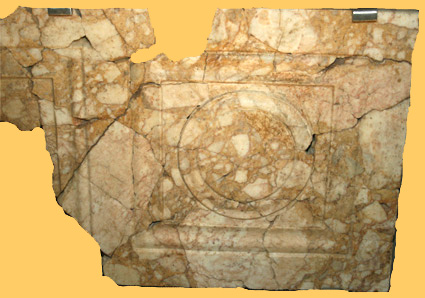
A porch surrounded this natatio; scholars calculate that it was 5 or 6 metres high; three bases of columns and the supporting foundations of some others have been preserved. We do not know exactly the size of the porch, but it is sure that the porch and the room of the natatio were larger than the space that Museum of the Thermae occupies now. The room was decorated also with marble and very probably with statues. In the excavations marble plates from the recovering and the floor of the pool were found and decoration with floral motives belonging to the age of the Julio-Claudian emperors.
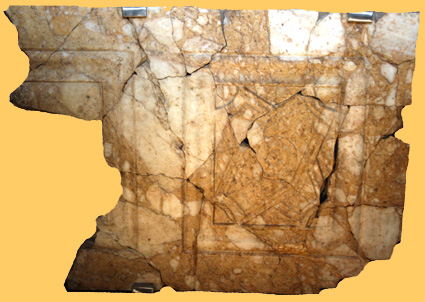
Marble plate from the natatio of the thermae. (Photo: Roberto Lérida Lafarga 28/04/2008) |
|
Marble plates from the natatio of the thermae. (Photo: Roberto Lérida Lafarga 28/04/2008) |
|
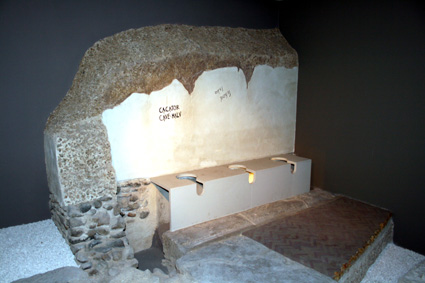
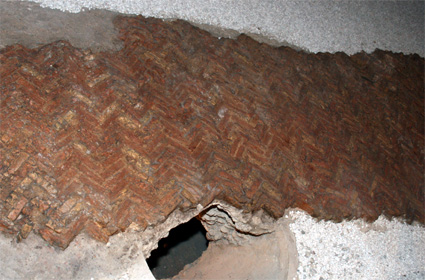
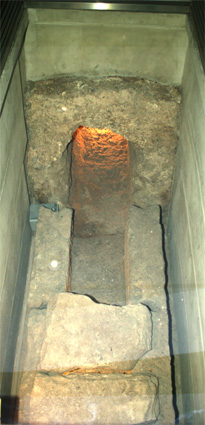
Nevertheless, the preserved natatio and the room that sheltered it were built on latrines dated previously to the room; in fact, the latrines were in use at the end of the I century b. C.; this fact supposes that the thermal complex suffered undoubtedly some reforms. From the latrines it is preserved the stone pavement with a small channel of running water to keep the hygiene of the establishment and of the users, in this channel the user wetted sponges and other hygienic implements for cleaning or making ablutions. Together with the pavement of the latrines, other parts have been preserved too: the threshold of the door to access to the latrines, the drain channel and another pavement from a former period made of bricks disposed in the shape of the wheat ear –opus spicatum-. To understand better the shape, the disposition and the use of the latrines they have been partially rebuilt, together with a wall and part of the pavement.
Reconstruction of the latrines , according to the diorams of the Museum of the Thermae of Caesaraugusta. (Photo: Roberto Lérida Lafarga 28/04/2008) |
|
Reconstruction of the latrines with their wall, seats, running water channel and pavement. (Photo: Roberto Lérida Lafarga 28/04/2008)
Pavement in opus spicatum near the latrines of the Museum of the Thermae of Caesaraugusta. (Photo: Roberto Lérida Lafarga 28/04/2008)
|
|
Near the natatio you can see also the remains of a sewer that passed under the pool and it was connected with the main net of sewers of the city; undoubtedly, no very far from the pool it was the connexion of this secondary sewer with the main sewer that it is partially visible in the Museum of the Roman Forum of Caesaraugusta. |
|
Sewer of the thermae. (Photo: Roberto Lérida Lafarga 28/04/2008) |
|
You can complete the visit of the Museum of the Public Baths of Caesaraugusta seeing an projection with the history of a imaginary aedilis of this Roman city who writes a letter to a friend talking about the thermae; there is a showcase with the reconstruction of some objects related to the bath and the hygiene and marble plates from the decoration of the thermae; some diorams explain the history of the thermae and offer pictures of the reconstructions of the thermae as they should be.
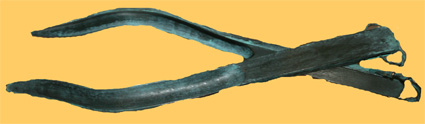
Reproduction of strígili, metallic scrapers for getting out the sweat, the oils and the sand after practicing some sports and before gooing into the pools. (Photo: Roberto Lérida Lafarga 28/04/2008) |
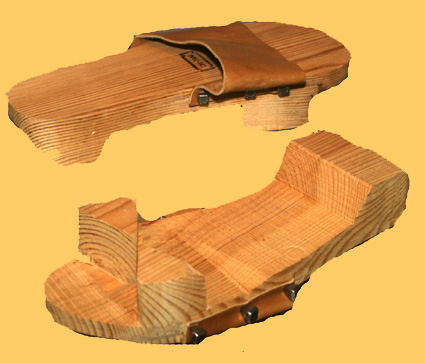
Reproduction of wooden shoes for walking along the rooms with heating in the thermae without burning one self. (Photo: Roberto Lérida Lafarga 28/04/2008) |
|
|
Anagram of the Museum of the Thermae of Caesaraugusta
Click here to visit the web of the Museum of the Thermae of Caesaraugusta. Click here to know more about the thermae, the latrines and the sewers in the Roman world. |
|
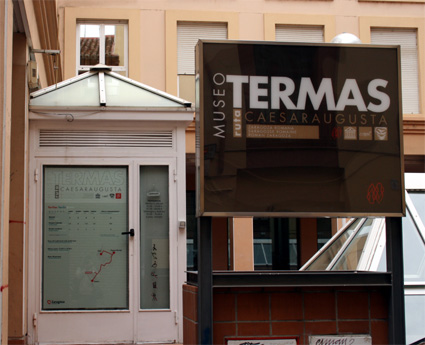
Entrance of the Museum of the Thermae of Caesaraugusta. (Photo: Roberto Lérida Lafarga 28/04/2008) |
|
Together with the public thermae, the archaeological discoveries have brought to light private thermae located under the modern corner of the Ossau and Méndez Núñez streets; from these thermae we know the suspensurae –supports for the heating system with hot air-, the caldarium –hot water pool-, the tepidarium –tepid water pool- and the frigidarium –cool water pool-. |
||
|
|
|
SOURCES: - BELTRÁN LLORIS, Miguel y FATÁS CABEZA, Guillermo: Historia de Zaragoza 2: César Augusta, ciudad romana, Zaragoza, 1998€ - Pamphlet of tourist information and explanatory panels of the Museo of the Thermae de Caesaraugusta |