MUSEUM OF THE FORUM OF CAESAR AUGUSTA

|
|
MUSEUM OF THE FORUM OF CAESAR AUGUSTA |
|
NOTE: THE BUILDING AND THE ARTISTIC PIECES EXPOSED IN IT BELONG TO THE TOWNHALL OF SARAGOSSA (AYUNTAMIENTO DE ZARAGOZA)
|
Caesar Augusta was planned from its foundation by Augustus as a new Roman city, i. e., created ex novo without using the structure of a previous inhabited urban nucleus, so that it was completely planned before being built, reserving some places for further building, as it was the case of the theatre that was built in the age of the emperor Tiberius. From a monumental point of view, the first constructions that should be built were the bridge-aqueduct over the Ebro river and at the same time of soon after the forum and the walls. The construction of the whole city lasted beyond the empire of Augustus and it was concluded in the age of his successor, Tiberius, in its entirety. |
|
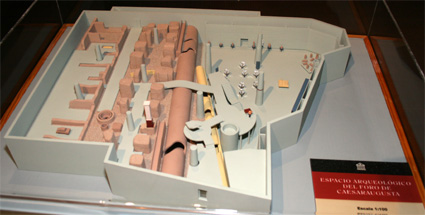
Scale model of the archaeological site of the Museum of the Forum of Cesaraugusta. In pink colour you can see the parts of the forum made in the age of Tiberius (on the left the ground floor of the tabernae, in the middle the foundations cubes that supported the porches of the forum and on the right the big sewer); in yellow colour you can see the sewer from the age of Augustus. (Photo: Roberto Lérida Lafarga 28/04/2008) |
|
So, as a typical Roman city Caesar Augusta had, at least, a forum; it is probable that, as it happened in the case of Tarraco (now Tarragona), Caesar Augusta had a forum characteristic of every Roman city and another forum as capital of the conventus iuridicus Caesaraugustanus. In fact, the archaeological excavations made in the area of the modern Santa Cruz and Ariño squares had betrayed the existence of a large space on the open air that reaches up to the rest of a possible basilica in the so called Casa Pardo, near San Juan and San Pedro street; in this sense, we must to say that the favourite place to the construction of a forum was the crossing of the two main streets of a Roman city, the cardus maximus –from north to south- and the decumanus maximus –from east to west- and the mentioned space on the open air should be located near the crossing of these streets –in Saragossa these streets have the following correspondence: the cardo maximus was the modern Jaime I street and the decumanus maximus the Mayor, Espoz y Mina and Manifestación streets-.
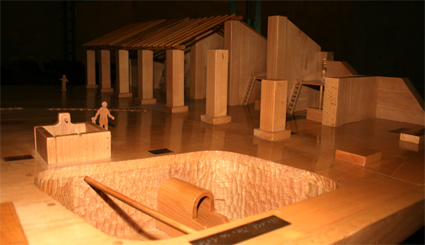
Scale model with reconstruction of the forum, its fountain, its tabernae, its porches and its sewers. (Photo: Roberto Lérida Lafarga 28/04/2008) |
|
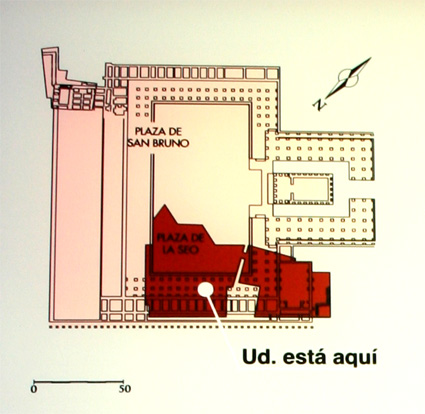
Plan of the forum built in the age of Tiberius under La Seo square, from the diorams of the Museum of the Forum of Cesaraugusta. (Photo: Roberto Lérida Lafarga 28/04/2008) |
|
It is sure that under the ground of the La Seo square and under the buildings that surround it there are located the remains of a Roman forum, displaced from the normal location of a forum, undoubtedly due to the nearness of the river port and the trade area of the city. The works of terracing and conditioning of the large trade area of Caesar Augusta were made in the age of the emperor Tiberius; among other works, the level of the city in this area was raised up to 4 metres over the river level, covering the market –macellum- built in the age of Augustus; the network of sewers acquired its definitive aspect with a large sewer under the cardo maximus up to the Ebro river that collected the residual water of the city from other secondary and perpendicular sewers and together with other large sewer that surrounded the forum to collect the rain water from the porches of the forum; finally, the Roman forum that is located under the La Seo square was built under Tiberius together with the theatre, the temples and the remodelling of the walls. |
|
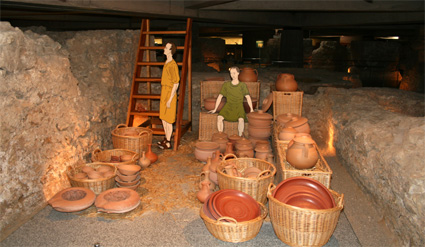
Reconstruction of a ground floor of a tabernae. (Photo: Roberto Lérida Lafarga 28/04/2008) |
|
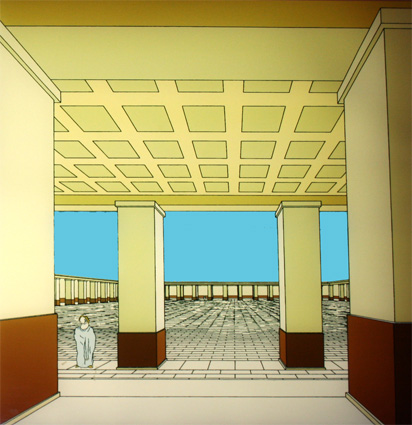
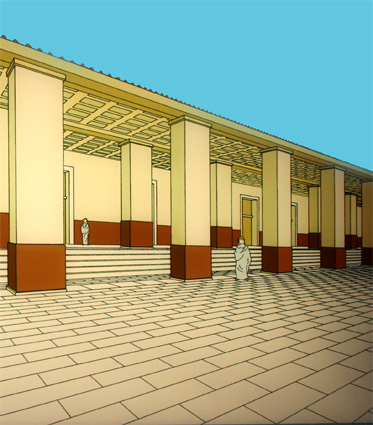
The forum of Tiberius had buildings to fill all the basic functions of a city: a curia –senate- for the administration, a basilica for the justice, a temple for the religion, shops for the economy and trade and even the porches could be used for educative aspects. Scholars calculated that the size of this rectangular forum were 160 x 120 metres, which supposed more than 19.000 m2 in its surface. According to the preserved rest we know that in the west side of the forum that reached up to the cardo maximus of the city there were double porches between 5 and 6 metres wide and all this side was filled of shops –tabernae- whose ground floors are partially preserved. The forum was paved with limestone flagstone and the construction was made using opus caementicium recovered with opus vitattum and opus africanum.
Reconstruction of the forum of Caesar Augusta with double porch, outside staircase and square on the open air, from the diorams of the Museum of the Forum of Cesaraugusta. (Photo: Roberto Lérida Lafarga 28/04/2008) |
|
Another view of the reconstruction of the forum of Caesar Augusta with double porch, outside staircase and square on the open air, from the diorams of the Museum of the Forum of Cesaraugusta. (Photo: Roberto Lérida Lafarga 28/04/2008) |
|
In the south side of the forum it was located the curia –senate- and maybe the basilica. The curia had rectangular plan with a size of 25 x16 metres, with a central access from the forum square; close to it there were two “offices”; from its decoration the archaeologist found columns lead against the walls and the seat for the magistrates should be wooden benches. Due to the size of the curia, the scholars think that in the city there was a large number of decuriones, i. e., men from rich families who belonged to the ordo Caesaraugustanus from where came all the magistrates who ruled the city. Near the curia a series of five parallel walls made of opus caementicium and located in a short distance between them (2 and 4,50 metres) have been found; the disposition of these walls suggests that they were part of some horrea –granaries-. |
|
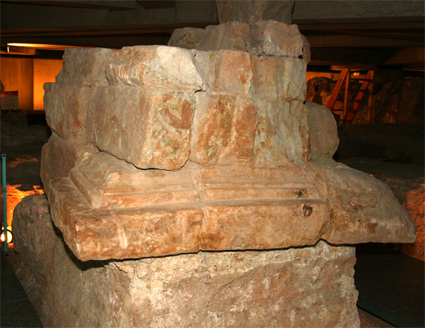
Foundations and base of a pilaster of the forum with mouldings and blocks of stone. (Photo: Roberto Lérida Lafarga 28/04/2008) |
|
Under the Cathedral of La Seo there are some foundations in opus caementicium that scholars think that were part of a Roman temple that dominated the forum; probably the rests of big semicircular columns lean on the walls with a diameter of 1,09 metres belonged to it. A coin of the city from the year 28 or 29 d. C. is a testimony of the existence of a temple in the city dedicated to the Pietas Augusta –Augustus’ Pity-; it was a hexastyle –with six column in its main façade- temple with columns of Corinthian order with three steps to access to the podium, with Attic bases and a simple pediment. On the other hand, another coin from the year 33 d. C. shows other temple, tetrastyle –with four columns in its main façade-, with columns of Corinthian order and with the Livia’s –Augustus’ wife and Tiberius’ mother- head on the reverse of the coin; this temple could be dedicated to her. |
|
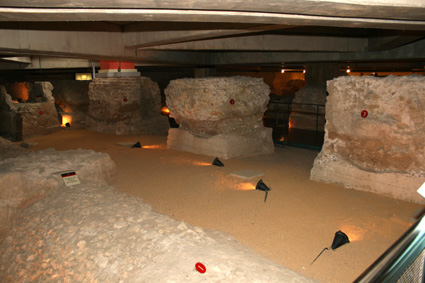
Cubos de cimentación para las pilastras de los pórticos del foro. (Photo: Roberto Lérida Lafarga 28/04/2008) |
|
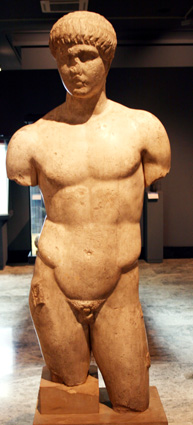
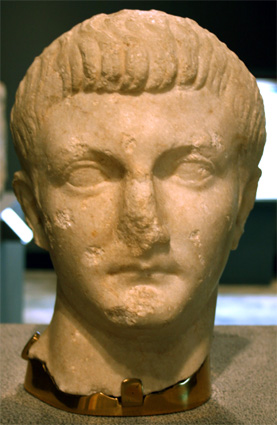
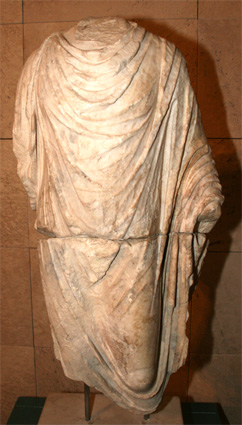
In the square of the forum, undoubtedly, there were honorific statues dedicated to the members of the imperial family of the Julio-Claudian dynasty; from them it is preserved a bust of Drusus the Minor, dated between the years 21 and 23 a. C.; the existence of a coin of the city from 31-32 b. C. with the image of Tiberius riding a horse could mean that in the forum there was an equestrian statue of this emperor to celebrate the fifty anniversary of the recovery by Augustus of some legionary standards lost in a war against the Parthians. Under the Flavian dynasty, at the end of the I century a. C., the forum was modified with the addition of new statues; we know this thanks to the preservation of a statue of a men dresses with the toga –typical dress of the Romans-.
Statue of a unknown man from the age of the emperor Nero found in the excavations of the forum of Caesar Augusta. Museum Provincial of Saragossa. (Photo: Roberto Lérida Lafarga 03/01/2008) |
|
Bust of Drusus the Minor, Tiberius' and Vipsania Agripina's son, killed by his wife Livila in the year 23 a. C. when he was 38 years old. It was part of the statues of the imperial cult in the forum. Museum Provincial of Saragossa. (Photo: Roberto Lérida Lafarga 03/01/2008)
Statue of a man dressed with the toga from the age of the Flavian diynasty. (Photo: Roberto Lérida Lafarga 28/04/2008) |
|
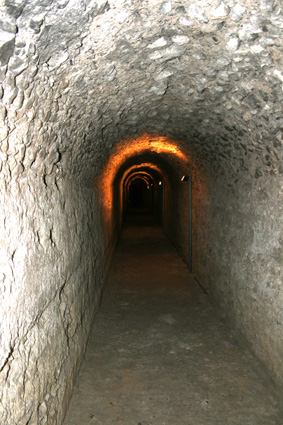
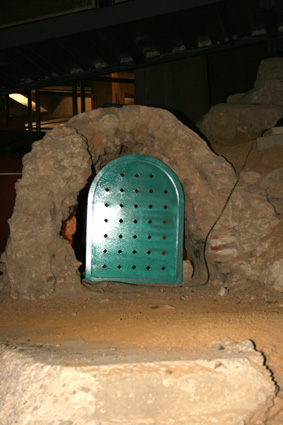
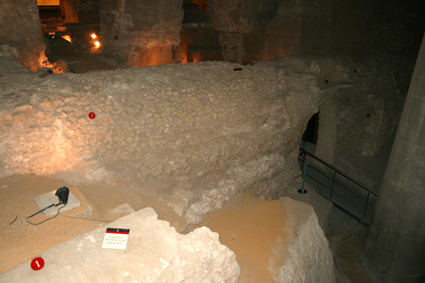
In the Museum of the Forum of Cesaraugusta you can see the ground floors of some shops –tabernae- of the west side of the forum, parts of a water channel, the foundations of the porches of the forum and some pieces of the diary life found in the excavations of the La Seo square; we want to point up the rests of two sewers: especially surprising it is to walk inside the big sewer from the age of Tiberius that was the water collector from other secondary sewers and that was almost under the cardo maximus; this sewer is 2,82 metres high and 2,20 metres wide with an incline of 9% down to the Ebro river; close to this sewer there is another one, more modest, from the age of Augustus, 1,28 metres high and 0,90 metres wide.
Big sewer from the age of Tiberius that runs almost under the cardo maximus. (Photo: Roberto Lérida Lafarga 28/04/2008) |
|
Sewer from the age of Augustus under the forum. (Photo: Roberto Lérida Lafarga 28/04/2008)
Detail of the two parallel sewers in the Museum of the Forum of Cesaraugusta. (Photo: Roberto Lérida Lafarga 28/04/2008) |
|
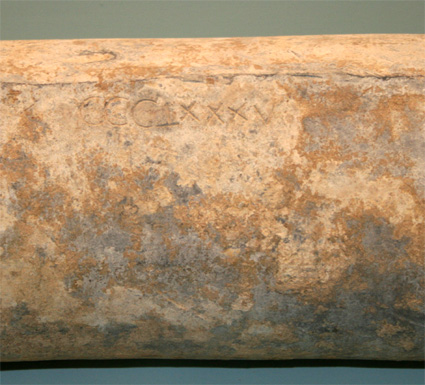
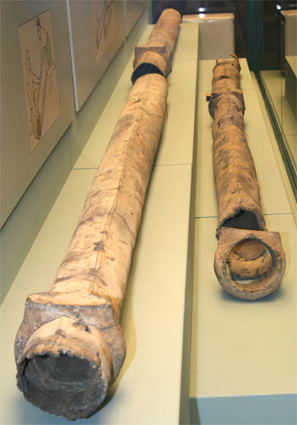
The visit to the museum is completed with the view of short film, with scale models of the forum, with explanatory dioramas and with showcases with object from the diary Roman life and with some lead pipes from the bridge-aqueduct that supplied water to the city from the ancient Gallicum river –the modern Gállego- and that were put in the Roman bridge, crossing the last obstacle of the aqueduct, the Ebro river.
Detail of a lead pipe from the bridge-aqueduct of Caesar Augusta with numerical inscription: CCCLXXXV. (Photo: Roberto Lérida Lafarga 28/04/2008) |
|
Lead pipes from the bridge-aqueduct of Caesar Augusta (Photo: Roberto Lérida Lafarga 28/04/2008) |
|
Anagram of the Museum of the Forum of Cesaraugusta
Click here to visit the web of the Museum of the Forum of Caesaraugusta. |
|
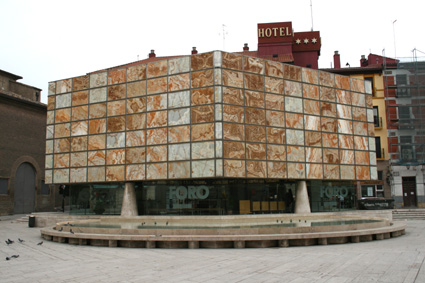
Façade of the Museum of the Forum of Cesaraugusta. (Photo: Roberto Lérida Lafarga 28/04/2008) |
|
|
|
SOURCES: - AGUAROD OTAL, Carmen (coord.): Foro de Caesaraugusta. Programa didáctico. Libro del Profesor y Fichas para los alumnos, Zaragoza, 1996 - BELTRÁN LLORIS, Miguel y FATÁS CABEZA, Guillermo: Historia de Zaragoza 2: César Augusta, ciudad romana, Zaragoza, 1998 - Folleto de información turística y paneles explicativos del Museo del Foro de Caesaraugusta |