MUSEUM OF THE THEATRE OF CAESAR AUGUSTA

|
|
MUSEUM OF THE THEATRE OF CAESAR AUGUSTA |
|
NOTE: THE BUILDING AND THE ARTISTIC PIECES EXPOSED IN IT BELONG TO THE TOWNHALL OF SARAGOSSA (AYUNTAMIENTO DE ZARAGOZA)
|
In the I century a. C., in the last year of the emperor Tiberius, it was possible that the inhabitants of Caesar Augusta went to their recently finished Roman theatre. This building kept its splendour and use during two centuries, suffering a reform at the end of the I century d. C. with the marble pavement of the orchestra and probably of the whole theatre, until it started to be dismantled in the III century. This big public building occupied tour blocks of the Roman city (regio antica dextrata), 40 metres far away from the walls, in a space that had been reserved to this building in the plan of the city in the age of the emperor Augustus. It is a pity that part of the Roman theatre has not been excavated due to it is under the church of the Holly Heart, under the building of the museum and under the street. |
|
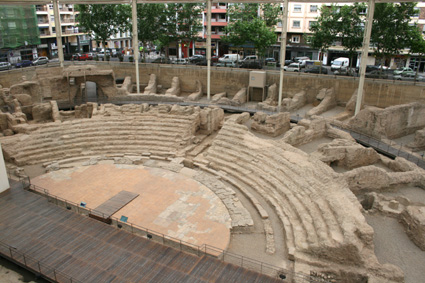
View of the Roman theatre of Caesar Augusta. (Photo: Roberto Lérida Lafarga 28/04/2008) |
|
|
|
|
|
The first work necessary to the building of the theatre was the terraces in the terrain to obtain a regular surface suitable to this building, i. e., a levelling of the terrain due to the unevenness that existed in this part of the city between the different layers of natural gravels. So, the theatre occupied the highest point of the city, looking down on an axe that came from the theatre and arrived to the river port, crossing the thermae and the forum. |
|
Phase of the terracing and foundations of the theatre according to the explanatory panels of the Museum of the Theatre of Caesaraugusta. (Photo: Roberto Lérida Lafarga 28/04/2008) |
|
|
|
|
|
The theatre of Caesar Augusta is a Roman theatre in a strict sense, because it was not built using the sides of a hill, but it was erected completely from its foundations that, as we can see in the visit to the museum, are preserved in a large extension; these foundations –opus caementicium- were organized in radial rings and walls that follow the semicircular design of the rows of seats –cavea- of the theatre, taking as a model the theatre of Marcelo in Rome, a kind of theatre in fashion in the I century a. C. very extended especially in Italy, being the theatre of Caesar Augusta the only example of this kind of theatres in Hispania. The foundations were covered with marble in the cavea, while in the façade they were covered with big blocks of stone –opus quadratum-.
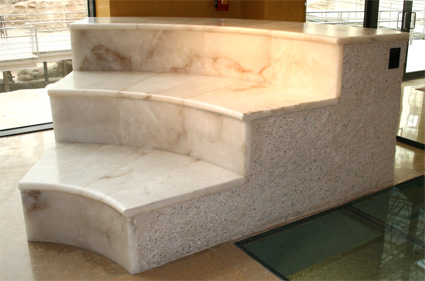
Reconstruction of the rows of seats recovered by marble of the Roman theatre of Caesar Augusta. (Photo: Roberto Lérida Lafarga 28/04/2008) |
|
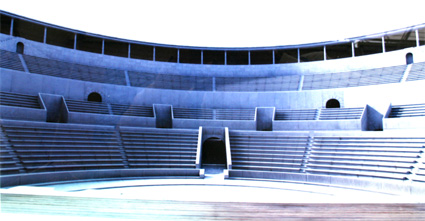
View of the cavea of the Roman theatre of Caesar Augusta. (Photo: Roberto Lérida Lafarga 28/04/2008) |
|
|
|
|
|
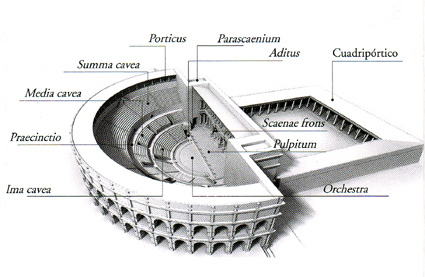
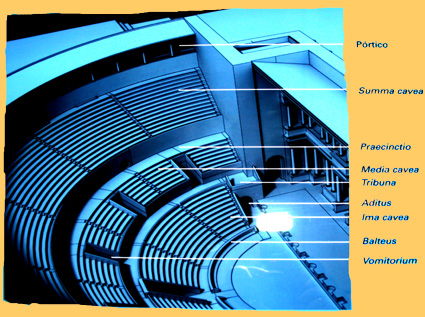
Between the rings and the walls made of mortar it was erected a system of galleries, two large and circular aisles -a porch, the outer, and a crypta, the inner- and stairs with vomitoria that allowed to access to the cavea. The rows of seats ware organized in three parts: the ima cavea –lower rows of seats, to the rich people, official guest, etc.- that was separated from the orchestra by a small parapet –balteus- and a small aisle –praecinctio- were the firs seats –proedria- were decorated with mouldings; over the ima cavea it was the media cavea –middle rows of seats- to which it was possible to access through the vomitoria; and over this it was the summa cavea –higher rows of seats- to which it was possible to access by aisles and stairs, although nothing of it has been preserved.
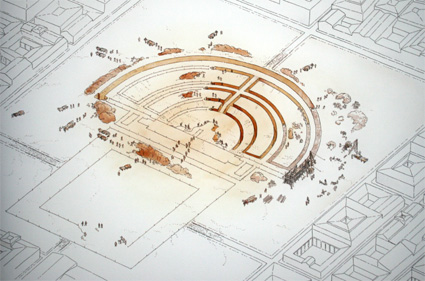
Reconstruction of the Roman theatre of Caesar Augusta, according to the informative pamphlet of the Museum. |
|
Reconstruction of the Roman theatre of Caesar Augusta, according to the explanatory panels of the Museum. (Photo: Roberto Lérida Lafarga 28/04/2008) |
|
|
|
|
|
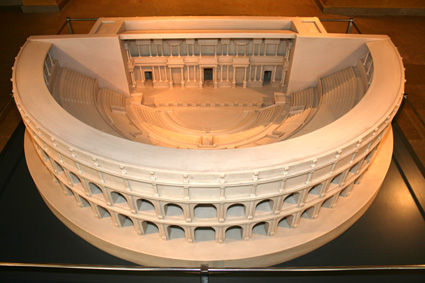
Well preserved is the orchestra of the theatre –semicircular space between the scene and the cavea; around this it was organized the rows of seats and it was destined for the performance of the musician, dancers, etc.- from which many marble flagstones have been preserved that covered it in the technique of the opus sectile. This orchestra and its surrounding were reformed at the end of the I century a. C. Archaeologically we can indicate that under the modern orchestra there was a underground room of the former orchestra in the theatre; scholars think that it was a fosse with the “stair of Charon”, i. e., a room from which some characters came out in a moment during a performance, like a deus ex machina.
|
|
Reconstruction of the Roman theatre of Caesar Augusta in a scale model of the Museum. (Photo: Roberto Lérida Lafarga 28/04/2008) |
|
|
|
|
|
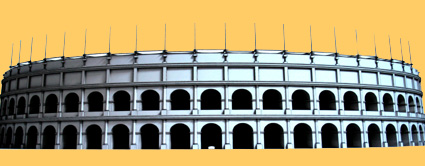
The size of the theatre reached about 106 metres in its outer diameter, sheltering to about 6.000 spectators; it was a high number related to the building –that means its importance- and related to the city, because the building could shelter a large proportion of the inhabitants of the city. Its façade should have three levels up to 25 metres high; the two first levels were divided into arches. |
|
Reconstruction of the façade of the Roman theatre of Caesar Augusta, according to the explanatory panels of the Museum. (Photo: Roberto Lérida Lafarga 28/04/2008) |
|
|
|
|
|
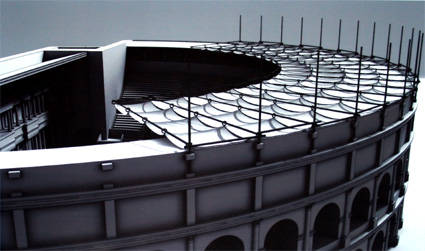
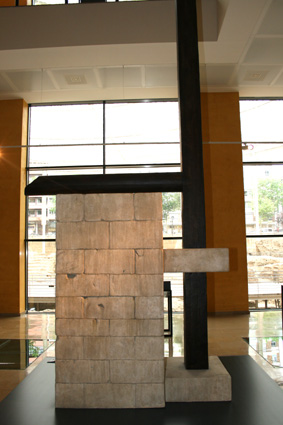
We must remember that the buildings to spectacles built by the Romans were on the open air; this fact supposed some inconveniences. So, like other Roman theatres, the building was planned so that the scene was the north face and, in this way, the spectators received the midday sun on the back; nevertheless, according to archaeological testimonies, it seems that, like in the case of the Coliseum in Rome, the theatre of Caesar Augusta had a system of sunblinds –velarium- that covered the rows of seats when the weather was hot; the mechanism was simple: in the façade, in regular intervals, the engineers and architects put two corbels, one perforated and the other no; every no perforated corbel was used as base and support for a large and solid wooden post and every perforated corbel kept it vertical; every post had a wooden beam that supported a linen sunblind with ropes that was extended or taken in with pulleys when it was necessary; in some occasions the sunblinds were sprayed with perfumed water to aromatize the atmosphere.
Reconstruction of the velarium of the Roman theatre of Caesar Augusta, according to the explanatory panels of the Museum. (Photo: Roberto Lérida Lafarga 28/04/2008) |
|
Reconstruction of the system of supporting of the corbels of the velarium of the Roman theatre of Caesar Augusta. (Photo: Roberto Lérida Lafarga 28/04/2008) |
|
|
|
|
|
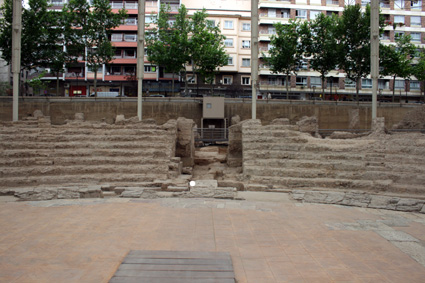
One of the most important peculiarities of the theatre of Caesar Augusta was the existence of a central access, axial and independent, that allowed to access to the orchestra and to the pre-eminent seats directly from the outer, without crossing the inner aisles and stairs of the building; this feature exist only in a few number of theatres (those of Libarna, Turin and Minturno in Italy, for example); scholars think that it could be used to the performance of other kind of spectacles different form the theatre (gladiators’ fights). This axial access stopped being used in the II century a. C.
Reconstruction of the axial access of the Roman theatre of Caesar Augusta, according to the explanatory panels of the Museum. (Photo: Roberto Lérida Lafarga 28/04/2008) |
|
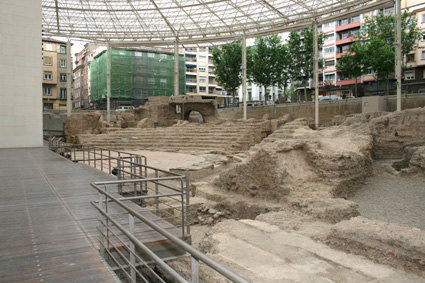
Rests of the axial access direct from the outside up to the centre of the orchestra of the Roman theatre of Caesar Augusta. (Photo: Roberto Lérida Lafarga 28/04/2008) |
|
|
|
|
|
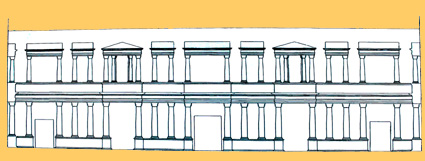
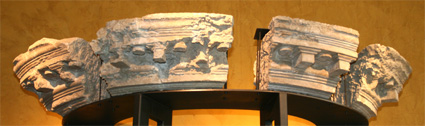
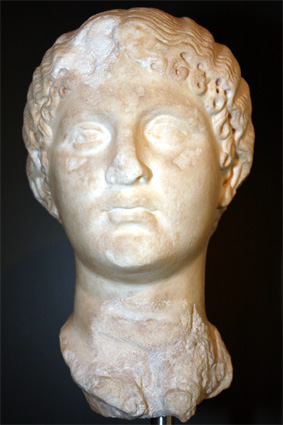
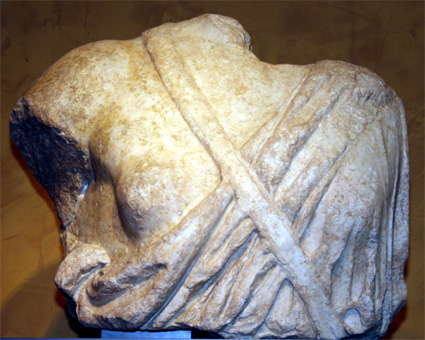
The most spectacular architectural element of the theatre was its frons scaenae, i. e., the façade of the scene that closes the semicircular ring of the rows of seats and, therefore, the building, not only because it was the decorative setting where the performances took place, but because it was the place where the cult to the emperor and other divinities was made. So, the frons scaenae was profusely decorated with local stones and marbles from different parts of the empire and with statues of the imperial family and other divinities, from which there are preserved some rest and Corinthians capitals, column bases and column timbers. In its façade right elements alternated with curve elements, according to the archaeological discoveries. Among all this decoration there were three valvae –accesses- that connected the frons scaenae with the postscaenium –the back side of the scene-; through these valvae the actors came into and out from the scene. The part of the scaena where the performances were made was the pulpitum, elevated on the orchestra; normally it was covered by wooden boards.
Reconstruction of the frons scaenae of the theatre of Caesar Augusta, according to the explanatory panels of the Museum. (Photo: Roberto Lérida Lafarga 28/04/2008) |
|
Rests of statues and of the decoration from the frons scaenae. (Photos: Roberto Lérida Lafarga 28/04/2008) |
|
|
|
|
|
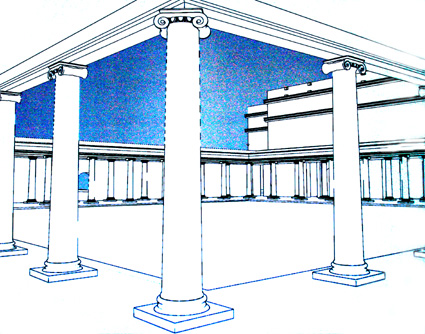
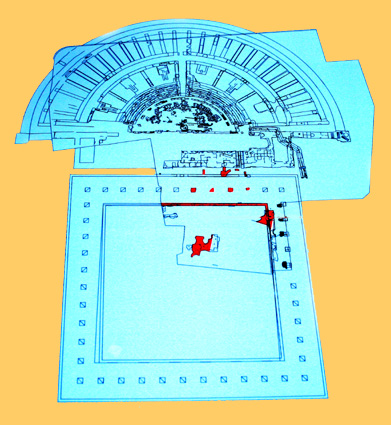
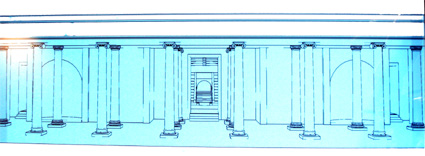
The archaeological evidences –we have rest of the south and west side- inform us that in the back side of the frons scaenae –the postscaenium- a square garden -quadriporticus- existed, with a plan similar to those of the forum of the city, with a double porch with columns with Ionic capitals; one on these capitals is preserved. This space seems to be in use until the age of the Flavian emperors at the end of the I century a. C. It was frequent that in the urban theatres spaces like this were reserved to the reunion of the citizens. However, this space was intimately connected with the theatre and the imperial cult; so, it is as well to remember that the performances had to start with a ceremony and a procession with the portable statues of the emperor and his family up to a place of honour in the theatre from which they presided the performances until their end.
Reconstruction of the quadriporticum of the theatre of Caesar Augusta, according to the explanatory panels of the Museum. (Photo: Roberto Lérida Lafarga 28/04/2008) |
|
Plan of the quadriporticum of the theatre of Caesar Augusta, according to the explanatory panels of the Museum. (Photo: Roberto Lérida Lafarga 28/04/2008)
Reconstruction of the façade of the south sideof the quadriporticum of the theatre of Caesar Augusta, according to the explanatory panels of the Museum. (Photo: Roberto Lérida Lafarga 28/04/2008) |
|
|
|
|
|
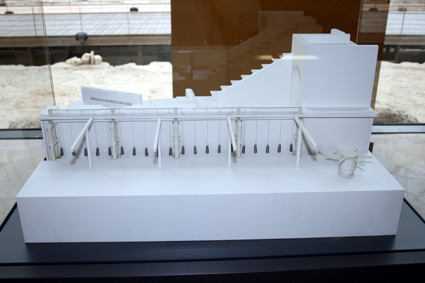
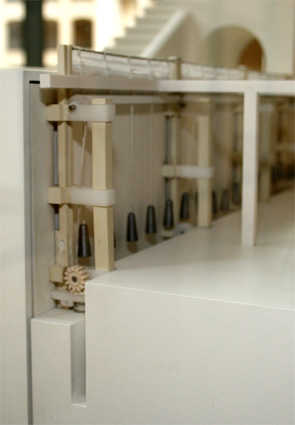
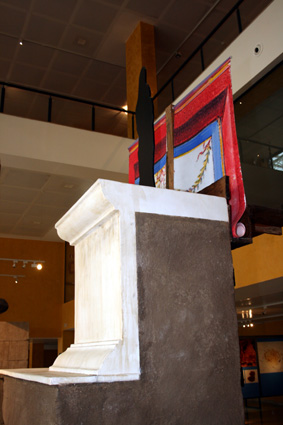
Related to the scenic games we have to say that in the Roman theatres the difference in the level of the scaena –scene- and the orchestra was used to make scenic movements, stage machineries, rising the curtain, etc.; so, the zone under the scene –hyposcaenium- was filled of mechanisms; one of them allowed to rise up the curtain –aulaeum- before the performances started and whet theses started it was lowered by a mechanism of corbels and counterweights up to 4 metres high, keeping the curtain taken in under the scene –pulpitum- near its edge close the orchestra –the opposite than the modern curtain that keeps lowered before the performance and it is raised up when the performance starts; this mechanism stopped being used with the reform of the theatre in the age of the Flavian emperors, at the end of the I century a. C.
Reconstruction in a scale model of the system or raising up the aulaeum of the theatre of Caesar Augusta, according to the explanatory panels of the Museum. (Photo: Roberto Lérida Lafarga 28/04/2008) |
|
On the left, detail of the reconstruction ein a scale model of the system or raising up the aulaeum of the theatre of Caesar Augusta, according to the explanatory panels of the Museum. On the right, reconstruction of the pulpitum and the aulaeum. (Photos: Roberto Lérida Lafarga 28/04/2008) |
|
|
|
|
|
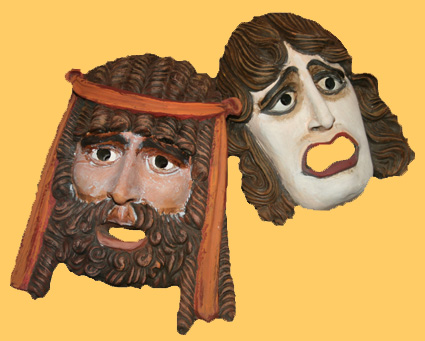
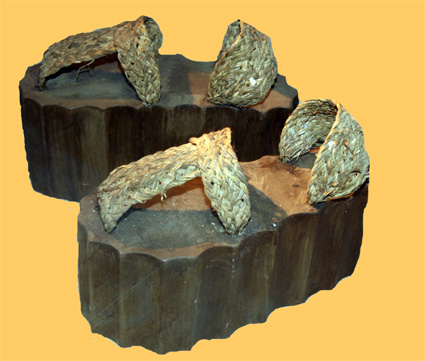
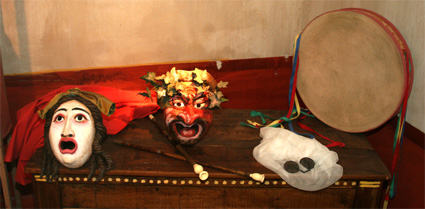
All the things related to the Roman theatre of Caesar Augusta are located in the underground floor of the Museum of the Roman Theatre; in the ground floor there are explanatory panels of the different phases of construction and dismantling of the Roman theatre and the history of the place from the theatre up to the present; in the first floor there are explanatory panels and exhibitions about the spectacle of the theatre and the performances, the calendar of the Roman festivities to know the days when there were performances; there are also archaeological pieces found in the site of the theatre belonging to other ages. From the section of the theatre and the performance we must mention the reproductions of theatre masks, cothurni –the especial shoes of the Greek and Roman actors-, musical instruments, clothes, etc.
Reproduction of masks. (Photo: Roberto Lérida Lafarga 28/04/2008) |
|
Reproduction of cothurni. (Photo: Roberto Lérida Lafarga 28/04/2008)
Reproduction of mask and instruments. (Photo: Roberto Lérida Lafarga 28/04/2008) |
|
|
|
|
|
Anagram of the Museum of the Theatre of Caesaraugusta.
Click here to visit the web of the Museum of the Roman Theatre of Saragossa (http://www.zaragoza.es/ciudad/museos/es/teatro/). Click here to know more about the theatres and the performances. |
|
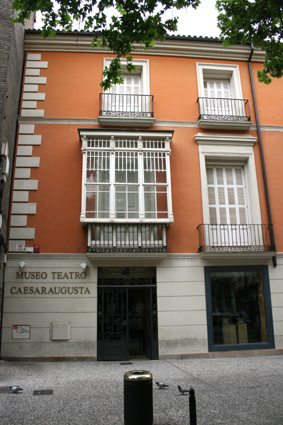
Façade of the Museum of the Theatre of Caesaragusta. (Photo: Roberto Lérida Lafarga 28/04/2008)
|
|
|
|
|
|
|
|
SOURCES: - BELTRÁN LLORIS, Miguel y FATÁS CABEZA, Guillermo: Historia de Zaragoza 2: César Augusta, ciudad romana, Zaragoza, 1998 - Pamphlet of tourist information and explanatory panels in the Museum of the Roman Theatre of Caesaraugusta |