BILBILIS AUGUSTA: HISTORICAL CONTEXT

|
|
BILBILIS AUGUSTA: HISTORICAL CONTEXT |
|
|
Bilbilis was the main city of a Celtiberian tribe called lusones, which occupied the Jalon middle valley and the Jiloca valley; this tribe was closely related to the beli and the titi, which were its nearest neighbours and had as main city Segeda (Mara, Zaragoza), and some less related to the arevaci, whose main city was Numantia (near Garray, Soria).
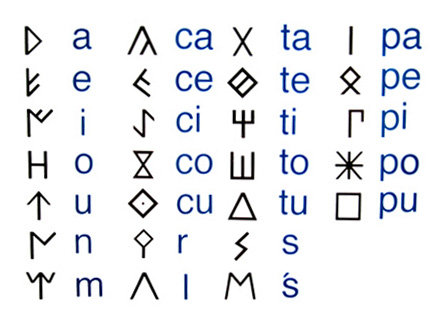
Bilbilis written in Iberian signarium: bi.l.bi.l.i.s
The Roman Bilbilis is inherited of a former Celtiberian indigenous city with the same name; however, due to the fact that only scarce Celtiberian remains have been found under the remains of the Roman city, some scholars think if the Roman Bilbilis is really over the Celtiberian or if it took place a transductio, i. e., a move or change of place from one city to another (a phenomenon testified in other cases). Nevertheless, the last discoveries of urban structures dated in the I and II century b. C. on this hill, under the Roman city, seem to confirm that the Celtliberian Bilbilis should be located on the Bambola hill too.
|
|
Iberian signarium
|
|
|
|
|
|
The location of Bilbilis was very important because it was the natural route from the Ebro valley to the Meseta –plateau-; its fertile and extended territory and the roads favoured a very important trade development, in spite of depending administratively on Caesar Augusta, the main city of its conventus iuridicus -administrative Roman division-. The first contact of Bilbilis with the Romans took place in the II century b. C., about the year 181, when Quintus Fulvius led a Roman army from the Mediterranean east through the Jiloca valley up to the inner Celtiberia. After a period of wars between Romans and Celtiberians, with the campaigns of Tiberius Sempronius Gracchus a honourable peace was made and the first Celtiberian War finished; with this peace it started a period of prosperity for the Celtiberian cities. We do not know anything about the role of Bilbilis in the war between the Romans and the Segedian beli. However, according to its neighbourhood and the historical events, we can deduce that Bilbilis helped to the Segedians or, at least, they did not raise objections to their flight to the Arevaci territory and to Numantia. Nevertheless, from a war point of view, Bilbilis seems to keep neutral in this war and it is sure that after this war and the later war in Numantia neither the beli nor the lusones were a danger or a threat to the Romans. In fact, the lusones, included the Bilbilitani, made a policy of approach to Rome, keeping loyal inside the terms of a Roman legality. |
|
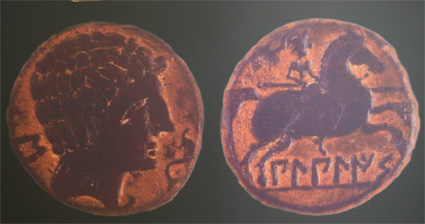
Celtiberian coins from Bilbilis with the Celtiberian horseman adn the name of the city written in Celtiberian signarium, picture from one of the panels in the Museum of Calatayud. (Photo: Roberto Lérida Lafarga 16/03/2008)
|
|
|
|
|
|
During the Roman civil wars the city was conquered by Quintus Sertorius in the year 77 b. C., although soon after it was reconquered by Quintus Caecilius Metellus. In the next Roman civil war, due to the fact that a part of the new no-Celtiberian citizens established in Bilbilis were Italics, they offered its support to the Caesar’s party; this is demonstrated by the fact that the city took the nickname of Italica: Bilbilis Italica. Under the emperor Augustus Bilbilis received a new denomination and the status of municipium, so it changed its nickname to Augusta: Bilbilis Augusta; quite probably this fact took place as reward for its loyalty to the Caesar’s party, and due to the fact that it was a city with Roman laws and Italic colonist. Anyway, Bilbilis was inscribed into the administrative subdivision of the conventus iuridicus Caesaraugustanus. The presence of Romans in Hispania and in the Ebro valley is the responsible fo our culture and our way of life, in short, of such basic aspects as the language, the administrative organization, the cities, the roads and the bridges, the laws, the irrigation lands, the property registers, etc. Within this process that is the Romanization and among the whole of Roman townships, Bilbilis was a minor urban centre, but essential to the administrative and urban net that the Romans made in the Ebro valley together with cities like Osca (Huesca) and Turiaso (Tarazona). |
||
|
|
|
|
|
Bilbilis was a local centre with a rich political, administrative, economical and social life, especially since the age of Augustus. Bilbilis Augusta was a very representative municipium for its antiquity and its history; in a short time it reached considerable urban transformations and it suffered an excessive development according to its capacity of economical development. In the Roman age, concretely, since the age of Augustus, Bilbilis suffered a deep and ambitious structural modification, becoming an example of local nucleus and reliable exponent of the Roman administrative mentality. Logically, this new plan of urban reform responded to the schemes that were applied around the Roman Empire in the same age, but adapted to the characteristics of the sitting. So, the period of splendour of the city of Bilbilis coincided with the dynasty Julio-Claudia in the I century a. C., especially, with the emperor Tiberius, when there were finished projects like the thermae, the nymphaea, the fountains, and when the forum was finished. Some products of this period manufactured along all the Empire have been found in Bilbilis: dishes from Italy and Gaul, glasses, chandeliers, marbres from Chemtou (Tunisia), Teos and Ayon (Turkey), Luni-Carrara (Italy), Chios (Greece), etc, and at the same time the near quarries were exploited to supply the large quantity of stone needed to build the big public buildings of Bilbilis. This period of prosperity coincided with the economical development of the zone and with the initial economical effort of the city, in large measure thanks to the evergetism –generosity and patronage- of the elites and magistrates of the city. |
|
|
|
|
|
|
|
The extension of the ius Latii –Latin law- to all the Hispanics by the next dynasty, the Flavian, and the period of peace that was inaugurated after the troubled year 68-69 a. C. with four emperors supposed a new stage in the Hispanic cities and a second moment of splendour of Bilbilis with a large trade and economical activity until a prosperity in the age of the Antoninian emperors. Under Trajan new and important works were undertaken in the forum, the thermae, which were enlarged, and in many domus, which were reformed. Anyway, during this II century a. C. Bilbilis kept some economical activity, but there were fewer importations of materials and the city did not increase any more, new buildings were not built any more; this fact clearly means that, although there was an attempt of revitalization and recovering of the declined cities, however, they could not reactivate their economy nor they had a new urban increase; on the contrary, these cities deepened in the reasons that had led to the first period of crisis so that the decline became finally insuperable and it was permanent since the middle II century a. C. So, since the III century a. C. the gradual and definitive decline of Bilbilis was unavoidable and unstoppable yet; some scholars think that at the end of the III century the city was almost completely abandoned and its inhabitants had emigrated to some villas and farmer exploitations in this region or to the main city of its conventus iuridicus, Caesar Augusta. It is sure that since this century all the aspects of the city remained weak and the austerity was prevailing over all the spheres; so, the trade and economical activity was decreasing, new buildings were not built nor the ancient buildings were repaired, the thermae became stores and houses, the cisterns were filled right up and fell intro disuse, the theatre left to be used and its structure in divided to new uses, some streets and road started to be impassable. Nevertheless, the city was not dead, it only languished; it lost its importance as inhabited nucleus and its inhabitants lost its quality of life. Logically all these things supposed that large sectors of the city were abandoned –the houses on the Bambola hill- and they were regrouped in other part of the city –on the Santa Barbara hill, near the monumental buildings-; in this relocation a large number of people moved to rural villas, farmer exploitations safer, more inhabited and with sure job. At the end of the IV century Bilbilis, like Turiaso, should be a semi-deserted city, according to the information that Paulinus of Nola and Ausonius transmitted us in their letters; until the arrival of the Muslims in the VIII century it seems that there was still a residual nucleus of population in Bilbilis, but the construction of the Qal’at Ayyud, i. e., Ayud Castle, the original nucleus and location of the modern city of Calatayud -6 km far away from Bilbilis- supposed the almost definitive abandonment of Bilbilis and, at the same time, a terrain propitious to the sacking of building material. |
||
|
|
|
|
|
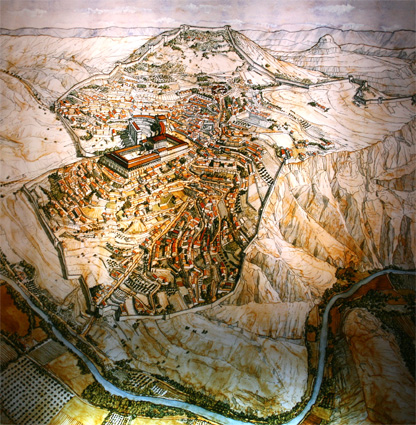
The urban site for the moment excavated in Bilbilis offers as big structures and buildings a forum and a theatre; that is completed by public thermae, a temple in Ionic order, rich and modest houses, a nymphaeum –a decorative public fountain- and an important net of cisterns and canalizations for a system of supply and distribution of water in the city. In this sense we must say that up till now Bilbilis, with its more than 60 discovered cisterns –probably there were more-, is the city of the Roman Empire that had more cisterns according to its size and proportion; we must consider this fact as normal, because the city is on a hill and the river flows on the foot of the hill, so that it could not be supplied from the river, while the orography in the zone made non-viable the construction of an aqueduct to supply water to the city. So, the cisterns to store rain water or water from torrents were the best method of storing and supplying the esteemed liquid. Finally, the city of Bilbilis was surrounded by a wall with square towers and irregular sections adapted to the terrain; this wall was made with block of local stone with an irregular size; due to the age of building and the characteristics of the location of Bilbilis, its walls had a propagandistic more than a mere defensive value. |
||
|
|
|
|
|
One of the building problems that had Bilbilis was the orography; the hill and the hillsides were not, a priori, a place very adequate to construct a city. However, thanks to the knowledge of the Roman engineers and architects the problem was pragmatically resolved. The public and private buildings are supported by terraces that cut in a series of steps the terrain. The communications and the public roads were resolved with steep streets, outside staircases or ramps there where it was necessary. So, Bilbilis was not planned as the typical Roman cities from a system of streets perpendicular and parallel to two main axes (the cardo –from north to south- and the decumanus –from east to west-), but it has a picturesque structure and planning. Nevertheless, all the elements of a Roman city were present at the city: cleverly distributed spaces, public services like the supply of water and the sewers, walls, public squares, fountains, public and private buildings, thermae and theatre. No doubt, Bilbilis, a mix of indigenous –the setting- and Roman –the planning and the urban development- characteristics, was developed as a city that reflected the spirit of its citizens anxious for being Romans. |
||
|
|
|
|
|
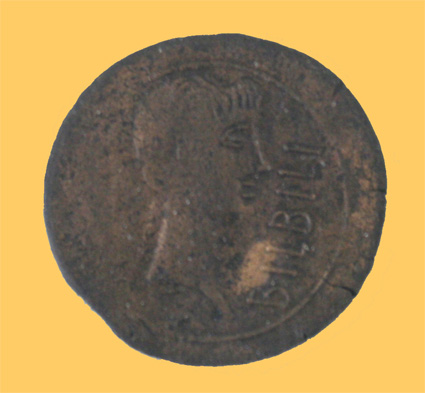
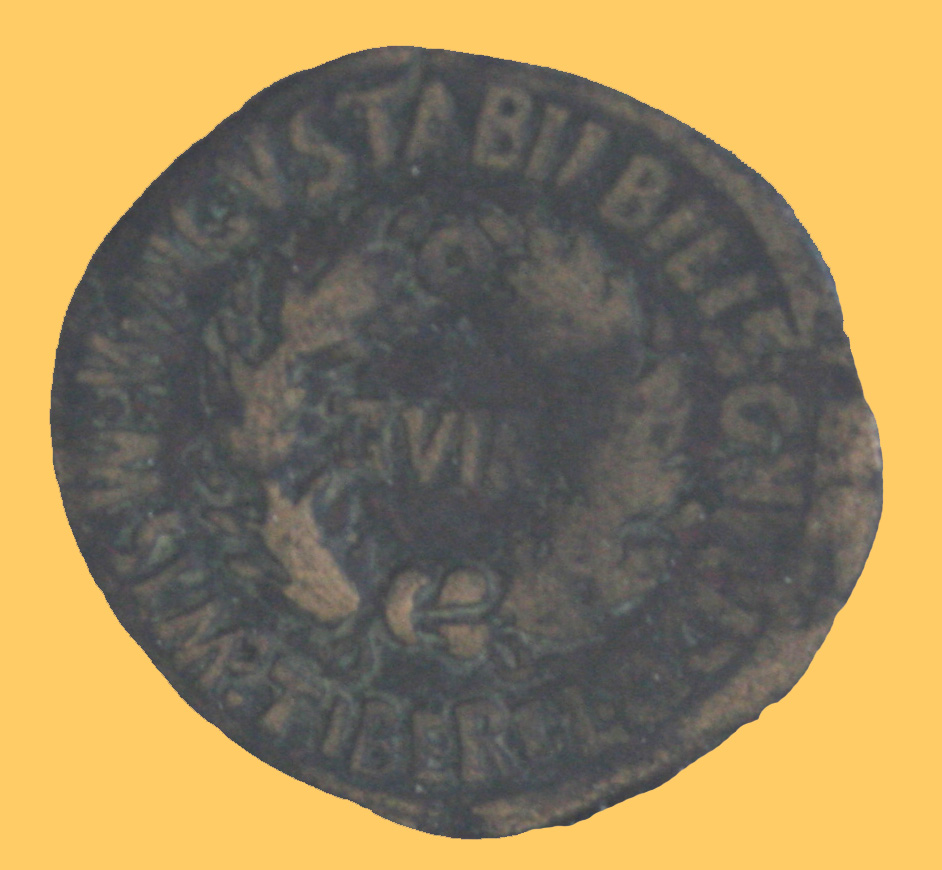
We must say that Bilbilis minted its own coins under the emperors Augustus, Tiberius and Caligula; the goal of this minting was to introduce, promote and show the category of this Roman municipium; at the same time the minting demonstrated the eminently economical character of this sitting as centre supplier in this zone. The new coins of the Roman Bilbilis, ases and semises, were diffused around all the Empire; as features they showed on the back the civic crown or laurea –so called because it was a crown made of laurel leaves- with the name of municipal magistrates to demonstrate its new condition of Roman municipium and subsidize the costs of the civic dignitaries’ politic. In the Celtiberian period the coins of Bilbilis were minted with the typical Celtiberian horseman; in an intermediate period, when the Celtiberian Bilbilis received Italic population that settled there –emeritus soldiers-, it minted coins with the legend Bilbilis Italica. |
|
Coins form Bilbilis dated in the Roman age; on the left. coin probably with the bust of an emperor, and on the right coin with the laurea. Museum of Calatayud. (Photos: Roberto Lérida Lafarga 16/03/2008) |
|
|
|
|
|
|
|
Sources: - MARTÍN BUENO, Manuel y SÁENZ PRECIADO, Juan Carlos: Bilbilis, Calatayud, Zaragoza, 2005 - MARTÍN BUENO, Manuel y MAGALLÓN BOTAYA, M.ª Ángeles: Cuaderno de campo Grupo URBS: Bilbilis y Labitolosa, Zaragoza, 2006 |