BILBILIS AUGUSTA: FORUM

|
|
BILBILIS AUGUSTA: FORUM |
|
|
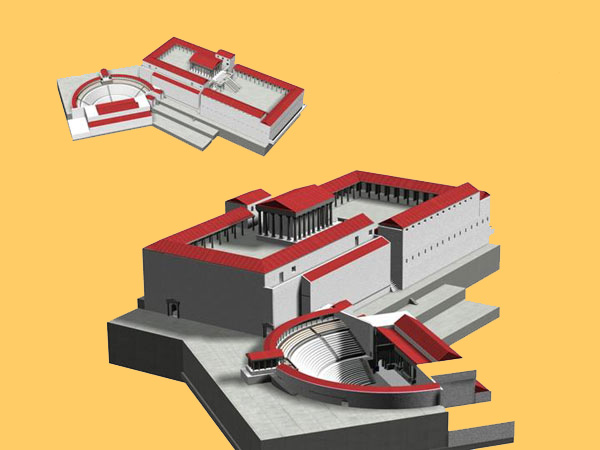
The Roman city of Bilbilis, or more concretely its civic, religious, monumental and administrative centre, was planned as a whole in the age of the emperor Augustus. It is composed by a forum with square, a temple in it, dominating the square, because it was elevated 6 metres high on the forum with an outside staircase, with two porches with the shape of the Greek letter pi (π), one of them in front of the temple and the other one in the back side of the forum. Probably, according to a large base found at the end of the square, there could be a curia, a building to the local magistrates. |
|
Reconstruction of the forum and the theatre of Bilbilis, from MARTÍN BUENO, Manuel y SÁENZ PRECIADO, Juan Carlos: Bilbilis, Calatayud, Zaragoza, 2005 |
|
The temple, probable hexastylum –with six columns in the façade-, peripterum –surrounded by columns- and sine posticum –without wicket gate- were about 12 metres high, it had a whitish colours, because it was made of limestone and gypsum, and at the same time it was recovered with marble from Luni-Carrara (Italy). The temple was built in the age of the emperors Augustus and Tiberius and it was remodelled in the age of Trajan. The communication between the forum and the temple was a outside staircase that overcame the lower porch of the square. In the eastern side of the forum there was the basilica, erected with cryptoportici –covered porches- over a high base; it had three naves or two naves and a continuous porch that was the façade in the side that looked out on the forum. One part of the forum was occupied by tabernae –shops- and by some passageway it was possible to access to the theatre from the forum. |
|
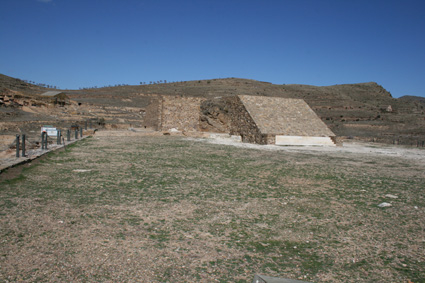
Reconstruction of the platform and outside staircase to access to the temple from the forum. (Photo: Roberto Lérida Lafarga 16/03/2008) |
|
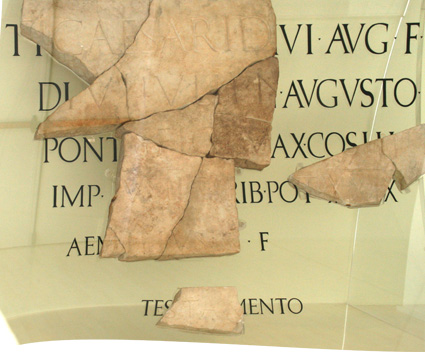
Due to the discovery of the bases of some statues, two busts of the emperor Tiberius and one bust that probably belonged to his mother and Augustus’ wife, Livia, in the city, and due to one inscription that alludes to the construction of the forum and its finishing financed by L. Aemilius, a rich Bilbilitan, the scholars think that in the forum there were statues of the imperial family. In the forum seems to be located the mint of Bilbilis -the workshop where the coins were minted-, because there have been found planchets –metal pieces not minted yet- in one of the sides of the forum. The Latin text of the inscription of L. Aemilius says: TI(BERIO) CAESARI DIVI AUG(USTI) F(ILIO) DIVI IULI N(EPOTI) AUGUSTO PONTIFICI MAX(IMO) CO(N)S(ULI) III IMP(ERATORI) VIIII TRIB(UNICIA) POT(ESTATI) XXIX L(UCIUS) AEMILIUS C(AII) F(ILIUS) TESTAMENTO; its translation is: "(Dedicated) to Tiberius Caesar Augustus, the divine Augustus' son, the divine Iulius (Caesar)'s grandson, Highest Pontiff, Consul three times, emperor eight times, with the Power of a Tribunus twenty nine times. Lucius Aemilius, Caius' son, (did it) according to his testament". |
|
Inscription of L. Aemilius. Museum of Calatayud (Photo: Roberto Lérida Lafarga 16/03/2008) |
|
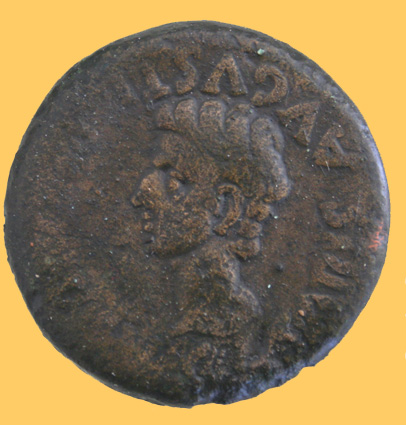
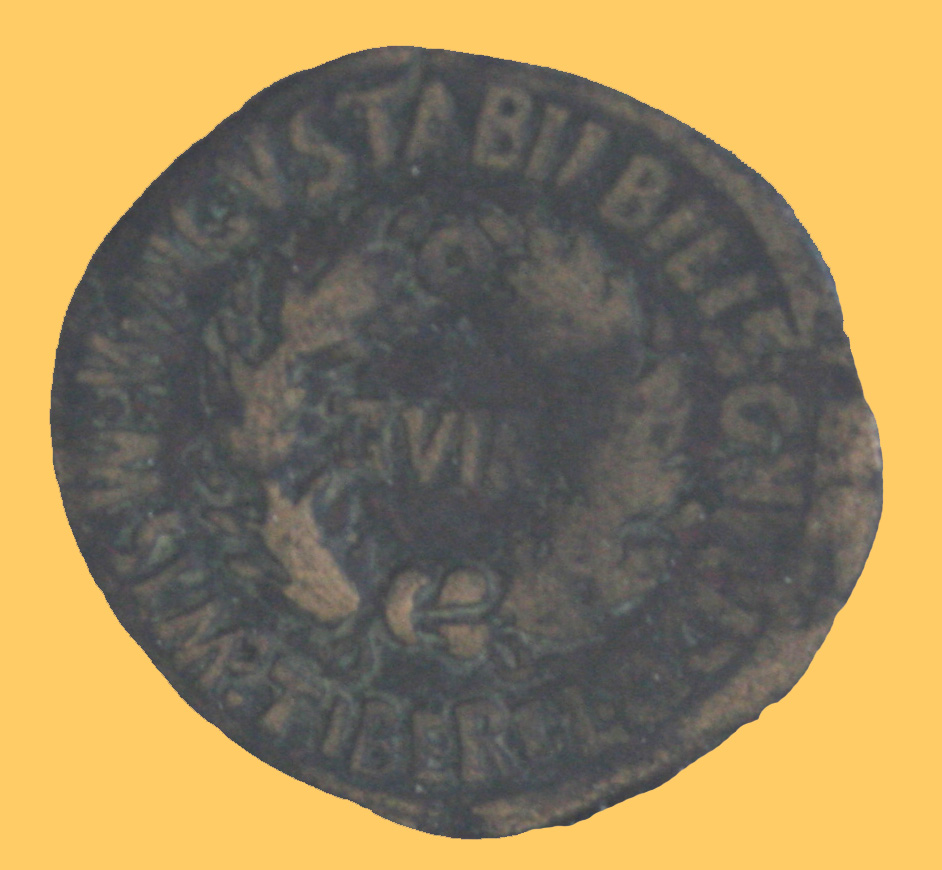
We must say that Bilbilis minted its own coins under the emperors Augustus, Tiberius and Caligula; the goal of this minting was to introduce, promote and show the category of this Roman municipium; at the same time the minting demonstrated the eminently economical character of this sitting as centre supplier in this zone. The new coins of the Roman Bilbilis were diffused around all the Empire; as features they showed on the back the civic crown with the name of municipal magistrates to demonstrate its new condition of Roman municipium and subsidize the costs of the civic dignitaries’ politic. In the Celtiberian period the coins of Bilbilis were minted with the typical Celtiberian horseman; in an intermediate period, when the Celtiberian Bilbilis received Italic population that settled there –emeritus soldiers-, it minted coins with the legend Bilbilis Italica. |
|
Coins of Bilbilis from the Roman age; on the left coin with bust, probably of the emperor Augustus or Tiberius; on the right, coin with laurea. Museum de Calatayud. (Photos: Roberto Lérida Lafarga 16/03/2008) |
|
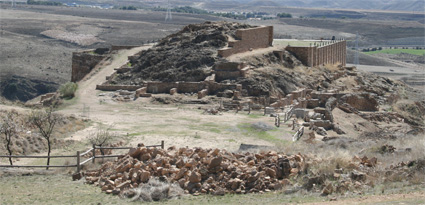
The forum of Bilbilis was built demolishing a zone of houses and probably some monuments from the age of Iulius Caesar, according to the discoveries of structures, materials and remains of pictures. The forum was started in age of Augustus and was partially finished in the age of his successor, Tiberius. The amplification of the porches and the reconstruction of the temple are dated in the age of Trajan. |
|
View of the forum from the thermae. (Photo: Roberto Lérida Lafarga 16/03/2008) |
|
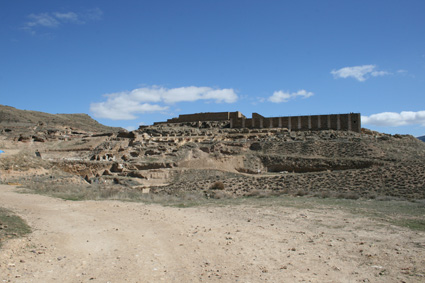
The large space, the neuralgic centre of the municipium, was also used to the concentration and the reunion of citizens, to trade transactions and to know the political life of the city. To this we must add that the location of the forum demonstrates a propaganda function, in fact, it was visible from afar, because they wanted to introduce their city to those who went across the via Augusta Emerita that connected Tarraco (now Tarragona) and Caesar Augusta (Zaragoza) with Emerita Augusta (nowadays Merida, Badajoz). The forum of Bilbilis is the result of a careful planning of its implantation on the terrain, its size, its wealth and its distribution of its elements; all theses things supported by the local elites. So, the city bought sumptuous marbles to its decoration and filled the forum with decorative statues, giving a big monumentality to this forum. |
|
View of the archaological site of Bilbilis, where the forum stands up. (Photo: Roberto Lérida Lafarga 16/03/2008) |
|
So, the forum of Bilbilis saw on the Roma style and in a minor size the development of the political, economical and social life of this municipium, where an autochthonous population was mixed with Italic immigrants and where all a ephemeral wealth was moulded in its monumentality. |
||
|
|
|
Sources: - MARTÍN BUENO, Manuel y SÁENZ PRECIADO, Juan Carlos: Bilbilis, Calatayud, Zaragoza, 2005 - MARTÍN BUENO, Manuel y MAGALLÓN BOTAYA, M.ª Ángeles: Cuaderno de campo Grupo URBS: Bilbilis y Labitolosa, Zaragoza, 2006 |