WALLS OF CAESARAUGUSTA

|
|
WALLS OF CAESARAUGUSTA |
|
|
From its foundation Caesar Augusta had a wall that delimited the perimeter of the city. The existence of this walls responded to a foundational rite, to the presence of soldiers and veterans of the civil Roman wars in Hispania as origin of the population, and to the organization of the city like a camp with hypodamic design, i. e., a city planning with perpendicular and parallel streets. |
||
|
|
|
|
|
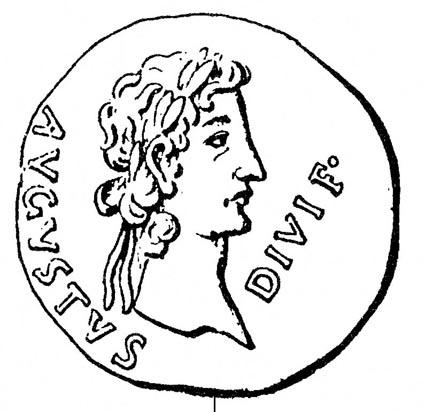
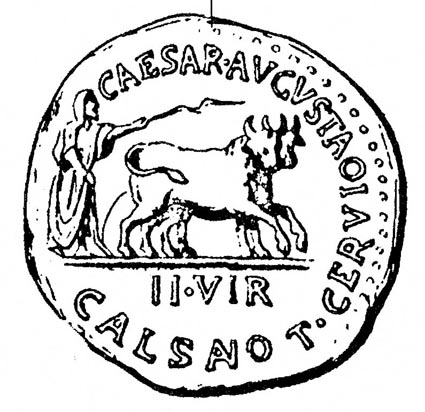
The way of the foundation received the name of deduction, i. e., etymologically “to bring something from a place to other), in the practice, “to transplant a piece of Rome to a new ground”. For an effective deductio it was necessary “to found a new Rome”, i. e., to follow the foundational ceremony –originally Etruscan- that Romulus used in the foundation of Rome: a priest yoked a couple of oxen and then drew the perimeter of the city and its walls with a ritual plough with bronze ploughshare, breaking in that way the ground of the Mother Earth; so the city’s enclosure became consecrated, protected by the Roman gods and in its interior nobody could be killed, any body could be buried, any troop could be entered, etc. In the drawing of the perimeter, the priest raised up the plough from the ground only four times, in the four cardinal points, where the four gates to access to the city were respectively placed. This ritual foundation was reflected in coins minted in Caesar Augusta. |
|
Coins of Caesar Augusta with Augustus' face and with the foundational rite of the town, according to DELGADO, A., Nuevo método de clasificación de las medallas autónomas de España, Sevilla, 1871-1876. (Photo from BELTRÁN LLORIS, Miguel y FATÁS CABEZA, Guillermo: Historia de Zaragoza 2: César Augusta, ciudad romana, Zaragoza, 1998) |
|
|
|
|
|
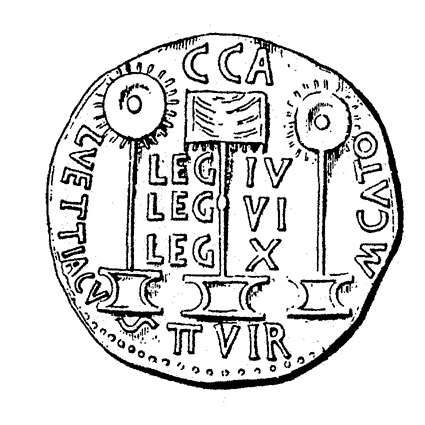
On the other hand, the foundation of new cities responded too to economical, social, expansionist and military reasons. Every year thousands of soldiers from the Roman army were licensed. They had to be paid from the public found with big quantities of money. The foundation of new cities resolved this question, because, instead of the soldiers were paid by cash, they received lots of lands, becoming new landowner in the new cities; so, the romanization, the latinization and the acculturation of the provinces were extended and the loyalty of the new territories added to Rome was guarantied. A prove of this is too the minting of coins of the Colonia Caesar Augusta, where the emblems and the names of these first Caesaraugustan licensed appeared, proceeding from the legions IV Macedonica, VI Victrix and X Gemina (cf. web about legions). |
|
Dupodius from the Tiberian age (31-32 d. C.) with the badges and the quotation of the legions whose the veterans founded Caesar Augusta, according to DELGADO, A., Nuevo método de clasificación de las medallas autónomas de España, Sevilla, 1871-1876. (Photo from BELTRÁN LLORIS, Miguel y FATÁS CABEZA, Guillermo: Historia de Zaragoza 2: César Augusta, ciudad romana, Zaragoza, 1998) |
|
|
|
|
|
The status of the city and its citizens can be considered from the text of Strabo, Geography III 2, 15, who said that ca. the years 17-18 a. C. the city was considered as a mixed city completely romanized where lived together natives subjected to the Latin or Roman law (Iberians and Celts) with predominantly Italic ex-legionaries. |
||
|
|
|
|
|
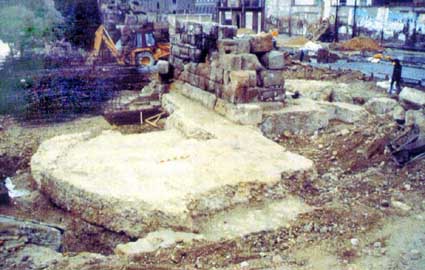
On the building of the walls we can say that it is adapted to the land gaps of the city, according to the remains appeared in the north-eastern zone. The technique of its building is uniform in this age: in the centre opus caementicium, i. e., concrete made with water, sand and small rolling stones (in some parts its thickness amount to 4 meters); on the outside the builders used big blocks of stone in order to give strength to the walls; in some zones the wall was strengthened with a round turret, like in the zone near the Torreón of the Zuda, where the basis reached almost 11 meters of diameter with a big unevenness. The construction of the wall started yet under Octavius Augustus and, certainly at the end of the I century b. C. should be already finished, meaning an evident and manifest prove of the level and prestige of the colony. From this early age the tower in the 154-156 Echegaray Road, the decumanian western gate, the remains in the 7 and 13 Coso Road and the area next the Torreón of the Zuda. |
|
Basamento de cubo de la muralla junto al Mercado Central (Foto procedente de BELTRÁN LLORIS, Miguel y FATÁS CABEZA, Guillermo: Historia de Zaragoza 2: César Augusta, ciudad romana, Zaragoza, 1998) |
|
|
|
|
|
This wall, powerful and marked out by towers, delimited a rectangle with 895 x 513 meters with an almost right angle in the north-western corner; the orography of the land and the Ebro River could not allow that the city had had a perfect rectangular shape; so, the south-east corner has a circular shape in order to be adapted to the ground levels and to the unstable lands near the Huerva River. |
||
|
|
|
|
|
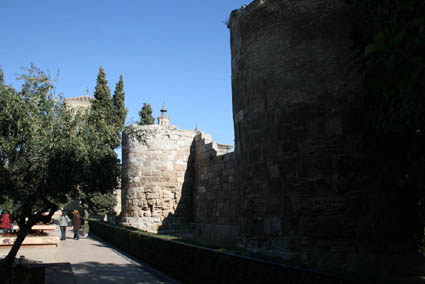
Nevertheless, along through the history the wall was submitted to several repairs and maintenance works. In the II century a. C., under the Antoninian dynasty, the wall was completely finished and we have two sections well preserved: the first one, in the north-western area, near the Saint John of the Panetes’ Church, between the road and the square called Cesar Augusto; the second one, in the north-eastern area, in the Saint Sepulchre Convent, in its back side in the corner of Coso Road and Echegaray Road. The north-western section of the wall preserves about 80 meters of the walls with three towers well preserved and the remains of a fourth; the towers have about 8,30 meters of diameter, 2, 28 meters of unevenness and a distance between them of 14 meters; the same disposition we can see in the walls of Asturica Augusta (nowadays Astorga) and Regio VII Gemina (León). |
|
(foto: Roberto Lérida Lafarga 1/11/2007) |
|
|
|
|
|
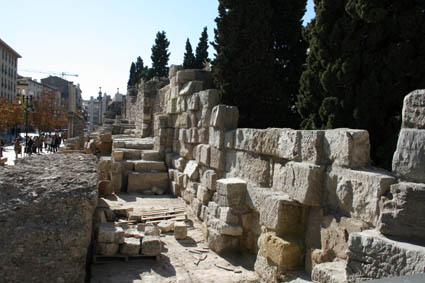
Big blocks of stone were added to the opus caementicium under Octavius Augustus, but in the II century –or probably some time before- there was a halfway space –about 3,20 meters width- refilled with smaller blocks of stone, disarranged and mixed with capitals and tambours from columns and other building materials; we can find the same space in the walls of Barcino (nowadays Barcelona) with 4,50 meters width, and Legio VII Gemina (León) with 5,27 meters width. It is a proved fact that materials from the wall and from other buildings were used during the II century to strengthen the wall. |
|
(foto: Roberto Lérida Lafarga 1/11/2007) |
|
|
|
|
|
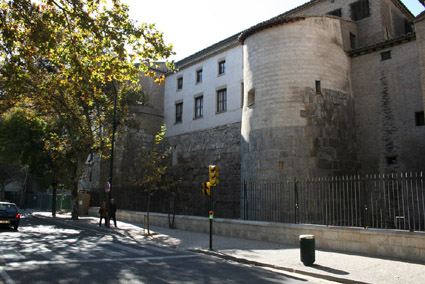
In the north-eastern section of the wall two towers are preserved with 7,40 meters of diameter and a distance between them of 13 meters; this section of the wall was erected on a level of fluvial clays; its construction is different from the north-western section, because here there are two rows of blocks of stone stuck out from the wall. The wall’s thickness and the neighbourhood of the defensive towers responded to the will of created an effective dissuasion when the possible enemies would see the wall and its hardness against battering rams, drop hammers and other artillery projectiles; this wall hardness is similar to the hardness in other places through the empire, especially in the later Roman age. The wall had four gates to come into the city: the two cardinal gates (placed at the both extremes of the cardo, the main road from the north to the south) and the two decumanian gates (placed at the both extremes of the decumanus, the main road from the east to the west). From the cardinals, the north gate, also known as Angel Gate, should be place in front of the bridg-aquaeduct that was erected where nowadays the Stone Bridge is, while the south gate, called Cinegia Gate or Arch Cinegio Gate, should be placed in the nowadays Spain Square; on the other hand, from the decumanian, the eastern gate, called Valencia Gate, should be placed in the lower Coso Road, while the western gate, called Toledo Gate, should be placed in the area near the nowadays Central Market. |
|
(foto: Roberto Lérida Lafarga 1/11/2007) |
|
|
|
|
|
About 1460 it is well known that there was a wall section with eleven towers that disappeared with the Toledo Gate. Also it is well known that there were remains of the wall in the ground floor of the Palace of the Earls Morata (nowadays the Provincial High Court) and its neighbour houses; under the north-western tower of the Pilar Basilica were found too remains of the wall; and there exists small sections from the south wall in the 75-79 Coso Road (segments from towers in a distance of 13,12 meters), in the 99-101 Coso Road, in the corner of Coso Road with Saint George Street and in the Main Theatre (a tower with 7 meters of arch). |
||
|
|
|
|
|
|
|
Fuentes: - BELTRÁN LLORIS, Miguel y FATÁS CABEZA, Guillermo: Historia de Zaragoza 2: César Augusta, ciudad romana, Zaragoza, 1998 |