VILLAE

|
|
VILLAE |
|
|
A city so organized as Rome was became heterogeneous and chaotic; so, the most exquisite citizens included some emperor, went out of Rome and built their residences in the land; these residences were called villae. The villae were a new version of the traditional country house that the Romans had as houses in the fields where they lived and they had their livestock, their granaries, their wine presses and their oil presses, etc. That is why since ancient time the villae had to well differentiated parts: the villa rustica, i. e., the part where the slaves and the servants lived and where the agricultural and cattle buildings and rooms were; they looked after the agricultural and cattle works; and the villa urbana, i. e., the part where the owner and his family –and his guests, of course- lived. We can see this division in its construction too, because the villa rustica obeyed to principles of functionality according to the requirements of the agricultural and cattle practice, while the villa urbana were built in the style of the aristocratic domus in Rome, and, if the owner’s wealth allowed it, they were built with all kind of luxuries, becoming even authentic palaces. |
||
|
|
|
|
|
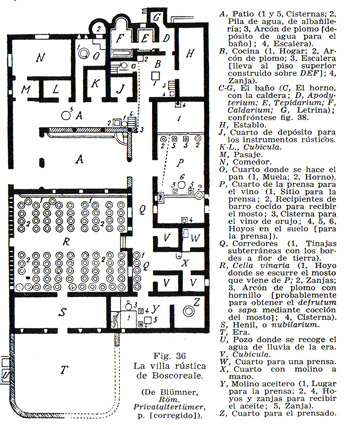
A typical villa rustica had two yards or court –cortes-, one interior and other exterior; every one of them had a drinking trough or basin –piscina- where the animals watered or where the servants do especial works, like the leather treatment; around the first court there were rooms to the servants and the slaves with their bedrooms –cellae familiars-, with the kitchen –culina- where they did some works with the food; here there were the latrines, the wine cellar and pantry, the cowshed to oxen –bubilia- and to horses –equilia-; if there was a henhouse, it was here; far from the kitchen and the water there were the rooms that needed a dry place: granaries –granaria-, raised granaries –horrea- and rooms to preserved fruit –oporothecae-; the stores of combustible materials used to be in especial buildings apart –villa fructuaria-, separately from the villa rustica. This villa rustica used to be near the threshing floor where some big huts allowed to store away the wagons –plaustra- or to store temporally grain in case of raining –nubiliarium-. In several villa rustica there was an ergastulum, a jail to slaves who were condemned to make the hardest works, and a valetudinarium, a room to ill slaves.
|
|
Plan of the villa rustica in Boscoreale, near Pompeii (Italia). Plan from PAOLI, Ugo Enrico: URBS. La vida en la Roma Antigua, Barcelona, 1990 |
|
|
|
|
|
The villa urbana used to have overlooking the sea or the fields; they were comfortable buildings, well aired in summer and warm in winter. The rooms in these villae urbanae could be built in separate buildings connected by covered corridors –cryptoportici-. The most important parts of the most sumptuous villae were the dinner rooms –triclinia o cenationes-, different in summer and in winter and with views to the landscape through big windows; the bedrooms –cubicula-, not only to the night, but to study or have a rest in the afternoon; study rooms –bibliotheca-; baths –thermae o balnearia- built in the style of the Roman public baths, with all their rooms –apodyterium, frigidarium, tepidarium and caldarium- and sometimes with a pool to swim in the open air –natatio- and gymnasium –gymnasium sphaeristerium-; there were porches to have a walk if there was no good weather –ambulationes-, even to ride horses –gestationes- wider and longer; finally, in some villae there were racetracks –hippodromi-, i. e., poplar groves or fields used exclusively to ride.
|
|
|
|
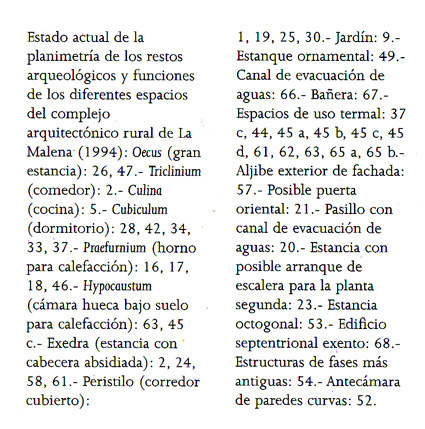
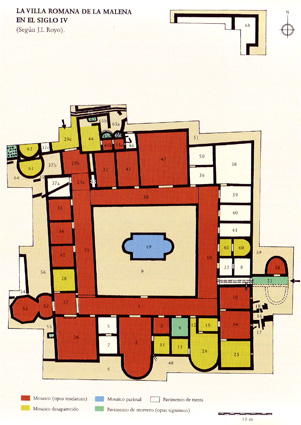
Plan of the Villa de la Malena (Azuara, Zaragoza), according to ROYO GUILLÉN, José Ignacio: La Malena (Azuara, Zaragoza). Precedentes y evolución de una villa tardorromana en el valle medio del Ebro, Azuara, 2003 |
||
|
|
|
|
|
A villa was always surrounded by land: in general kitchen gardens and orchards –horti rustici-, but by the so called xystus, i. e., small woods –nemora- mixed with garden filled of exotic and luxury plants, pines, fences, plane trees, etc.; there were poplar groves and roads flanked by trees where the owners, their families and their guests could have a pleasant walk. The number of villae increased considerable in the imperial age; this fact was usually connected to the large estates, the important landowners and the gathering of lands by an only landowner. Nevertheless, in some parts of the Roman empire the settlements of population were not very numerous and a traditional way of social grouping were the villae –in Spanish the Latin word villae became the word to designate small settlements or small villages-. In Aragon, in the Roman age, the population was organized in villae and scattered settlements; that is why there are not too many remains of cities, but there are a lot of remains from villae: Villa Fortunatus in Fraga (Huesca), Villa de la Malena in Azuara (Zaragoza), etc. |
||
|
|
|
|
|
|
|
SOURCES: - AA. VV.: Museo de Zaragoza. Guía, Zaragoza, 2003 - CARCOPINO, Jerôme: La vida cotidiana en Roma en el apogeo del Imperio, Madrid, 1993 - CONNOLLY, Peter y DODGE, Hazel: La Ciudad Antigua. La vida en la Atenas y Roma clásicas, Madrid, 1998 - PAOLI, Ugo Enrico: URBS. La vida en la Roma Antigua, Barcelona, 1990 |