THE TRIUMPH

|
|
THE TRIUMPH |
|
|
Under determinate circumstances, the Roman generals and emperors could celebrate triumphs, i. e., their victories against the enemies of Rome. To celebrate these triumphs it was necessary that some conditions took place: to put a stop to a war, to kill more than 50.000 enemies and to extend the frontiers of the Roman state. |
||||
|
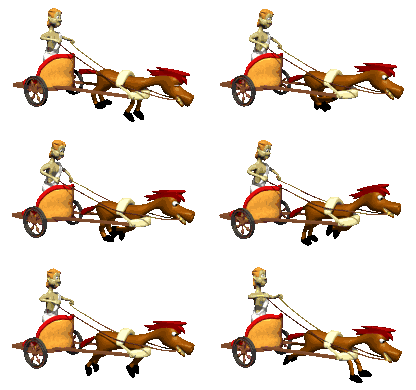
The ceremony consisted on the entrance of the victor general in Rome through the triumphal gate –porta triumphalis- and a parade up to the Capitolium; the entrance in Rome could not take place any day, but only a day established by law and by the senate; up till then, the general had to keep outside the city. We know that Iulius Caesar renounced to a military triumph because he could not wait its celebration outside the city, due to the fact that he could not have been candidate for the elections of his first consulate, if he had waited to the celebration of the triumph. The victor general entered on a golden chariot hauled by four white horses surrounded by his children, his family and his clientele. In addition, he wore the toga picta –the national Roman dress embroidered in gold- and a laurel crown on the head, while a slave held a golden crown on his head and said to the victor general hominem te esse memento, “remember that you are a man”. |
|
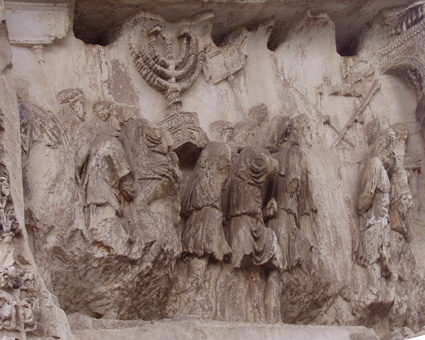
Interior of the Titus' arch, where we can see the plunder obtained in the war against the Jews and in the conquist of Jerusalem in the year 71 a. C. From right to left we can see a standard where probably was written the name of the defeated nation, the candelabrum with seven arms, symbol of the Jewish nation, the silver trumpets and the triumph gate. (Photo: Roberto Lérida Lafarga 28/12/2004) |
||
|
|
|
|
||
|
After the general a big parade marched past: the war plunder; the emblem with the names of the defeated nations and drawings of the conquered territories; famous prisoners in chains, very often with their families –they were thrown up to the Mamertina prison, near the Capitolium; lictores on chariots with fasces crowned with laurel; and victims to be sacrificed in honour of Jupiter Capitolinus. The entourage was made pleasant with the songs of the soldiers –carmina triumphalia- with jokes and praises of the victor general. |
|
|
|
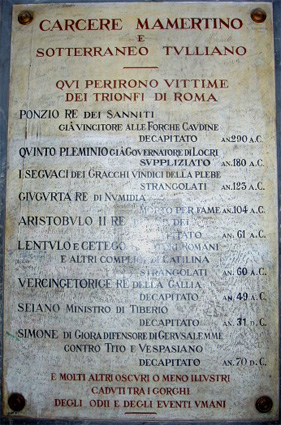
A placard still announces us where are the remains of the Mamertina and the Tullianus prisons and some of their most famous no christian guests. We can reed between them the names of some foreing kings like Iugurtha, king of Numidia, Vercingetorix, king of the Gaul and Aristobulus II, king of Iudaea. (Photo: Roberto Lérida Lafarga 28/12/2004) |
|
In the imperial age the emperor used to add to his honorific titles the name of the nations defeated in the wars. |
||||
|
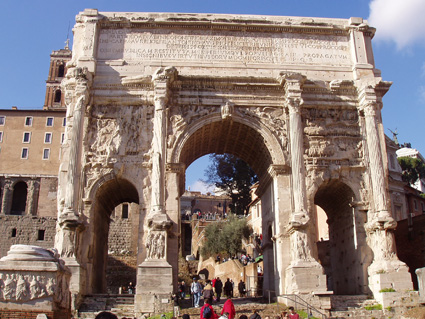
Inscription in the Septimius Severus' arch . In the first line we can see IMP. CAES. LVCIO SEPTIMIO M. FIL. SEVERO PERTICACI AUG PATRI PATRIAE PARTHICO ARABICO ET, i. e., "[Arch of triumph dedicated] to the Emperor Caesar Lucius Septimius, son of Marcus, Severus Pertinax, Augustus, Father of the de la Fahterland, Parthian Arabian and ...", where to the name of the emperor, Lucius Septimius Severus Pertinax, son of Marcus, there were added the titles of Emperor, Caesar, Augustus and Father of the de la Fahterland, and two nicknames, Parthian and Arabian , due to his victories against the Parthians and the arabians. (Photo: Roberto Lérida Lafarga 28/12/2004) |
||||
|
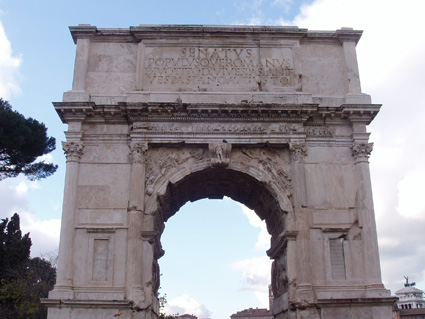
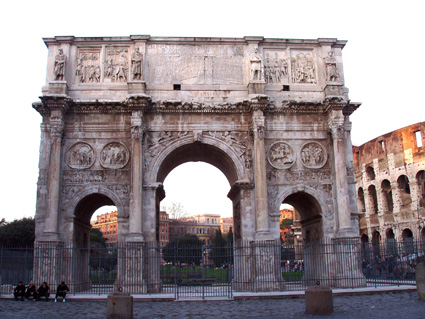
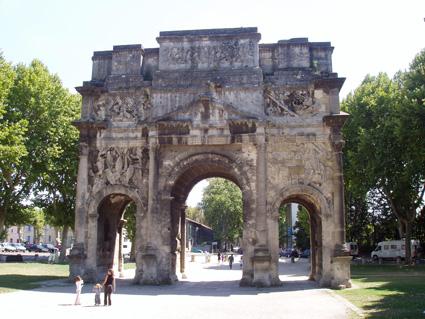
Even in this age the emperors who obtained a triumph used to erect in Rome or even in the provinces arches of triumphs to commemorate their victories. In Rome there are preserved three: the Titus’ arch in the Forum Romanum, the Constantinus’ arch, near the Coliseum, and the Septimius Severus’ arch, at the foot of the Capitolium. En Hispania two arches are preserved, in Bará (Tarragona) and in Medinaceli (Soria). In Aragón there are not remains of any arch, but we know that in the XVII century an arch existed in the site of Tarraca, according to Juan Bautista Labaña. |
||||
|
Titus' Arch, in the Forum Romanum. (Photo: Roberto Lérida Lafarga 28/12/2004) |
|
Constantinus' arch, near the Colisum. (Photo: Roberto Lérida Lafarga 28/12/2004) |
|
|
|
|
|
Septimius Severus' arch , in the Forum Romanum at the foot of the Capitolium. (Photo: Roberto Lérida Lafarga 28/12/2004) |
|
Arch in Orange (France). (Photo: Roberto Lérida Lafarga 09/08/2007) |
|
|
|
|
|
|
|
SOURCES: - GABUCCI, Ada: Roma, Barcelona, 2006 |