TOMB OF MIRALPEIX

|
|
TOMB OF MIRALPEIX |
|
|
|
|
|
|
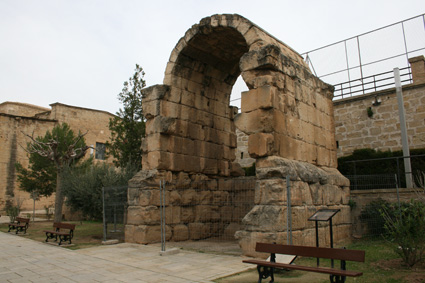
This Roman funerary monument was moved in 1962 to its current location in Caspe due to the works in the dam of Mequinenza in order not to be under the water. Its original location was an area called “Mas de los Tumberos” or “La Tumba” (“The tomb”), in a country house in the left bank of the river Ebro, in the northeast of the bridge that now crosses the river, near “Soto del Suelto”, in the neighbourhood of a village called Miralpeix. |
|
Tomb of Miralpeix in its location in Caspe. (Photo: Roberto Lérida Lafarga 01/03/2008) |
|
|
|
|
|
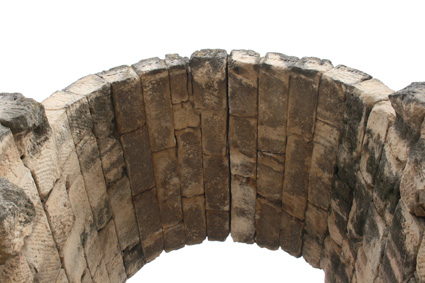
The building, in its interior, should be similar to the mausoleum of Fabara, with a cella or naos and under it a conditorium to place the remains of the dead. Three walls are preserved from the building; two of them are the buttresses of a semicircular vault with big voussoirs and they are thicker at the bottom, corresponding to the conditorium, where the blocks of stone are bigger, and the third wall reaches only the height of the conditorium. The walls are made in big blocks of sandstone exactly cut and squared that are perfectly fixed in rows without mortar –opus caementicium-, i. e., the Romans used the technique of the opus quadratum; to join them they used iron cramps. |
|
Detail of the semicircular vault with big voussoirs. (Photo: Roberto Lérida Lafarga 01/03/2008) |
|
|
|
|
|
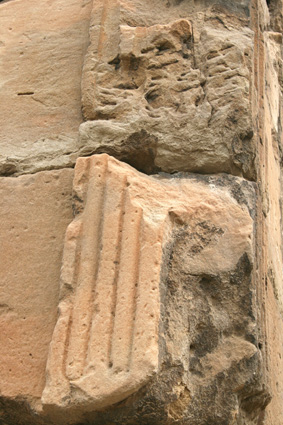
In the corners of the side façades with the main and back façades we can see columns carved in the blocks of stone, furrowed with four grooves, no exempt and crowned with Corinthian capitals with acanthus leaves, carved in the blocks of stone too. |
|
Detail of the decoration of the angular columns. (Photo: Roberto Lérida Lafarga 01/03/2008) |
|
|
|
|
|
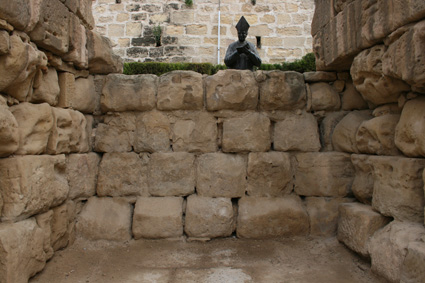
Like in the mausoleum of Fabara, in the side façades a moulding separated the plinton –corresponding to the inner conditorium- from the façade body –corresponding to the inner cella-. The mausoleum has been date in the II century a. C. according to its structure, its shape and its decoratcion, and according to the historical context. |
|
Conditorium. (Photo: Roberto Lérida Lafarga 01/03/2008) |
|
|
|
|
|
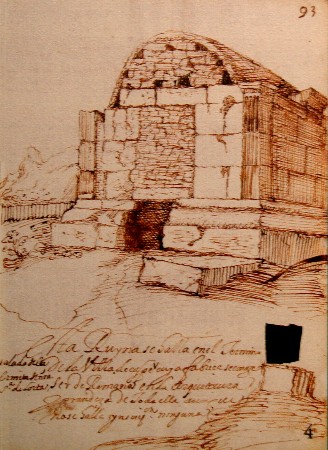
From a very close area come the scarce remains of the mausoleum of the hermitage of Saint Mary of Horta, whose location was covered by the water of the dam too; only a few rests are keeping in the Caspe town hall, although we know this by a description made by Vicencio Juan de Lastanosa (1607-1681), that saw it in the XVII century and drew it, and by another description made by Mariano Valimaña in the XIX century. Its aspect, as you can see in the drawing, was very similar to the Tomb of Miralpeix. |
|
Drawing of the Mausoleum of the hermitagee of Santa María de Horta according to Vicencio Juan de Lastanosa en el siglo XVII. |
|
|
|
|
|
|
|
FUENTES: - MELGUIZO AÍSA, Salvador: Mausoleo de Fabara, Zaragoza, 2005 |