HISTORICAL CONTEXT

|
|
HISTORICAL CONTEXT |
|
|
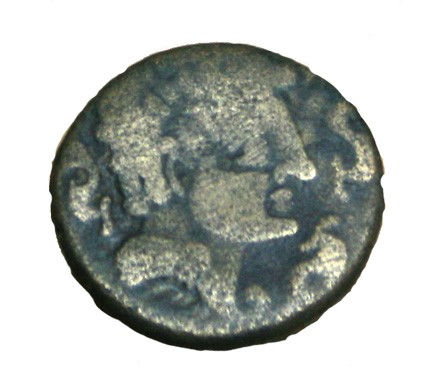
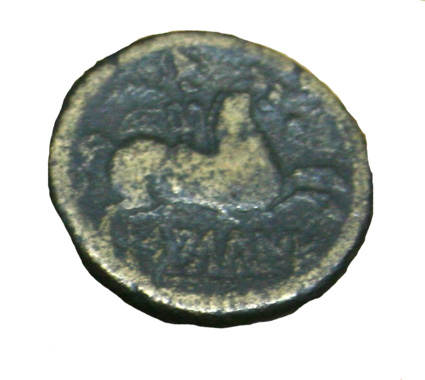
Salduie, an Iberian city Between the years 400 and 250 b. C., in the Ebro’s zone near the mouths of the rivers Huerva and Gallego, we know the existence of an Iberian city called Salduie; it belonged to the people called sedetanians, who collaborated with Rome from the year 200 b. C. Salduie received a big cultural and trade influence from Rome. On the ancient name of the city, Pliny, Natural History III 24, in the year 79 a. C., said that the Roman city Caesar Augusta stood up on the place where a native city called Salduvia had been placed before. The Roman form was identified with the name Salduba (near the current Malaga existed a Salduba in the same period), but, with the decipher of the Iberian writing, we can read that the title that appeared in the city’s coins should say S.a.l.du.i.e or S.a.l.tu.i.e; so, the original name should be Salduie. From an early period, the city must have had a cosmopolitan, multiethnic, polyglot, open and mixed-race atmosphere. Between the years 91 and 88 b. C. a civil war, called Social War (Bellum Sociale), took place between Rome and some Italic nations: the Romans did not want to give them the Roman law neither the Roman citizenship. The Romans recruited for this war non Italic (barbarian) auxiliary troops in order to reinforce their own legions. In this context, we have knowledge of the presence of some Iberian troops from the Ebro’s Valley inside these auxiliary troops, according to an official document, called Ascoli’s Bronze, a unique specimen due to its characteristics. In the Bronze a very important historical fact was mentioned: for the first time (there is not other documents that confirm a former concession) the Roman citizenship was conceded to a cavalry battalion, in this case an Iberian cavalry called Turma Salluitana, due to its inestimable help in the Roman victory during the siege of Asculum (nowadays Ascoli-Piceno, on the Adriatic coast of Italy). Although in this battalion there were only few cavalrymen from Salduie, it is logical to think that the recruitment of all the battalion were made by a Roman governor who should have Salduie as base of his operations. We have another testimony on the city in other Bronze, usually called Tabula Contrebiensis or Bronze of Contrebia Belaisca (nowadays Botorrita) and dated in the year 87 b. C. This Bronze contains a juridical dispute, the most ancient conserved in Hispania. Its motivation was a water conflict in the Ebro’s Valley, exactly a conflict on the possession of some lands between the city-estates of Alaun (nowadays Alagón) and Salduie; the latter was building works for irrigation and channels and it wanted to pass them through these disputed lands; so, Alaun and Salduie went to the arbitration from a neighbouring city, Contrebia Belaisca, in order to settle their differences in the dispute. Beyond the juridical dispute, this Bronze shows the high degree in the Iberian city-estates’ organization en the Ebro’s Valley, subject, however, to the Roman rule of going to the arbitration and the publishing of the agreements. |
|
Coins from Salduie. Museo Provincial de Zaragoza. (Photos: Roberto Lérida Lafarga 3/1/2008)
|
|
|
|
|
|
Salduie during the Roman civil wars Between the years 89 and 82 b. C., the civil conflict in Roma reached the military confrontation that reached too to the Ebro’s Valley. When Mithridates, king of the Pontus, invaded Asia Minor and killed about eighty thousand Roman and Italic soldiers, Lucius Cornelius Sulla, leader of the conservative faction, was elected to face up to this exceptional crisis, winning the elections to Caius Marius, the popular leader. In absence of Sulla, who was occupied in the campaign against Mithridates, slaughters of Marius’ and Sulla’s supporters took place in Rome. Neverthelles, Sulla, with his victory on Mithridates, obtained to be designated dictator by unlimited time. The conflicts of Rome reached the Ebro’s Valley: Quintus Sertorius, a Marius’ and populars’ supporter, entrenched himself in different cities of the valley, like Osca (Huesca), Calagurris (Calahorra) Bilbilis (Calatayud) o Ilerda (Lérida). Meanwhile, Caius Valerius Flaccus, at first supporter of the popular faction too, seemed to have been designated proconsul (i. e., a magistrate similar to a governor of a province) of the Hispania Citerior for ten years (we have news about the Valerius Flaccus’ facts en the Ebro Valley through Apianus of Alexandria and Granius Licinianus). This lasting charge was unusual in the Roman Republic and only could be explained by a political change of Valerius Flaccus and his family, from supporting the popular faction to praise to the conservative faction of the optimates and Sulla; so, whilst Sulla obtained power as dictator legibus scribundis et rei publicae constituendae (i. e., dictator with faculties to issue laws and to lead the Estate with constituent power, as a clear antecedent of the exceptional charge that later was occupied by Caius Iulius Caesar and Octavius Augustus), Valerius Flaccus would be renewed in his charge. Valerius Flaccus was a very important man for Salduie due to the fact that he should select this strategic city in the Ebro Valley as a recruitment centre, taking clientelae (bonds of dependence; through these bonds free men joined and served to a powerful Roman in order to receive protection from him) from many villages or towns; so, Valerius Flaccus should guide the political and institutional life of Salduie to such an extend that he minted own coins with his name and the condition of imperator. Soon after, Rome was immersed in other crisis that reached to the civil war due to the rivalries between the conservative Gnaeus Pompeius (known as the Great) and the popular Caius Iulius Caesar. Both stayed in the Ebro Valley and very probably they visited Salduie. The Ebro Valley became for some time the scene of the fights between these two powerful Roman citizens (cf. Caesar, Civil War ). |
|
|
|
|
|
|
|
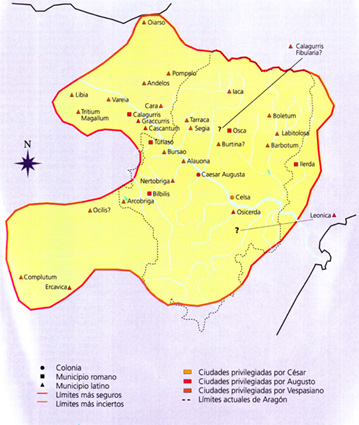
Augustus in Hispania: the foundation of the Colonia Caesar Augusta Although Octavius Augustus was not fond of travelling, he must have done two travels to Western; then he visited Hispania. During the second one, between the years 16 and 13 b. C., he reorganized Hispania, specially Hispania Citerior, algo called Province Tarraconensis; he considered it as an imperial province, subjected to the emperor’s will and, moreover, with a strong military presence with at least two legions (during the Empire provinces could belong or depend on the emperor or on the senate). During this travel, Augustus founded several cities in Hispania and in the Ebro’s Valley this activity was specially intense, conferring the Roman laws to cities as Ilerda (now Lérida), Osca (now Huesca), Calagurris (now Calahorra), Turiaso (now Tarazona) and Bilbilis (now Calatayud) and the Latin law to other cities as Graccurris (now Alfaro) and Cascantum (now Cascante). However, the case of Caesar Augusta is a bit special and strange in its denomination. Caius Iulius Caesar and Octavius Augustus as well founded at least seventy five cities that received their own names (Julia in the case of Caesar, like Juliobriga, and Augusta in the case of Octavius, like Emerita Augusta –nowadays Mérida-), but only one city received both names at a time, with a little variation, Caesar Augusta. This exceptional denomination can be explained because the city was founded during the celebration of an important event in the Augustus’ life, such as his fiftieth birthday, so the date of the foundation of the city should be the year 13 a. C. The foundation of this colony responded to its strategic position in the Ebro’s Valley and the big extension of its territory. The way of the foundation received the name of deduction, i. e., etymologically “to bring something from a place to other), in the practice, “to transplant a piece of Rome to a new ground”. For an effective deductio it was necessary “to found a new Rome”, i. e., to follow the foundational ceremony –originally Etruscan- that Romulus used in the foundation of Rome: a priest yoked a couple of oxen and then drew the perimeter of the city and its walls with a ritual plough with bronze ploughshare, breaking in that way the ground of the Mother Earth; so the city’s enclosure became consecrated, protected by the Roman gods and in its interior nobody could be killed, any body could be buried, any troop could be entered, etc. In the drawing of the perimeter, the priest raised up the plough from the ground only four times, in the four cardinal points, where the four gates to access to the city were respectively placed. This ritual foundation was reflected in coins minted in Caesar Augusta. On the other hand, the foundation of new cities responded too to economical, social, expansionist and military reasons. Every year thousands of soldiers from the Roman army were licensed. They had to be paid from the public funds with big quantities of money. The foundation of new cities resolved this question, because, instead of the soldiers were paid by cash, they received lots of lands, becoming new landowner in the new cities; so, the romanization, the latinization and the acculturation of the provinces were extended and the loyalty of the new territories added to Rome was guarantied. A prove of this is too the minting of coins of the Colonia Caesar Augusta, where the emblems and the names of these first Caesaraugustan licensed appeared, proceeding from the legions IV Macedonica, VI Victrix and X Gemina (cf. web about legions). The status of the city and its citizens can be considered from the text of Strabo, Geography III 2, 15, who said that ca. the years 17-18 a. C. the city was considered as a mixed city completely romanized where lived together natives subjected to the Latin or Roman law (Iberians and Celts) with predominantly Italic ex-legionaries. The position of Caesar Augusta, without big populations in its neighbourhood, made it to have an enormous ager (land, territory) with useful and fertile land, irrigated by several rivers and actually by works of an early channelling; The archaeologists estimated that the ager reached until Gallur o Borja in the West and until Fuentes de Ebro in the East. So, the first licensed soldiers with honours (emeriti) received lots of rural and urban land. The technician of the legion (gromatici) and the surveyors, using the topographic tool called groma, surveyed the territory into plots through the centuriatio (division into plots); it seems that the present division of ground in the neighbourhood of Zaragoza still follow this primitive survey. In the mentioned provincial reorganization made by Augustus, two western provinces, Tarraconensis and Dalmatia, were divided in conventus iuridici (juridical groups). In this case, the Tarraconensis province was divided into seven conventus with capital cities in Tarraco (nowadays Tarragona), Caesar Augusta (Zaragoza), Cathago Nova (Cartagena), Clunia (Coruña del Conde, en Burgos), Asturica Augusta (Astorga), Lucus Augusti (Lugo) and Bracara Augusta (Braga, en Portugal). The conventus iuridicus of Caesar Augusta was very vast: it reached the Pyrenees and the Bay of Biscay in the North, to Calagurris (Calahorra) in the West, to Complutum (Alcalá de Henares) in the South and to Ilerda (Lérida) in the East; Pliny, Natural History III 3, 24, informed us about this. The existence of this conventus iuridicus implied in the case of Caesar Augusta the co-existence of a double administration, municipal as Roman colony, and conventual, as capital of a Roman territorial division; this made possible the existence of two fora in the city: one local, daily and colonial forum in the present Seo Square where the trade life of the city should take place, and the other one conventual and more ceremonial forum, maybe under the present Santa Cruz Square, where the centre of the city could be placed exactly, in the crossing point of the cardo (main road from North to South) and the decumanus (the other main road from East to West) and where the juridical facts concerning to all the towns and villages that belonged to the conventus caesaraugustanus should take place. So, Caesar Augusta became centre and capital of a complex juridical, administrative, religious and economic device and meeting point of the Celtic, Iberian, old Basque and Roman cultures. The constitution of Caesar Augusta as capital of a conventus and as city with strategic, trade, etc. importance justifies the size of the colony, the existence of a wall from the foundation as a prestigious element, its careful monumental planning with channelling, water supplies and sewers from its first moment. |
|
|
|
|
|
|
|
Caesar Augusta during the Roman Empire Under the Tiberius’ empire the colony was at its very peak and Caesar Augusta took its almost definitive aspect. During the Flavian dynasty Caesar Augusta appears already as a mature city, completely functional, with a large number of trade activities that were developed and focused on its forum. The relationship of all the conventus with its capital is vouched for a miliarium (milestone in a Roman way) from the age of the Emperor Domitius, found in the way from Caesar Augusta (nowadays Zaragoza) to Bilbilis (Calatayud); in this milestone we can read that imperator … refecit pontes vias colapsas (“the emperor repaired the bridges and the collapsed ways”). Nevertheless, under the Antoninian dynasty, in the II century a. C:, the process of adjustment of the city finished, while in its territory, in its ager, a reorganization of vast properties took place. In this century the city had its definitive and characteristic aspect with a wall marked by several towers, surrounded by extra-urban houses, craft settlements and necropolis next to the ways; however, the first abandonment of some building outside the wall started to take place. During the Severian dynasty and in general during all the century III a. C., the prosperity of the Christianity in the city is notable, while some changes took place in the town planning: some terraces in the outside of the wall, near the Huerva river, the maintenance of the wall and the architectonic re-used due to the ruin of some buildings. We have to say that Aragon has always been a zone with deficit in good building stone, so that in general along the years the big blocks of stone and marbles, etc. from the Roman constructions will be used in new buildings. In the late-Roman age (248-408 a. C.), the reforms in the provincial organization made by Diocletianus, Constantinus and his successors implied that, although Caesar Augusta kept belonging to the Tarraconensis province (this province was divided into three, Gallaecia, Carthaginiensis and Tarraconensis), the conventus iuridici disappeared; so Caesar Augusta stopped being the capital of one of this administrative subdivisions. Militarily the city kept having no stationed soldiers inside its walls and in case of attacks the city should be defended by the local militia, specially by the collegia iuvenum (groups of youngs) trained by veteran soldiers. |
|
|
|
|
|
|
|
|
|
SOURCES: - FATÁS CABEZA, Guillermo y BELTRÁN LLORIS, Miguel: Historia de Zaragoza 1: Salduie, ciudad ibérica, Zaragoza, 1997 - BELTRÁN LLORIS, Miguel y FATÁS CABEZA, Guillermo: Historia de Zaragoza 2: César Augusta, ciudad romana, Zaragoza, 1998 - ESCRIBANO PAÑO, M.ª Victoria: Historia de Zaragoza 3: Zaragoza en la Antigüedad tardía (285-714), Zaragoza, 1998 |