SUPERSTITIONS AND SACRILEGES

|
|
SUPERSTITIONS AND SACRILEGES |
|
|
The superstitions, the sortileges, the religious believes have a part of irrationality and ignorance that usually involves or produces fears, defencelessness, etc., so that among the people an irrational and fearful reaction is generated in the face of something that cannot be defined by ignorance. On the other hand, uncultured and ingenuous people, especially in the fields, were the group where these irrational believes went more deeply; in general, the people cultivated and instructed in philosophy and rationality used to give few or any importance to any kind of superstitions. |
||
|
|
|
|
|
In the ancient Rome the superstitions were frequents and they were considered as a part of the relationships between men and gods, on the one hand because there was nor a dogma neither a doctrine that ruled or avoided this irrational religious and human aspect, and, on the other hand, because it was considered that the ways that the gods could use to give advices to the humans were very different. In that way, a bad meeting, a terrible dream, a word listened by accident, the pouring of oil on the ground, etc., were interpreted as presages, auguries or messages from the gods. As other nations, also the Romans were superstitious: to stumble going out across the threshold of a house was considered as a bad augury and they thought that this day it was better to keep at home and not to go out. If someone said the word fire during a banquet, they poured water on the table to avoid the bad augury. If a cock crowed during a banquet, or they stopped to eat or they made the necessary incantations to avoid the bad augury. So, the Romans, who were superstitious almost by nature and fearful of the evil eye, used to wear amulets from their childhood. They had also manias as to cut their fingernails in a working day starting by the index finger, but, if they had to sail, they did not cut the fingernails neither the hair. |
|
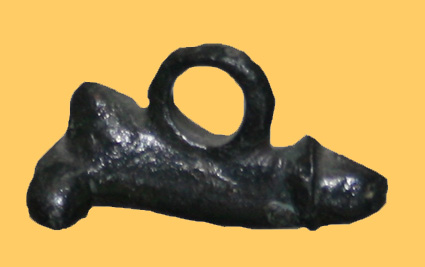
Phallic amulet (II-III century a. C.) made of bronze: with apotropaic meaning, i. e., with the supposed power for protecting those who wore. Museo Arqueológico de Tarazona. (Photo: Roberto Lérida Lafarga 21/03/2008) |
|
|
|
|
|
The magic had also a place among the Romans; if the magic was related to the love it is called sortilegi –“divination, omen”-, but, if it was related to the hate, then it was called defixiones –“curse, execration”-; like in the case of the superstitions, these practices were celebrated by the uncultured, ingenuous ignorant, irrational, fearful and credulous people, as it is showed by the language and the orthographical mistakes found in the preserved tabulae defixionis –“boards or writings of curse”-. Here, the belief that was occulted was the power to obtain that the divinities or the supernatural potencies intervened in love and hate matters. As a human element, the defixiones were thrown against any kind of enemies or rivals: judicial, familiar, trade, sportive, etc. The defixiones were written on lead plates with the name of the execrated person whom they cursed (usually accompanied by his mother’s name), with a curse formula and with a dedication of the victim to the hell deities; the plates were put in a grave, a temple or a well of a hot water spring; the text could be accompanied by magic or funeral symbols and designs; in the curse they often specified the harm that they wanted to provoke to the victim: “destroy him and smash his bones”, “drill his soul and his tongue”, “provoke horrible fevers in all his members”, etc. |
|
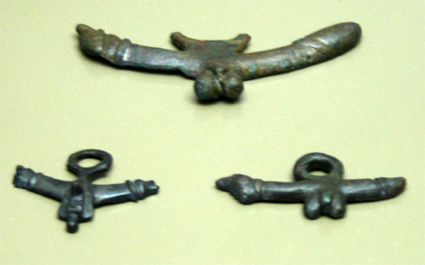
Roman amulet with phalluses and hands making a sing to avoid the evil eye -fascinum-. Museo Provincial de Zaragoza: Colonia Lepida Celsa. (Photo: Roberto Lérida Lafarga 21/06/2008) |
|
|
|
|
|
In the case of the sortileges, women, in order to attract their lover, became witches, enchanters, magicians, using terrible ingredients for their incantations: frog entrails, bird feathers, snake eggs, poisons, etc. They believed also that the astrology and the eclipses could have some influence in the success of their incantations. To make a sortilege could be complicated and even implicate horrible preparations in cemeteries, in graves, with bones of the deaths. On the other hand, as we frighten our children with the bogeyman, the Roman had the Lamia, a woman who patrolled threatening, cooking her food with children still alive, and who always carried a child into her stomach. However, this kind of believes reached also to the superstitious and fearful people in their adult lives; so, with an Etruscan origin, among the more credulous people it existed a belief in the souls of the deaths –the lemures- and in the life beyond the grave. They had also other odd believes: that some men –versipelles- could become wolves to assault the herds during the night; that some old women could become birds; that there were “sea men”, i. e., monsters in the north seas half men, half beasts; that witches and vampires tried to abduct cadavers in order to mutilate them, etc. |
||
|
|
|
|
|
|
|
SOURCES: - PAOLI, Ugo Enrico: URBS. La vida en la Roma Antigua, Barcelona, 1990 |