THE PRIESTHOODS

|
|
THE PRIESTHOODS |
|
|
In the age of the Monarchy (753-509 a. C.) the king was the chief of the national Roman religion; however, from the beginning he had a series of priests who helped him in the religious tasks. Since this period, the priests were elected among the patricians –noble families- and they were grouped in different associations –groups or brotherhoods- of priests, except the Flamines who did not formed a priest association. The Roman priests, except the Vestals, were not subjected to the vows of the celibate and they had many honorific privileges, as not to pay public taxes. The associations of priests were organized around the cult of the gods of the city (Flamines, Pontifices, Vestales, Salii and Feciales) or around the cult of the gods of the nature (Luperci and Arvales) or for the divination of the future (Augures, Haruspices and interpreters of the Sibylline Books). |
||
|
|
|
|
|
The Flamines were fifteen and they were the public priests of the Roman nation, although every one of them took charge of one divinity: there were three mayor Flamines who were consecrated to Jupiter –Flamen dialis-, to Mars –Flamen martialis- and to Quirinus –Flamen quirinalis- and twelve minor Flamines consecrated to minor divinities. The Flamen dialis was the priest with higher rank and he substituted the king in his religious tasks when he was absent; among their obligations it was the impossibility of making any kind of work, not riding a horse and not spending the night outside his residence; on the other hand, he had right to have a place in the senate, to have a lector under his command and to seat in the sella curulis –the special seat of the senators-. At the end of the Republic this priesthood almost disappeared, but it was restored by Augustus. The first association of priests was those of the Pontifices; they were three, tour or five; they received their name from the sacred bridge of the Romans, the Sublicius Bridge; this association was presided by the king and had as functions the survey of the religious practices, not only private but public; they determined also the obligations of the people with the gods –this is called pontifical law, written in the Pontifical Books-; they organized the annual ceremonies of the national cult in honour of the Capitoline Triad. The most important Pontifex was the Highest Pontifex –Pontifex Maximus- who elaborated the calendar of the fasti days –when it was licit (fas) to work, i. e., working days- and nefasti days –when it was not licit (nefas) to work, i. e., not-working days- and they kept up to date the roles of the Roman divinities –indigitamenta-. The Vestals were the only female priesthood; their number varied from tour to six and, finally, to seven; this priesthood was established even before Romulus, because his mother was a Vestal; they were elected among the young patricians without physical defects; they lived in the atrium Vestae, similar to a monastery and they were linked to their priesthood during thirty years: ten for their instruction, ten for their practice and then for teaching); they took vow of chastity and asceticism and any break of the priest rules was punished being buried alive. The head of the association was the Summa Vestal and her task was to keep burning the fire of the fireplace of the city, personified by the goddess Vesta. |
|
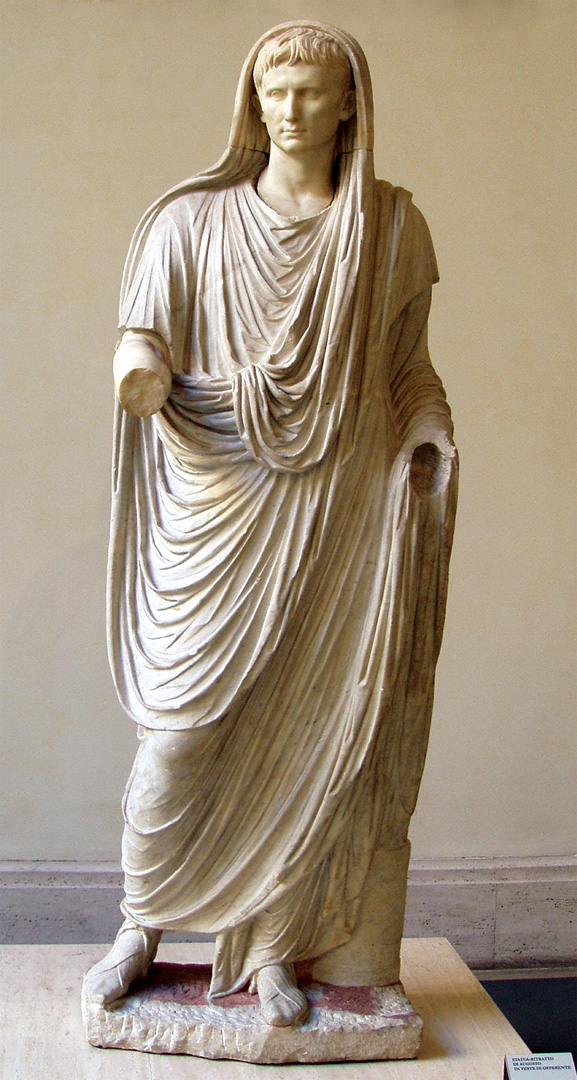
Statue of the emperor Octavius Augustus dressed as a Pontifex Maximus. Museo Nazionale Romano. (Photo: Roberto Lérida Lafarga 31/12/2004) |
|
|
|
|
|
The Salii –“jumpers”- were a priesthood formed by twelve priests who were consecrated to the cult to Mars and to protect from the theft his shield felt from the sky –together with other eleven false shields for misleading to the possible thieves-; they celebrated every year in March the Saltatio, a warrior dance accompanied with the rhythm of a sacred song. The Fetiales were another priestly association composed by twenty members; it had a very ancient origin, because their priests stroke their victims with silex, the typical stone of the pre-historic weapons; they acted as diplomatic corps and they were considered creators of the international law –ius fetiale-, because they accomplished the rites of the declaration of war and the conclusion of a treaty; the chief of every delegation was called Pater Patratus. The Luperci, an association of twelve priests, were considered previous to Romulus; they belonged only to two important patrician families, the Quinctili and the Fabii; in February they made magic rites to defend the herds from the wolves –their name came from these animals, because in Latin wolf is lupus-; afterwards they celebrated in the city the festivities of the fecundity, the Lupercalia, in honour of the god Lupercus –deer wolf- or Faunus –assimilated to the Greek god Pan-, running across the street half-naked and striking with straps made of leather of he-goat to those who wanted to have children, herds or good harvest. |
|
Preserved text of the hymn of the Salii priests, quoted by Varro and Terentius Scaurus. The text is written in archaic Latin and it cannot be translated in its totality. |
|
|
|
|
|
The Arvales, twelve priests too, were in their origin the twelve sons of the shepherd Faustulus and they celebrated every year in May, near Rome, the festivity in honour of Dea Dia, i. e., Ceres, the Feeder Earth. The Augures, six priests, two for every Roman tribe, are not strictly priests, but expert interpreters of the heavenly signs; they took auspices –from the Latin aves spicere, “to look at the birds”- observing the flight of the birds or the appetite of the sacred chicken. The Haruspices, of Etruscan origin –it seems that hara in Etruscan meant “entrails”- were minor priests, almost chatterboxes, who sent presages from their observation of the entrails of the animals sacrificed in the rites. The interpreters of the Sibylline Books were two associated priests who, according to the tradition, were nominated by the king Tarquinius the Superb when he obtained the Books of the Sybille of Cumae; these two priests –duoviri sacris faciundis, “two men to make the sacred things”- supposedly discovered in the books prodigies that became indications to keep Rome safe. |
|
Preserved text of the hymn of the Fratres Arvales, written in the official transactions of the year 218 a. C. The text is written in archaic Latin and cannot be translated completely. |
|
|
|
|
|
All the priesthoods before quoted came from the age of the Monarchy (753-509 b. C.); during the Republic (509-27 b. C.), some changes took place. However, the priests kept belonging to the patrician families, many times they were senators or magistrates and they wore the toga praetexta, the typical dress of the senators; in fact, some priestly charges, like the Pontifex Maximus, were considered as a magistratura. So, during the Republic, the Flamines lost importance in benefit of the Pontifices who increased their number up to fifteen with Sulla and up to sixteen with Julius Caesar (the same amplification of number took place among the Augures; the interpreters of the Sibylline Books were amplified also up to fifteen by Sulla). At the same time the Pontifex Maximus became the chief of the national religion, his charge was for life and he was elected first by his pontifical colleagues, but afterwards by the people in assembly; he had in charge the survey of the rites, he consulted the senate and he nominated and controlled the Flamines and the Vestals. After the expulsion of the kings the religious functions of the king were distributed among some magistrates –the praetores- and a priest –Rex Sacrorum or Rex sacrificulus- who had to renounce to the rest of the political functions in order to avoid a restoration of the monarchy. Afterwards this Rex Sacrorum was consecrated to the cult of Janus and he was subordinated to the Pontifex Maximus. When the Empire came, some modifications took place in the associations of Roman priests. So, the emperor assumed the most important religious charge, so that all the emperors were Pontifex Maximus during their empires. Also in the age of the empire the association of the Augustales was created; these priests celebrated the cult of the emperor’s genius and his Lares. Then, an especial Flamen was established for the cult to Julius Caesar, who was divinized too, and since then every emperor had a Flamen perpetuus. The Haruspices had to be instructed in an academy and they only could be sixty members, receiving their official consecration as priestly association thanks to the emperor Claudius. On the other hand, the eastern cult supposed the creation of their own priesthoods, so that the Archigalos for Cibeles, the Great Priest for Isis, the Fathers for isis, etc. were created. |
||
|
|
|
|
|
|
|
SOURCES: - CARCOPINO, Jerôme: La vida cotidiana en Roma en el apogeo del Imperio, Madrid, 1993 - ESPINÓS, Josefa et alii, Así vivían los romanos, Madrid, 1987 - GARCÍA GUAL, Carlos: La Mitología: Interpretaciones del Pensamiento Mítico, Barcelona, 1987 - GARDNER, Jane F.: Mitos Romanos, Madrid, 1995 - GRIMAL, Pierre: Diccionario de Mitología Griega y Romana, Barcelona, 1981 - HACQUARD, Georges: Guía de la Roma Antigua, Madrid, 2003 - PAOLI, Ugo Enrico: URBS. La vida en la Roma Antigua, Barcelona, 1990 |