THE IMPERIAL CULT

|
|
THE IMPERIAL CULT |
|
|
The first Roman emperor, Octavius, renewed and restored most of the traditional Roman cults that felt in disuse along the Republic, especially in the last times of this. As compensation, on the one hand he received an honorific title with religious character, Augustus, a word that up till then was only applied to the temples consecrated according to the Roman religious rites; on the other hand, the emperor ended being divinized, so that, since Octavius Augustus, most of the emperors in the first centuries of the empire were divinized too, almost ever still alive, they received cult in Rome and in the empire and in their honour several temples were erected. This situation lasted until the III century a. C. and this imperial cult had a unitary and united role; however, the irruption of the Christianity and its final adoption as official religion of the Roman Estate modified and eliminated the imperial cult. Nevertheless, the cult to the emperor had also some eastern influences, where nations as the Egyptians considered that their pharaohs were deities. In the case of Rome, it seems that, due to the initiative of influential aristocrats in the provinces and in Italy, some altars in honour to the goddess Rome and to the emperor Augustus, still alive, were built very probably in order to obtain his favour. In Rome Augustus was not deified alive; only the Augustus’ Genius was venerated, but when he died in the 14 b. C. a senatorial decree was issued that indicated that the emperor was divinized, i. e., more appropriately, the apotheosis of the emperor, the divus Augustus, took place. Since Augustus, the deification of the emperor took place when he was made still alive and only some emperors avoided or did not received the divinization still alive, like Caligula and Domitian. |
|
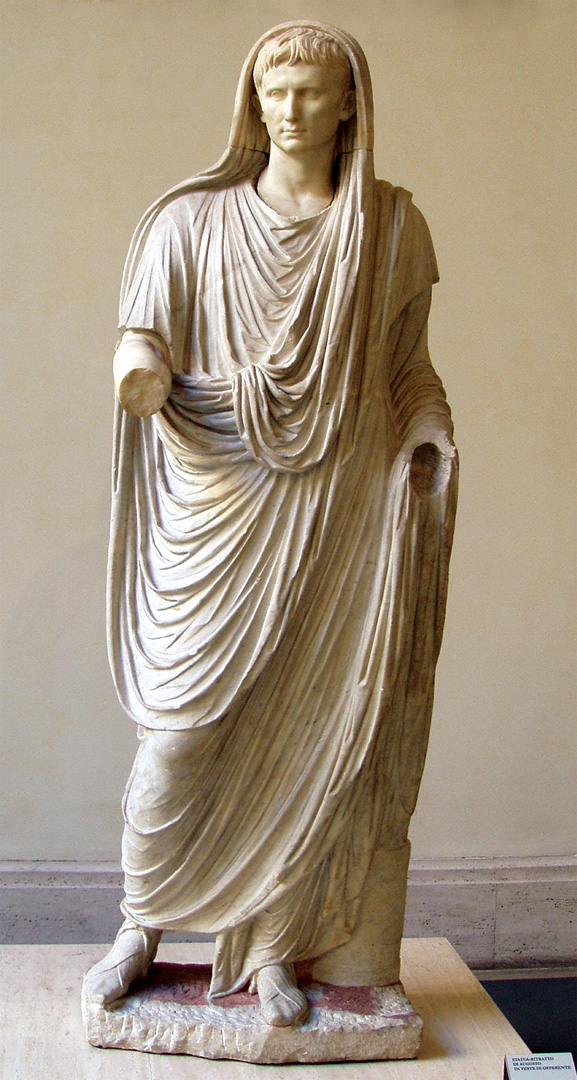
Statue of the emperor Octavius Augustus dressed as a Pontifex Maximus. Museo Nazionale Romano. (Photo: Roberto Lérida Lafarga 31/12/2004) |
|
|
|
|
|
The cult to the goddess Rome and to the emperor became a powerful link between the emperor and his subjects along the empire, so that in every municipium and in every province there were altars and temples dedicated to the emperor and their inhabitants celebrated rites where the low classes and even the liberti could take part also. |
|
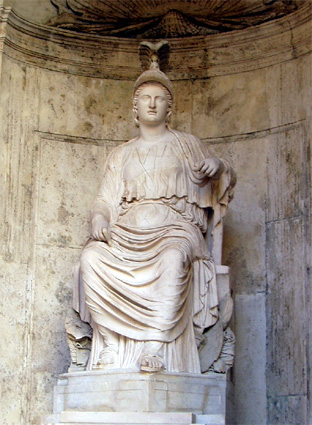
Statue of the goddess Rome. Musei Capitolini in Rome. (Photo: Roberto Lérida Lafarga 28/12/2004) |
|
|
|
|
|
Around these cults, especially, under the emperor Augustus games were established: the Ludi Actiaci, the 2nd September every four years to celebrate the Augustus’ victory over Marcus Antonius in Actium; the Ludi Augustales, between the 5th and the 12th October since the year 19 b. C. to celebrate the Augustus’ return from Eastern; in the year 86 a. C., the emperor Domitian established the Agon Capitolinus, in June and July every four years, with sport games in the style of the Greeks and literature and music competitions. |
|
Roman temple in Nîmes -ancient Nemausus-, in Francia, known as the Maison Carrée -"Square House"-, built by Agrippa in the age of Augustus, probably used to the cult to the emperor and the imperial family. (Photo: Roberto Lérida Lafarga 14/08/2007) |
|
|
|
|
|
However, we can say that, although the imperial cult created at first some passion and fervour, finally, due to the attitude of some emperors at the end of the Iulio-Claudian dynasty, the use of the violence to become an emperor and the passage of time, the imperial cult became another piece of the official political machine of the regimen, a symbol of loyalty and obligation related to the figure of the emperor, so that it lost its original significance and ended being secularized. |
|
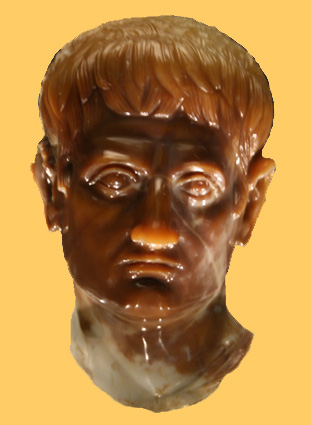
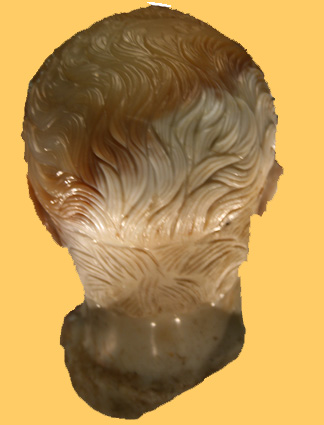
Augustus portrait en red agate found in Turiaso -nowadays Tarazona- (dated in 98-117 d.C.). Museo Provincial de Zaragoza. (Photo: Roberto Lérida Lafarga 03/01/2008) |
|
|
|
|
|
|
|
SOURCES: - CARCOPINO, Jerôme: La vida cotidiana en Roma en el apogeo del Imperio, Madrid, 1993 - ESPINÓS, Josefa et alii, Así vivían los romanos, Madrid, 1987 - GARCÍA GUAL, Carlos: La Mitología: Interpretaciones del Pensamiento Mítico, Barcelona, 1987 - GARDNER, Jane F.: Mitos Romanos, Madrid, 1995 - GRIMAL, Pierre: Diccionario de Mitología Griega y Romana, Barcelona, 1981 - HACQUARD, Georges: Guía de la Roma Antigua, Madrid, 2003 - PAOLI, Ugo Enrico: URBS. La vida en la Roma Antigua, Barcelona, 1990 |