DEFINITIONS AND CONCEPTS

|
|
DEFINITIONS AND CONCEPTS |
|
|
A myth, from the Greek μύθος, according to Carlos García Gual, is a tale that introduces a “story” from the past time, known by many people, like “the tribe stories” that live “in the country of the memory”. A myth used to have a dramatic and exemplary character and this is the reason why it is often located in the world of the symbols. In the myth there are told facts of an exceptional interest for a community because they explain essential aspects of the social life of this community. Very often this tale implicates wonderful and exemplary events, so that it is normal that in the myths gods, heroes, fantastic animals, etc., appear, which they normally have a role above the means of the natural truth. The myth is an attempt of explanation about the reasons of the things and its causes, i. e., it is an attempt of rational explanation of the origin of the facts and events, divine and human, locating them in immemorial times. So, the origin of the things is a favourite subject in the mythology: the cosmogonies –the origin of the universe-, the theogonies –the origin of the gods-, the heroic and foundational genealogies –the origin of the families of the ancient heroes and the ancient founders of the cities or tribes-; on the other side of the mythological subjects we find those related to the end of the life, the eschatology, i. e., tales about the death, the end of the life and the great beyond. Finally, a very usual subject among the myths is the explanation of the costumes, uses, morals and ways of life and acting –ethiologic myths, from the Greek αἰτία and λόγος (“that explain the causes”)-, which lost their explanatory function in proportion as the Greeks developed the philosophy and the logic. |
|
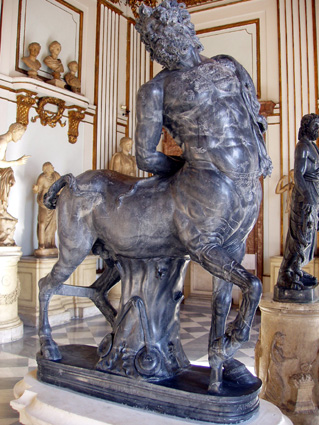
Statue of a centaur in the Musei Capitolini, Rome. (Photo: Roberto Lérida Lafarga 28/12/2004) |
|
|
|
|
|
The word mythology, from the Greek μύθος and λόγος, in a first instance has two meanings: collection of myths and explanation of the myths or science that studies them; at any case, the second meaning is only possible if previously it exists the first meaning. All the nations have their own collection of myths, i. e., a cultural tradition formed by this whole of tales and stories pre-philosophic or pre-logical where they could find a explanation of everything, from the origin up to the death, from the foundation of a tribe up to daily aspects. The second meaning is subsequent and it is the attempt of explanation of what these myths mean, i. e., an hermeneutic, an interpretation of their meaning and their symbolism. Religión, from the Latin religio, is a word difficult to translate; even in Latin its meaning was not clear, because sometimes the Romans considered that it meant “religious scruple”, sometimes “superstition” and it seems that the general agreement is that the word could mean at the same time something like “obligation acquired related to the gods, a religious bond or scruple”; another sense came from this meaning: “to worship to the gods”, which probably could be the meaning closer to our modern –and Christian- concept of religion. From here the definitions of religion have been multiplied and annexed according to the different religious confessions from which the definitions are made. If someone asks us a definition of religion, we don not want to be simplistic, but we will say, because we like to believe in it, that the religion is the believe or the faith in one or several beings that we consider superior to us and that give an explanation to everything that we cannot explain rationally and keep apart from our cognitive comprehension, especially in two aspects: our origin and our end (the death). |
|
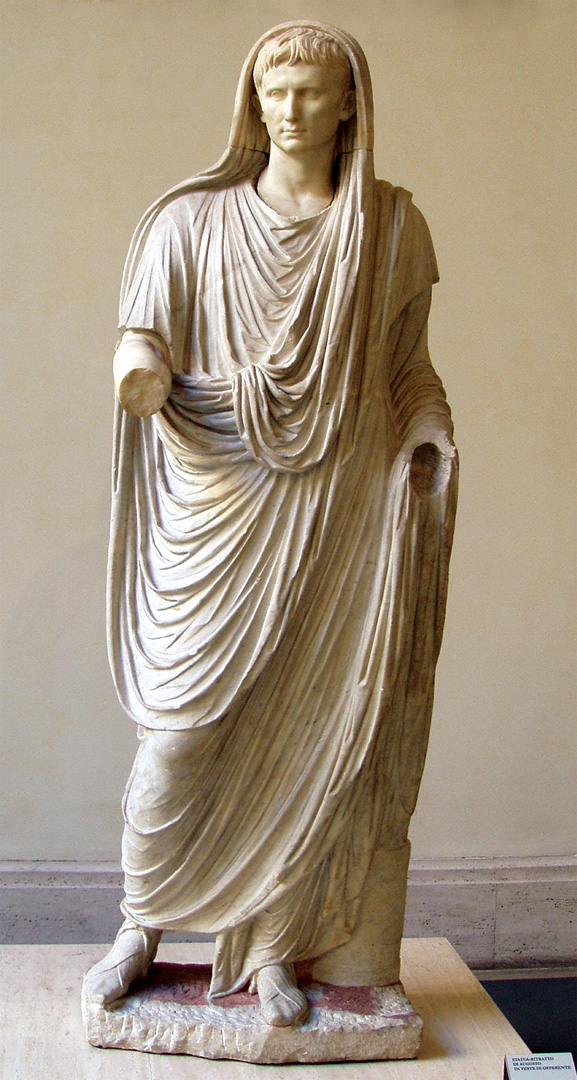
Statue of the emperor Octavius Augustus, dressed like a Pontifex Maximus in the Museo Nazionale Romano. (Photo: Roberto Lérida Lafarga 31/12/2004) |
|
|
|
|
|
So, in every religion every people have given form, characteristics, attributes, powers, etc. to these beings that we used to call deities or gods; as a whole and in a way valid for all the religious confessions, under the concept of religion we must include the believes and the faith in elements/deities that would explain all the things that in its origin could not be explained logically; also we must include inside this definition the rites, the sacrifices, the ceremonies, the festivities, the priesthoods, the divination, the oracles, the sacred books, the dogmas, etc., as different religious aspects. From these definitions we can deduce that in some moment religion and mythology coincide, because in a large number of myths the deities intervene and they are used to explain the facts and events. |
|
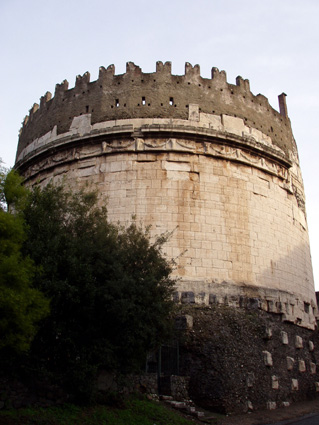
Tomb-Mausoleum of Cecilia Metela in the via Appia in Rome. (Photo: Roberto Lérida Lafarga 29/12/2004) |
|
|
|
|
|
|
|
SOURCES: - CARCOPINO, Jerôme: La vida cotidiana en Roma en el apogeo del Imperio, Madrid, 1993 - ESPINÓS, Josefa et alii, Así vivían los romanos, Madrid, 1987 - GARCÍA GUAL, Carlos: La Mitología: Interpretaciones del Pensamiento Mítico, Barcelona, 1987 - GARDNER, Jane F.: Mitos Romanos, Madrid, 1995 - GRIMAL, Pierre: Diccionario de Mitología Griega y Romana, Barcelona, 1981 - HACQUARD, Georges: Guía de la Roma Antigua, Madrid, 2003 - PAOLI, Ugo Enrico: URBS. La vida en la Roma Antigua, Barcelona, 1990 |