THE DEATH

|
|
THE DEATH |
|
|
As in all the humanity, the death and the destiny of the cadaver have always being linked to the religious rites. In the case of Rome the practices and the ceremonies that were developed from the moment when someone died until his cadaver rested definitely were different. |
||
|
|
|
|
|
The funeral of a Roman citizen belonging to a noble family could be the following: the moribund sick person used to be put on the bare land, where, with a kiss, a relative took his last sigh and closed his eyes. When he died, a conclamatio took place, i. e., those present said the name of the dead aloud. Afterwards the cadaver was prepared, a task that the women of the house or the pollinctores –men who had in charge this task, similar to our modern funeral ceremonies- did; the cadaver was washed with tepid water, it was covered with ointments and they made a kind of provisional embalm; if the dead was a Roman citizen, they dressed it with the toga, but, if he was a magistrate they dressed it with the toga praetexta; they put it on its funeral bed and they put it in the atrium of the house, exposed in order to be seen by the visits. Around the cadaver lamps and candelabrums burned and flowers, crowns and bands were put on the dead. The fire of the fireplace was put out as sign of sorrow. Meanwhile, the women of the house cried and they mourned, plucking out their own hair, scratching themselves, beating their own chest and tearing their clothes. Afterwards the solemn ceremony took place with a big procession in the cold light of day, the funus –“funeral”-, and the dead was incinerated in a funeral pyre or he was put in humus, i. e., buried, that was the prevalent use in the imperial age. |
|
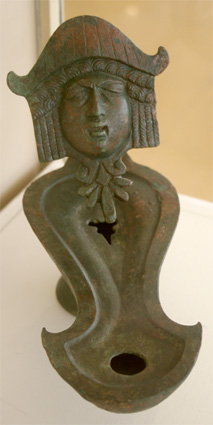
Roman lamps similar to those used to keep vigil near a cadaver. Museo Nacional de Arqueología de Tarragona. (Photo Roberto Lérida Lafarga 06/06/2008) |
|
|
|
|
|
Poor people were buried the same day as they died, but the emperors were exposed during a week. The funerals of the poor people –funus plebeium or tacitum- and those of the children –funus acerbum- were quick and used to take place in the night. If the funeral of a person was made by the Estate, it was a funus publicum, but, if it was made by his family, it was a funus privatum. Around the funeral there were some companies of funeral ceremonies –libitinarii- with their employees who had in charge the funerals: pollinctores for preparing the cadaver, vespillones for putting it in the coffin, for carrying it to the funeral pyre of for burying it, and dessignatores, who organized and directed the big funeral suite; it is logical to think that this business was very lucrative, although this job supposed a reduction in the civil rights. |
|
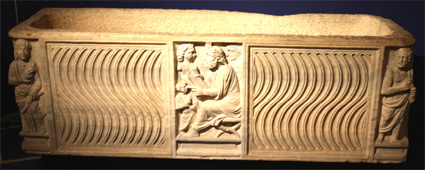
Sarcophagus of the Paedagogus, in the Museo y Necrópolis Paleocristianos de Tarragona. (Photo Roberto Lérida Lafarga 06/06/2008) |
|
|
|
|
|
Instead of the written death notice that we can read in the newspapers, a herald announced the funeral of a dead –indicere funus- through a fix formula: ollus [name of the dead] Quiris leto datus est –“those citizen [name of the dead] has been given to the death”-. A large funerary entourage –pompa- started with tibia players and with the sound of flutes, trumpets and tubae; afterwards the torch carriers and women paid –praeficae- who intoned sorrow shouts –lugubris eiulatio- and songs and praises of the dead –naenia-; sometimes there were too mimes and dancers who danced and made jokes during the funeral with songs that did not respect to the dead. Finally, after the images of the ancestors the uncovered coffin with the dead came, at sight of all those present, accompanied by the relatives dressed in black clothes and the women without adornment and undone hair. If the dead had had a political charge or he was an important person in the political life of the city, the funerary entourage crossed the forum, where his family kept sitting down in sellae curules–the seats reserved to some magistrates- near the rostra, where the dead’s son or a close relative pronounced a funerary discourse of praise –laudatio funebris-. |
|
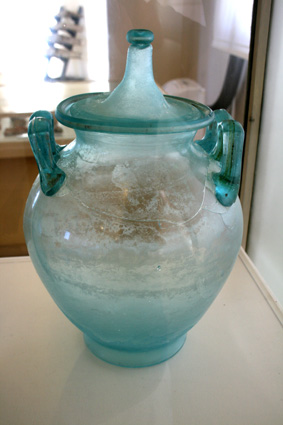
Glass funerary urn. Museo Nacional de Arqueología de Tarragona. (Photo Roberto Lérida Lafarga 06/06/2008) |
|
|
|
|
|
According to an ancient law it was prohibited that the dead were buried or incinerated inside the city of Rome. It seems that during the Republic and the first times of the Empire the incineration was the most frequent, being reserved the burial for the poor people and the slaves. So, the incineration was made in the most simple way, the bustum, i. e., a hole dug in the land that was filled with wood, then they put the dead on in and the burnt the pyre; finally, the ashes were covered with ground. However, it was most frequent that the body was incinerated in a bonfire or pyre in a place –ustrina- and then its ashes were buried in another place –sepulcrum-. In the important cases, the funerary pyre was not yet a mere pile of wood to become a construction similar to an altar where the cadaver was put and where the friends and relatives left some objects like clothes, weapons, jewels, food, etc. The dead’s eyes were opened and closed as a sign of farewell and then the dead was burnt; the final live coals were put out with wine, the bones were picked up and covered with ointments or honey up to its burial, deposited into an urn. Until the mortal remains were buried, the family had the condition of impurity –familia funesta-. |
|
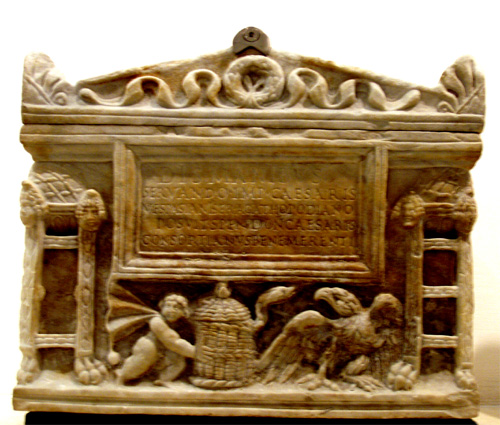
Funerary urn with the indication Dis Manibus. Museo alle Terme in Rome. (Photo: Roberto Lérida Lafarga 31/12/2004) |
|
|
|
|
|
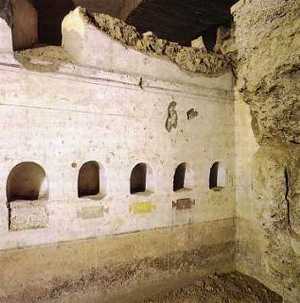
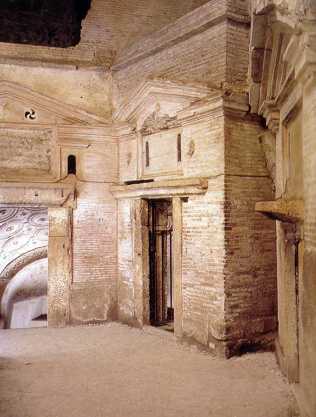
The mortal remains were deposited in columbarii, niches disposed like dovecotes; in every one of them there was space for an urn. The rich people could build for their mortal remains luxury monuments surrounded by a space consecrated to the dead or a garden. When the burial became more frequent, the Romans had to enable spaces for the burials of a large population, so that the catacombs (probably a derivation from the Greek κατά “under” and τύμβος “tomb” or from κατά “under” and κύμβας “cavities”) that existed yet outside the city were amplified. Inside these catacombs the families with some economical resources built private mausoleums and there were also spaces reserved for the urns of incinerated dead, the columbarii. These catacombs were dug in a volcanic stone, soft and easy to be extracted, up to they found another kind of stone very hard; so, the catacombs used to have some floors and many aisles and corridors that, like a fish bone, came from a central aisle. Some catacombs, like those of Saint Sebastian, can reach 12 kilometres as a whole of all its aisles. In general, these catacombs were active and in use as burial place up to the VI century a. C.
Columbarii where the funerary urns were deposited in the catacombs of Saint Sebastian, in Rome. |
|
Entrances to different familiary pantheons in the catacombs of Saint Sebastian, in Rome. |
|
|
|
|
|
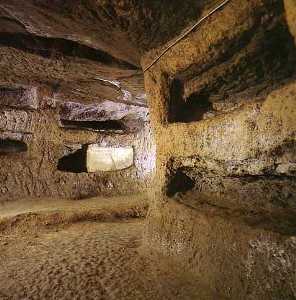
We have to abandon the idea of that the catacombs were the place where the prosecuted Christians took refuge. As all the inhabitants of Rome, especially the poor people, Christians and Jews had to be buried in the catacombs, so that the rites of the death took place in them; afterwards, due to the fact that these catacombs were the burial place of many Christians martyrs –for example, saint Sebastian-, they became place of devotion, pilgrimage and celebration of masses for the Christians; so these buildings kept linked to the imagery and the tradition of the ancient Christians in Rome. |
|
Niches for cadavers in the catacombs of Saint Sebastian, in Rome. |
|
|
|
|
|
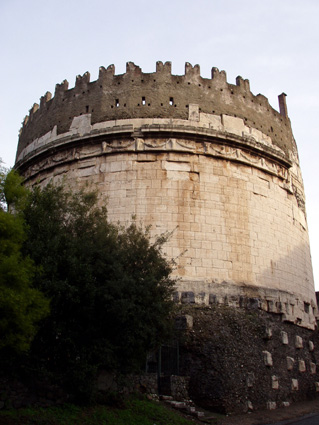
Due to the fact that it was prohibited the burials inside the city, except for the generals who had won in battles, the Romans chose as place suitable for their burials the catacombs and the ways that came from the city. So, if you are visiting Rome, we recommend you to tour the via Appia, at least up to the Caecilia Metella Tomb. In the Antiquity a large part of this way was filled with mausoleums and monumental tombs belonging to important citizens of Rome: the Scipiones’, Geta’s and Pricilla’s sepulchres, the columbarii of Vigna Codini or dei Liberti di Augusti, the Romulus’ and Caecilia Metella’s mausoleums, the catacombs of Saint Sebastian, the Praestatum, the Hebrew catacombs, etc., among others, are the funerary monuments that you can still visit along this way. |
|
Caecilia Metella's tomb-Mausoleumo in the via Appia in Rome. (Photo: Roberto Lérida Lafarga 29/12/2004) |
|
|
|
|
|
|
|
SOURCES: - CARCOPINO, Jerôme: La vida cotidiana en Roma en el apogeo del Imperio, Madrid, 1993 - ESPINÓS, Josefa et alii, Así vivían los romanos, Madrid, 1987 - GARCÍA GUAL, Carlos: La Mitología: Interpretaciones del Pensamiento Mítico, Barcelona, 1987 - GARDNER, Jane F.: Mitos Romanos, Madrid, 1995 - GRIMAL, Pierre: Diccionario de Mitología Griega y Romana, Barcelona, 1981 - HACQUARD, Georges: Guía de la Roma Antigua, Madrid, 2003 - PAOLI, Ugo Enrico: URBS. La vida en la Roma Antigua, Barcelona, 1990 |