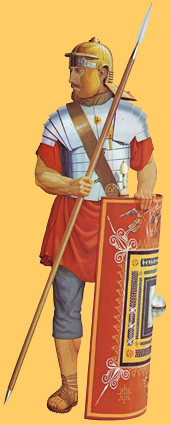
MILITARY RANKS

|
|
MILITARY RANKS |
|
|
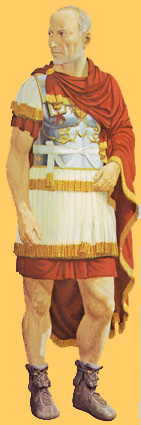
In the Roman army there was not an only command because the supreme command –imperium- was very often held by a magistrate who was replaced every year; at the same time some military ranks were collegiate, so the command was alternated with some periodicity. It seems to be sure that the officer who had the command had to wear a red cloak –paludamentum- in order to be recognized. The superior officials were always Roman citizens with Roman origin, even in the foreign allied troops, where it was allowed that the subaltern officials were natives. |
|
|
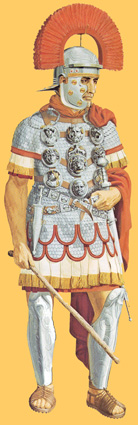
Provincial legatus with paludamentum; reproduction from imperial sculptures from the I and II centuries a. C. |
|
|
|
|
|
|
In the infantry, in the legion, the chain of command was very complicated. The supreme general –dux-, with the command on the whole army –imperium- was a consul or a praetor; he had a headquarter –cohors praetoria; from this terms are derived court, “the entourage that surrounds a commander” and praetorian, “personal guard of the man who had the imperium”-; the dux had adjutants in the fields –legati- who could take the command of a legion temporally, the command of the cavalry or the command of the reserve troops; in addition, the dux had a quaestor for the service corps, i. e., an officer in charge of the supplying of the army, the distribution of the camp and the buildings occupied by the army. Every legion had as superior officials 6 military tribunes –tribuni militum, laticlavii if they belonged to the senatorial order, and angusticlavii, if they did not belong to it-; they were chosen every year and they had the command over 10 centuriae and, in turn, the command of a legion. These tribunes were elected by the tribal assemblies –comitia tribute- between the young sons of the senatorial order –tribuni militum a populo- or they were elected directly by the dux between the veteran officers –tribuni militum rufuli-. In general it was necessary to have occupied the inferior ranks in order to reach the superior ranks, i. e., it was necessary to accomplish the complete military career to become dux. Afterwards, the army had as subaltern officers 60 centuriones; the pilus prior was the higher rank, the primipilus of the first cohort and then he was followed in order by the primipili from the other cohorts; every manipulus had 2 centuriones: one of them belonged to the first order –ordo prior-, from the first centuria of the manipulus, and the other one belonged to the second order –ordo posterior-, from the second centuria; the centurion of the ordo prior had the command over two centuriae, while the the centurion of the ordo posterior had the command over only one centuria. Under the centuriones there were subaltern officials called principales, without military command, but in charge of the general services; every centuria had a “mayor sergeant” called tesserarius and there was an assistant –optio- too; in addition, the legion had standard-bearers –signifier, imaginifer and aquilifer, if they bore a standard, an image or an eagle-, instructors –campidoctores, literally “teachers of camp” and officers in charge of the supplies –pecuarii-. Finally, the army had corps of architects, doctors, musicians with conductor, etc. Under all these officers it was the troop –militia caligata, literally “army with caligae (shoes half boots half sandals; their diminutive –caligulae- gave his nickname to the emperor Caligula, because he spent long periods of time in his childhood in military camps with his father and he used to wear these caligae)-, who could not reach in their military career other rank but centurion; they were divided into first class soldiers –immunes-, i. e., exempt from load –munus-, and second class soldiers –munifices-, i. e., who had to load their munus. The general diagram of the commands in the republican age could be the following: |
|||
|
MILITAR RANK |
ORDER OF COMMAND |
POLITICAL CHARGE OR MAGISTRATURA |
NUMBER |
COMMENTS |
EQUIVALENCE IN THE MODERN ARMY |
|
Dux |
Superior officials |
Consul or praetor |
1 |
General-in-chief of the whole army |
Supreme commander |
|
Quaestor |
Quaestor |
1 |
Service or quartermaster corps' chief |
|
|
|
Legatus |
|
from 4 to 6? |
Dux' adjutant, command over the cavalry or over a legion or over the reserve |
Major or Colonel |
|
|
Tribunus militum |
|
24 6 per legion |
Command over 10 centuriae |
Captain |
|
|
Centurio |
Subaltern officials |
|
60 2 per manipulus 1 per centuria |
|
Lieutentant |
|
Principales |
Subaltern officials without military command |
|
Diifferent types per legion or centuria |
|
Sargeant |
|
Militia caligata |
|
|
|
|
|
|
|
|
|
|
|
|
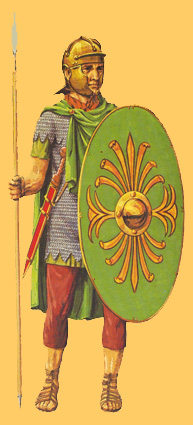
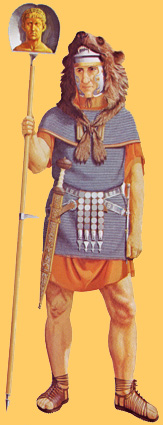
Auxiliary soldier at the beginning of the II century a. C. |
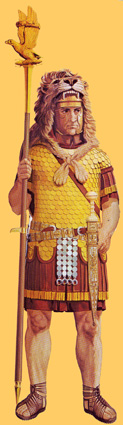
Aquilifer in the middle of the I century a. C. |
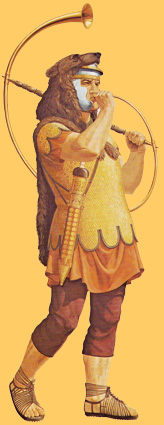
Cornicen in the early II century a. C. |
Imaginifer in the middle of the I century a. C. |
Centurio in the middle of the I century a. C. |
|
In the cavalry the division of ranks was easier: every turma was commanded by a superior official, the prefect –praefectus-, while every decuria was commanded by a subaltern officer, the decurion –decurio-. In the artillery and in the engineers’ corps a superior official had the command: e. g., the prefect of the workers –praefectus fabrum-. |
||
|
|
|
|
|
In the imperial age the ranks were clear and the military career was very strict: first of all the officials started their careers as prefects of an auxiliary cohort –praefecti- and then they could promote to military tribunes –tribuni militum- and then to prefect of a cavalry wing. During the empire, in the legion the chain of command was less complicated. The commander-in-chief was the emperor, the imperator, who had the supreme command of the whole army –imperium-; however, the emperor had to delegate part of their functions due to the large number of legions and to the vast territory he had to control; then, the camp prefects were created, i. e., adjutants who took the command of some legions and big sections of the Roman army. The legates –legati- were kept, but one permanent legate in every legion. At the same time every legion had as superior officials 6 military tribunes –tribuni militum, laticlavii or tribuni militum a populo, if they were from the senatorial order, who were in charge of the legion administration, and angusticlavi or tribuni militum augusti, who were directly elected by the emperor or by a legate as emperor’s assistants-. Due to the permanent character of the legates, the tribunes lost command capacity, keeping the rank sometimes with an honorific meaning. |
||
Afterwards there were as subaltern officials 59 centuriones by legion; these officers and the troop had not too many changes in relation to the republican age. The general diagram of the commands in the imperial age could be the following:
|
MILITAR RANK |
ORDER OF COMMAND |
POLITICAL CHARGE OR MAGISTRATURA |
NUMBER |
COMMENTS |
EQUIVALENCE IN THE MODERN ARMY |
|
Imperator |
Superior staff officials |
|
1 |
Imperium, supreme command over the whole army |
Supreme commander |
|
Praefectus |
|
some |
Command over some legions to defend the frontiers |
Major or Colonel |
|
|
Legatus |
Senatorial order |
1 per legion |
Emperor's legate and embassador |
|
|
|
Tribuni militum |
Subaltern officials |
|
6 per legion |
|
Captain |
|
Praefecti |
|
|
|
Lieutentant |
|
|
Centuriones |
|
59 per legion |
|
Sargeant |
|
|
|
|
|
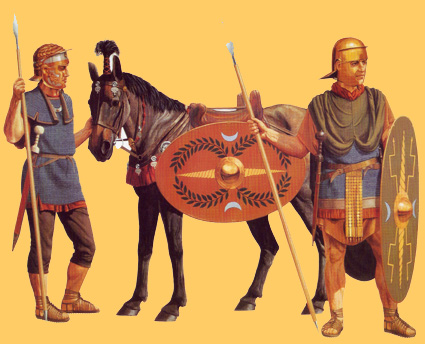
Auxiliary infantryman and cavlryman in the middle of the I century a. C. |
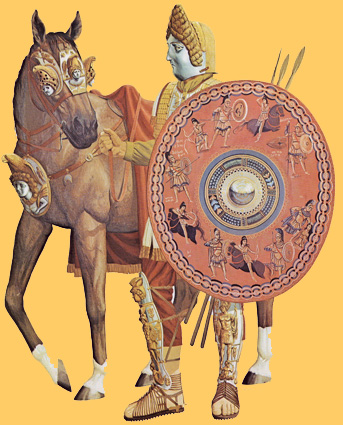
Cavalryman with the sport armour in the middle of the III century a. C. |
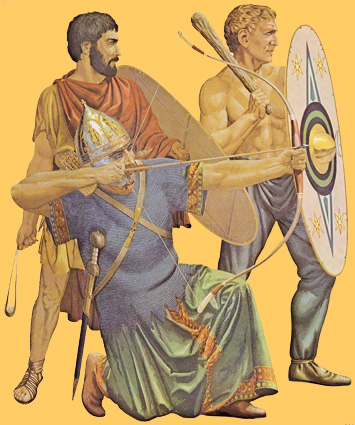
Auxiliary troops in the early II century a. C.: slinger, archer, and clubman. |
|
|
|
|
|
|
|
|
|
Late republican legionary |
Legionary of the first half of the I century a.C. |
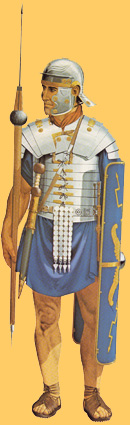
Legionary of the second half of the I century a. C. |
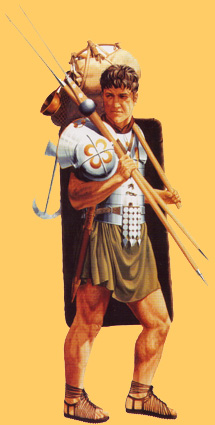
Legionary in agmen in the early II century a. C. |
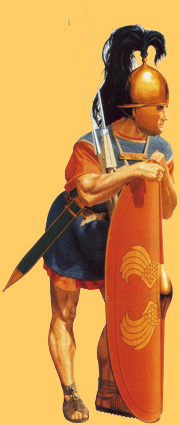
Legionary about the year 200 a. C. |
|
|
|
|
|
All the pictures from the different kinds of soldiers that appear in this web are taken from the reproductions of CONNOLLY, Peter: Greece and Rome at War, London, 2006 |
|
|
|
|
|
SOURCES: - BROCKLEHURST, Ruth: Roman Army, London, 2003 - CONNOLLY, Peter: Greece and Rome at War, London, 2006 - HACQUARD, Georges: Guía de la Roma Antigua, Madrid, 2003 |
|
|
WebQuest: Playmobil y el Ejército Romano |
|