THE ROMAN NAVY

|
|
THE ROMAN NAVY |
|
|
In spite of the fact that Rome is not far away from the sea and in its expansion along Italy, Europe, Asia and Africa it enclosed a complete sea –the Mare Nostrum, as they called it-, the Romans kept as a terrestrial army with a projection to the continent; although they resorted to build and maintain a war fleet, this fact did not suppose any advance in relation to the Greek, Hellenistic and Carthaginian fleets, nor a progress in the art of navigation and the naval wars; in a way, the fleet and the navy were a charge for the Romans. Probably, one of the reasons was the fact that the naval battles were in fact terrestrial battles on the ship decks and only the manoeuvres to sink and not to be sunk, crashing the bows reinforced with metallic spurs, made the difference between the naval and the terrestrial wars. |
||
|
|
|
|
|
Until the I Punic War, in the III century b. C., after the war against the king Pyrrhus, a Roman navy did not exist; we have previous news of the activity of some Roman war ship, but up till then these ships neither formed a fleet or a navy, nor its existence was regular and permanent. As a model for their fleet, the Romans took a Carthaginian quinqueremis –a ship with five rows of oarsmen in every side- that got stranded on the Italic coasts in the year 261 b. C. However, after the Roman victory over the Carthaginians, the Romans had no naval enemies and, with their control of all the shores of the Mare Nostrum, to have a permanent fleet and a navy left off being a need for the Romans. In any case, the fleet constructed for the I Punic War consisted on 100 quinqueremes and 20 triremes –a ship with three rows of oarsmen in every side-. That is no bar to the fact that in precise moments at the end of the Republic there were naval battles: sometimes with naval battles the Romans settled their differents against their enemies: Cnaeus Pompeius against the Cilicians of Asia Minor, Cnaeus Pompeius against Iulius Caesar, Octavius Augustus against Sextus Pompeius, and Octavius Augustus against Marcus Antonius in the battle of Actium. |
|
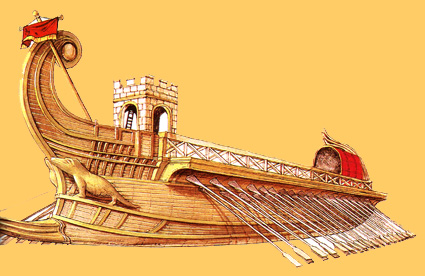
Reconstruction of a biremis that Cnaeus Pompeiius used against the pirates in the Mediterranean Sea, from AA. VV.: Atlas ilustrado de la Antigua Roma: de los orígenes a la caída del imperio, Madrid, 2002 |
|
|
|
|
|
The fleet organization was the following: there was a chief of the naval troops and the fleet, the prefect of the fleet –praefectus classis-; in some occasions two magistrates –duoviri navales- were chosen in the tribal assemblies –comitia tribute-, but we do not know their function in the navy; in every battle ship there were a captain –magister navis-, a first mate –gubernator- and decuriones who organized the ship equipment. In the military harbours like Ostia, near Rome, there were agents to administrate them, the quaestores of the fleet -quaestores classici-. Every ship was crowded by oarsmen –remiges- who were slaves; sailors –nautae- who were recruited between proletarii, liberti or maritime allies –these latter called socii navales; the Romans did not hesitate about trusting their ships to them-; marine infantrymen –classiarii- who fought on the ship decks and who could be foreigner and liberti, and even slaves in some occasions. |
||
|
|
|
|
|
In general the battle ships were called naves longae –long ships-, while the trade ships, rounder, heavier and with less length, were called onerariae naves –“cargo ships”-. Although all the ships had sails, their motive power was based on oarsmen and according to their number ships were classified: biremis, triremis, quadremis or quinqueremis depending on the fact of having two, three, four or five rows of oarsmen in every side; the most frequent were the triremes and the quinqueremes. All these ships had a minimum draught, i. e., there were only a small part of the ship under the sea; they weighted only some tons –hardly ever more than 200 tons-. A quinqueremis had 300 remiges, 120 classiarii and an indeterminate number of nautae. |
|
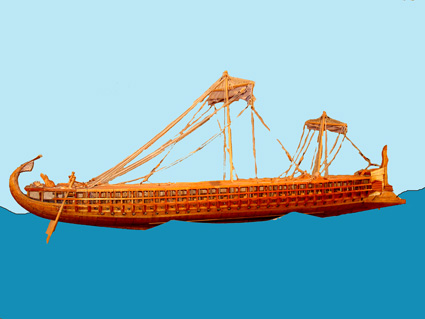
Reconstruction of a triremis from the Museum of Classical Archaeology de Cambridge (United Kingdom). (Photo: Roberto Lérida Lafarga 24/7/2007) |
|
|
|
|
|
Under Octavius Augustus and in the imperial age it was created a permanent fleet, at first as naval police to protect the cargo ships from the pirates, because the Mediterranean Sea was pacified. The imperial fleet was divided into 8 squadrons and 3 flotillas. |
||
|
|
||
|
|
|
|
|
|
|
SOURCES: - BROCKLEHURST, Ruth: Roman Army, London, 2003 - CONNOLLY, Peter: Greece and Rome at War, London, 2006 - HACQUARD, Georges: Guía de la Roma Antigua, Madrid, 2003 |
|
|
WebQuest: Playmobil y el Ejército Romano |
|