MAUSOLEUM OF THE SYNAGOGUE IN SADABA
|
|
MAUSOLEUM OF THE SYNAGOGUE IN SADABA |
|
|
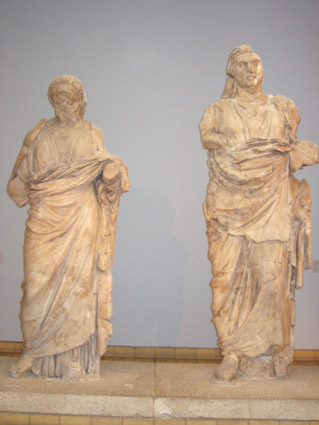
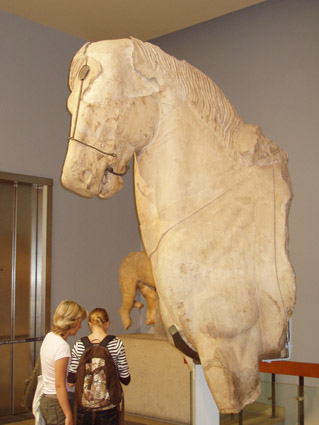
Mausolus, king of Caria who lived in the IV century b. C., when he died, was honoured by his wife, Artemisia, with the construction of an impressive funeral building in the city of Halycarnassus that was considered one of the seven wonders in the Antiquity. In honour to this king and this building, all the funeral constructions bigger than a simple grave, richly adorned or in which people want to do an artistic work take the name of Mausoleums. From the king Mausolus’ Mausoleum only a few statues and architectonical elements exist, preserved some of them in the British Museum in London. |
||
|
|
|
|
|
Statue of a men and a woman (Mausolus and Artemisa) and statue of a horse from thel Mausoleum of Halycarnassus. British Museum, London (photographies: Roberto Lérida Lafarga 21/7/2007) |
||
|
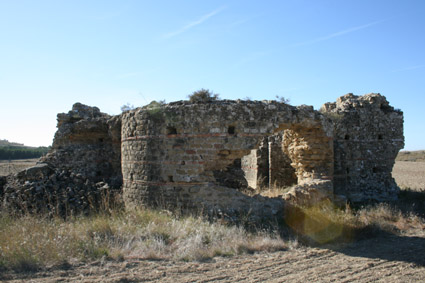
The Mausoleum of the Synagogue in Sadaba is dated in the second half of the IV century a. C. This Mausoleum belongs to an archaeological site near a Roman villa from the Late Empire that a rich landowner ordered to build. Only a few parts of the residential zone of the villa, located 100 metres west, are preserved, such as the baths and some rooms; one of them has an octagonal exedra –a room with benches leaned against the walls- paved with a geometrical mosaic in the central part made by hexagons and intertwined figures. |
||
|
|
|
|
|
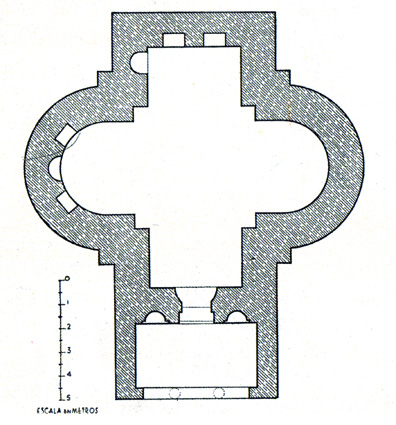
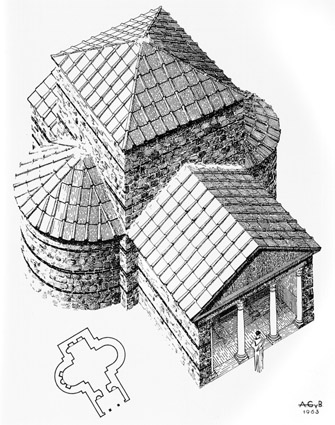
Architecturally the mausoleum has cross plan with equal arms and a quadrangular central space of 5 metres side that made the transept, raised up on the rest of the construction. The thickness of the walls -1,5 metres in all the perimeter, except in the vestibule- could mean that the roof was vaulted: the north and south arms with a half-sphere vault and the eastern and western arms with a quarter-sphere vault; the transept could be crowned with a dome or with an arris vault, although there is no evidence about this.
|
|
|
|
Plan and graphical restoration with perspective of the orginal state of the Mausoleum of the Synagogue of Sadaba, according to GARCÍA Y BELLIDO, A.: “La villa y el mausoleo romanos de Sádaba”, Archivo Español de Arqueología 36 (1963), pp. 166-170 |
||
|
|
|
|
|
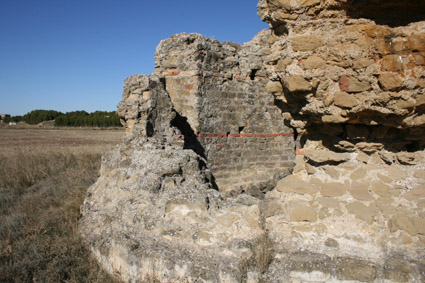
This kind of construction is typical in the late age of the Empire; it is called opus mixtum, i. e., a mix of regular stones in isodomic –with equal stones- regular rows with a single row of red bricks around all the perimeter of the building, at the same height, both inside and outside. The inner part of the walls is made with opus caementicium, i. e., concrete with unequal stones and mortar. |
||
|
|
|
|
|
|
|
|
|
Details of the walls and of the disposition of the block of stone and bricks in the Mausoleum of the Synagogue (Photographies: Roberto Lérida Lafarga 3/11/2007) |
||
|
|
|
|
|
Although the Mausoleum has cross form, Christian symbols are not found anywhere, so a relationship with this religion has been rejected. |
||
|
|
|
Sources: - ORTIZ PALOMAR, M.ª Esperanza y PAZ PERALTA, Juan Ángel: Los Bañales (Uncastillo). Los Atilios. La Sinagoga (Sádaba), Zaragoza, 2005 - ORTIZ PALOMAR, Esperanza: “Los Bañales (Uncastillo). El tiempo ausente del espacio vigente. Baños Romanos”, en AA. VV.: ArquEJEAlogía. Ejea de los Caballeros y las Cinco Villas, de la Prehistoria a la Antigüedad Tardía, Zaragoza, 2006 |