MAUSOLEUM OF FABARA

|
|
MAUSOLEUM OF FABARA |
|
|
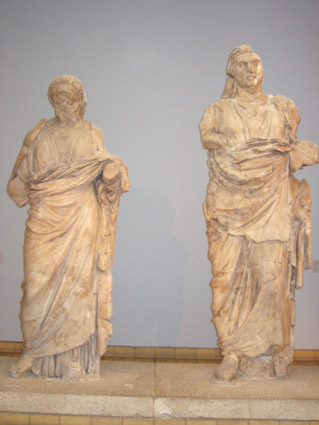
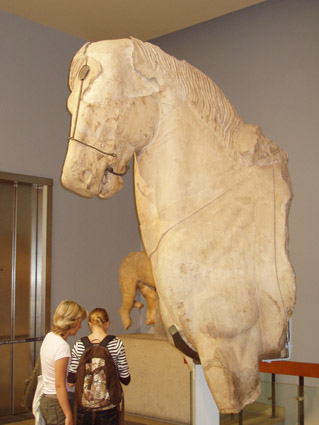
Mausolus, king of Caria who lived in the IV century b. C., when he died, was honoured by his wife, Artemisia, with the construction of an impressive funeral building in the city of Halycarnassus that was considered one of the seven wonders in the Antiquity. In honour to this king and this building, all the funeral constructions bigger than a simple grave, richly adorned or in which people want to do an artistic work take the name of Mausoleums. From the king Mausolus’ Mausoleum only a few statues and architectonical elements exist, preserved some of them in the British Museum in London. |
||
|
|
|
|
|
|
|
|
|
Statue of a men and a woman (Mausolus and Artemisa) and statue of a horse from thel Mausoleum of Halycarnassus. British Museum, London (Photographies: Roberto Lérida Lafarga 21/7/2007) |
||
|
|
|
|
|
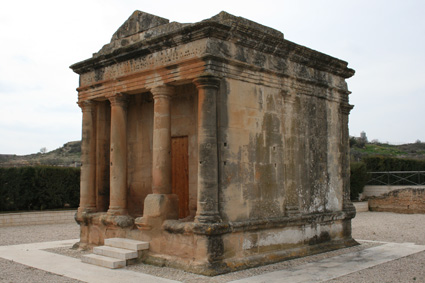
The Roman mausoleum of Fabara always kept at sight of those who passed by this village in the Bajo Aragon throughout more than 1.800 years. In Fabara the mausoleum was known as “Casa del Moros” (“The Moors’ House”), according to a tradition where any ancient building used to be considered belonging to the time of the Muslims (remember that the Atilii’s mausoleum is known as “Altar de los Moros” –“Moors’ Altar”-). Thanks to this tradition people said that the mausoleum was possessed and inhabited by a bewitched Moor woman and that the building sheltered a treasure. Throughout these 1.800 years the mausoleum was used as store and as refuge to peasants, beggars and brigands, and, although this fact damaged the building, it did not avoid that the building was preserved in a very good state of conservation. In the middle of the XVIII century some monks of Alcañiz knew the existence and importance of the mausoleum and in the early XIX century Evaristo Cólera introduced the mausoleum in the illustrate circles, making some pictures and descriptions that he sent round their contemporaneous scholars. Thanks to him one of the columns strongly damaged was repaired and further damages were avoided in the mausoleum’s structure. The building belonged to the lords of Fabara during centuries, but in 1942 the building passed to be property of the Estate. Since 1931 it is National Historic and Artistic Monument and now it is a Good of Cultural Interest according to the law of Aragonese Heritage. |
|
Mausoleum of Fabara. (Photo: Roberto Lérida Lafarga 01/03/2008) |
|
|
|
|
|
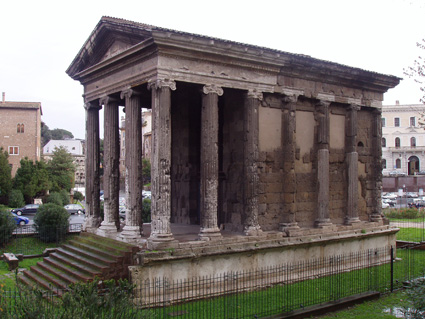
The building is a mausoleum, a sanctuary to worship to the memory of the dead ancestors. Among the different types of mausoleums, this is a mausoleum type temple, because it imitated in a small scale the shape of the Roman temples, as e. g. the Maison Carrée in Nimes (the ancient Nemausus, in France) or the temple of Portunus in Rome.
Templ of Portunus in the Forum Boarium, Rome. (Photo: Roberto Lérida Lafarga 27/12/2004) |
|
Temple in Nemausus (nowadays Nîmes, Provence, France), called Maison Carrée ("Square House"). (Photo: Roberto Lérida Lafarga 14/08/2007) |
|
|
|
|
|
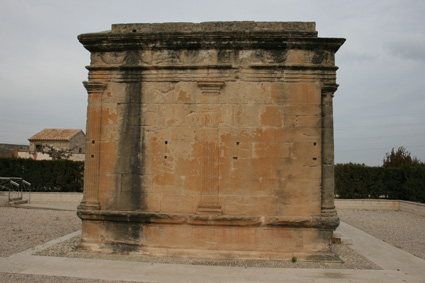
The mausoleum is made in sandstone, a kind of rock very frequent in the area, whose quarry has been located. The way of building corresponds to a technique called opus quadratum, i. e., big blocks of stone exactly cut and squared that settle perfectly in rows without mortar, i. e., without opus caementicium; to join the blocks of stone the Romans used iron cramps. |
|
South façade sur where you can see the big blocks of stone. (Photo: Roberto Lérida Lafarga 01/03/2008) |
|
|
|
|
|
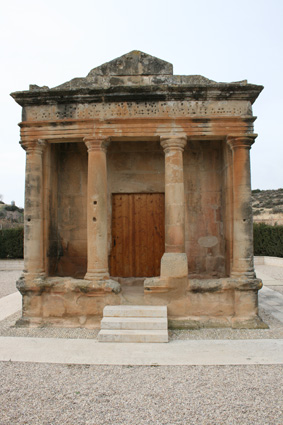
The building faces east and it is 7,40 x 6,06 metres in its plan. Architecturally it has a main façade like the temples in antis, i. e., with columns both sides of the door; a porch with four columns –tetrastylus- , with free-standing central columns and side columns lean to the elks with less diameter than the central columns. The columns had attic base, smooth shaft thickened in the central part and capital in Tuscan order. From a front view the building shows three parts: plinton at the bottom, the columns body, 3,64 metres high, and a Ionic entablature, 1,24 metres high, where we can clearly distinguish architrave, frieze with different decoration in every façades of the mausoleum and cornice with mouldings; finally, on the entablature we can see the tympanum as the only rest of a pediment. The tiled gable roof and the euthynteria are not preserved; the building is 9,30 metres high: 5,84 metres correspond to the cella –the inner cell o nave- and 3,14 metres to the conditorium –a lower space reserved to the tomb-. In its outside, the building is rounded by a moulding that separates the plinton –corresponding to the inner conditorium- from the façade body –corresponding to the inner cella-. En the sides the moulding is the support to some columns in Tuscan order with seven flutes with smooth arris; there are two columns in every side, one of them in the middle of the façade and the other forming corner with the back façade; the distance between these columns is 2,90 metres and they support the Ionic entablature that round all the mausoleum. The back façade only had the angular columns in the corners and a triangular pediment with smooth tympanum. |
|
Main façade. (Photo: Roberto Lérida Lafarga 01/03/2008) |
|
|
|
|
|
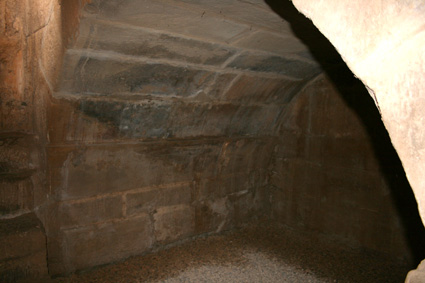
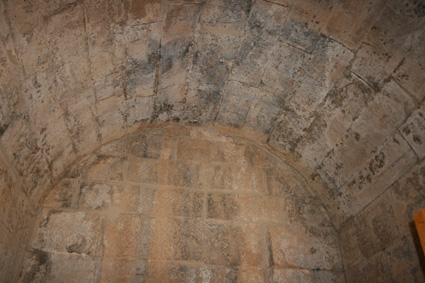
After going up stairs, we can enter in a narrow pronaos, 4,80 x 0,86 metres, and through a big door 1,70 metres wide we can enter into the mausoleum, divided into two bodies, the cella o naos –a cell or nave- 2,94 x 3,22, covered by a semicircular vault, whose voussoirs start from the walls; this part is used to make sacrifices and libations in honour of the dead; under this cella it is the conditorium, where the mortal remains rest; we enter here though a narrow stairs; the dimensions of the conditorium are similar to those of the cella, except the highness, and it had a similar vault.
Conditorium. (Photo: Roberto Lérida Lafarga 01/03/2008) |
|
Semicircular vault of the cella. (Photo: Roberto Lérida Lafarga 01/03/2008) |
|
|
|
|
|
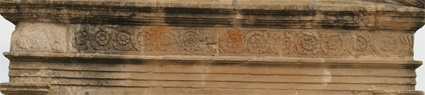
The outer decoration of the mausoleum is very interesting due to its variety, because the frieze in the entablature has different motives in its four façades. The back façade –the western, less eroded and best preserved- shows acanthus leaves with small roses in their interior in different kinds of flowers; in the middle there are two symmetrical leaves that stick up with two volutes. |
|
Decoration in the back façade with small roses of flowers. (Photo: Roberto Lérida Lafarga 01/03/2008) |
|
|
|
|
|
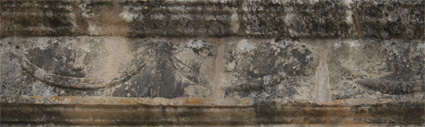
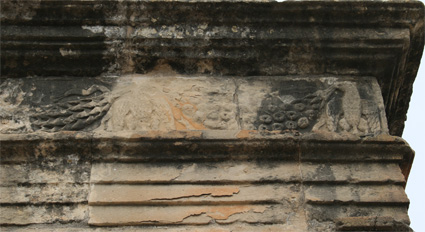
The south façade is decorated with seven eagles put face to face, except one of them, holding up in their beaks garlands and flowers. In the north façade the eagles are substituted by rectangles like columns; garlands hang from them, narrower and simpler than those of the south façade.
Decoration in the north façade : columns with garlands. (Photo: Roberto Lérida Lafarga 01/03/2008) |
|
Decoration in the south façade : eagles with garlands. (Photo: Roberto Lérida Lafarga 01/03/2008) |
|
|
|
|
|
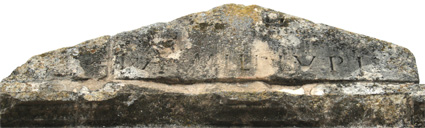
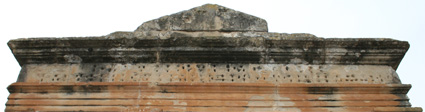
The main façade –the eastern- has a frieze without decoration: there are only holes in the frieze; an inscription with bronze letters must have been extracted; the holes indicate where the letters were nailed down; the disposition of the holes allows knowing the content of the text: the dead was Lucius’ and Lucretia’s son, 13 (or 23) years old. However, on the frieze, in the tympanum, we can read some Latin letters that indicate the name of the dead buried in the mausoleum: L A(E)MILI LUPI, “Lucius Aemilius Lupus’ (Mausoleum)”. The inscription is a Latin proper name with the tria nomina –three names-: praenomen L=Lucius, nomen A(e)mili=Aemilius, and cognomen Lupi=Lupus (“Wolf”). Between the praenomen and the nomen was used as decorative motif a hedera distinguens, an ivy leaf instead of a point. Probably some letters had been lost in the tympanum: a D and a M, the abbreviation of Diis Manibus, “dedicated to the manes gods”, that is a very frequent formula in the Roman funerary inscriptions, where a tomb is dedicated also to the domestic gods of the ancestors. Nevertheless, we do not know anything about the dead; it is documented that the nomen Aemilius is very frequently used in the conventus iuridicus caesaraugustanus, but it does not happen with the cognomen Lupus. |
|
Tympanum in the main façade with inscription. (Photo: Roberto Lérida Lafarga 01/03/2008)
Tympanum and frieze in the main façade with inscription. (Photo: Roberto Lérida Lafarga 01/03/2008) |
|
|
|
|
|
The decoration of the mausoleum belongs to the so called “provincial art”, opposite to the big works in the cities; this kind of mausoleums started to be built and to be frequent since the I century a. C.; on the other hand, the use of Tuscan columns with Ionic entablature was generalized in the age of the Antoninian emperors, 96-192 a. C., and some characteristics of the inscription hint at the II century a. C. The scholars are mostly agreeing in dating the mausoleum at the end of the II century a. C. The historical context of the building is the I and II century a. C., when this area, as the rest of Hispania, had a strong economic increase thanks to the agrarian exploitations, especially, cereal exploitations. Like other areas in Aragon, the more usual kind of Roman township was not the cities, but the villae, i. e., agrarian and cattle exploitations in a medium or large size, property of a rich family that, thanks to its economic resources, obtained pre-eminence and political power in the neighbouring Roman municipia. Since the I century a. C., the emperor Vespasianus gave them the Latin citizenship. So, the big landowners, rich and powerful, showed off their lives in their last moment, erecting wonderful mausoleums to shelter their tombs and remains. |
||
|
|
|
|
|
|
|
FUENTES: - BELTRÁN LLORIS, Francisco: "Las inscripciones del "Mausoleo de Fabara" (Zaragoza)", Caesaraugusta 74 (1998), pp. 253-264 - MELGUIZO AÍSA, Salvador: Mausoleo de Fabara, Zaragoza, 2005 |