ATILII' MAUSOLEUM

|
|
ATILII' MAUSOLEUM |
|
|
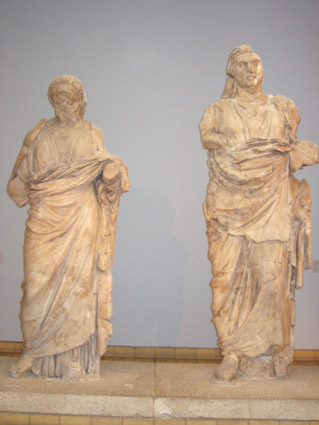
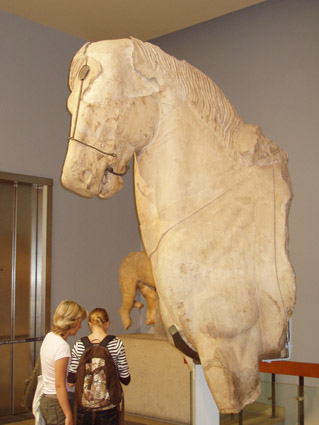
Mausolus, king of Caria who lived in the IV century b. C., when he died, was honoured by his wife, Artemisia, with the construction of an impressive funeral building in the city of Halycarnassus that was considered one of the seven wonders in the Antiquity. In honour to this king and this building, all the funeral constructions bigger than a simple grave, richly adorned or in which people want to do an artistic work take the name of Mausoleums. From the king Mausolus’ Mausoleum only a few statues and architectonical elements exist, preserved some of them in the British Museum in London. |
||
|
|
|
|
|
Statue of a men and a woman (Mausolus and Artemisa) and statue of a horse from thel Mausoleum of Halycarnassus. British Museum, London (Photographies: Roberto Lérida Lafarga 21/7/2007) |
||
|
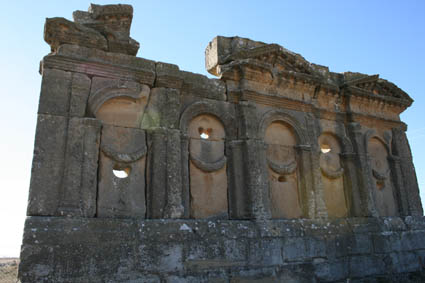
Also known as the “Altar de los Moros” (“Moors’ Altar”), the Atilii’ Mausoleum is a funeral monument that it is located in the municipal township of Sadaba. Only the main façade is preserved from the original building; this sheltered the funeral remains of three generations from a same family –a Hispanoroman gens-, the Atilii. Its date is doubtful, due to the artistic and architectural elements seems to point to the III century a. C., but according to the epigraphy the date could take back to the middle of the II century a. C., maybe with the summit of the Antonianan dynasty. |
|
(Photography: Roberto Lérida Lafarga 3/11/2007) |
|
|
|
|
|
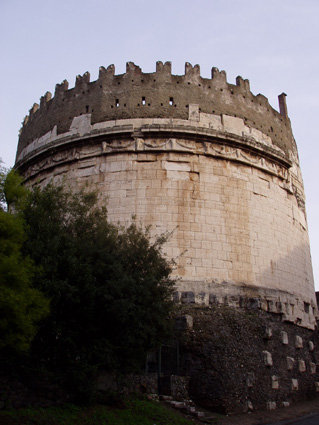
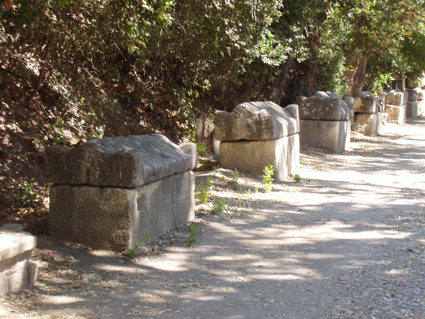
The mausoleum is far from the town due to that in general the Romans never buried their dead or their ashes inside the limits of a town, except children under ten days –because they have no recognized legal existence- or generals that had taken part in battles. So the burials or the graves were made through the roads and ways outside the towns, so that the rich built tombs and mausoleums in order to be seen and admired by the travellers. In the case of the Atilii’ Mausoleum, this is located in the Roman way that connected Caesar Augusta (now Zaragoza) with Pompaelo (now Pamplona), through the a region nowadays known as Cinco Villas. |
||
|
Cecilia Metela's tomb in the Via Appia, Rome (Photo: Roberto Lérida Lafarga 29/12/2004) |
|
Les Alyscamps, in Arelate (nowadays Arlés, in Provence, France), is an archaeological site with lots of Roman tombs loccaated outside the city, in both sides of the ancient Via Domitia, the Roman way that communicated Rome and Hispania through the Gaul. (Photo: Roberto Lérida Lafarga 10/8/2007)
|
|
|
|
|
|
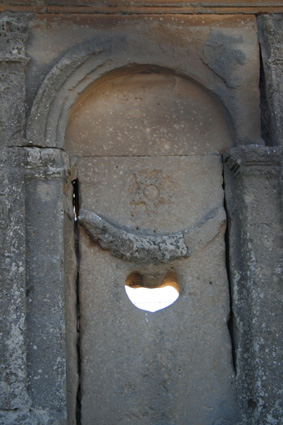
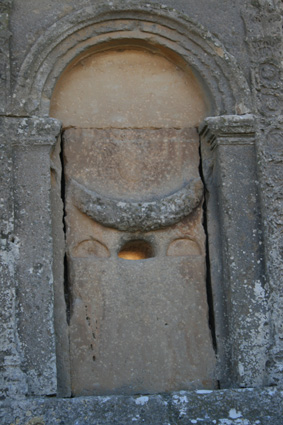
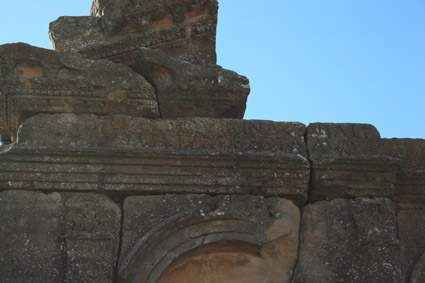
The character of this mausoleum, a rich and well decorated building, shows its ownership of a rich family in the zone. The Atilii should be a local oligarchic family, members of the municipal elites, probably due to the ownership of a large estate with cereal production; they surely occupied some charges in the local magistracies. They belonged to the Quirina tribe –one of the 35 tribes which the Romans were divided into-; in the municipalities founded by Flavian emperors the Quirina tribe was pre-eminent; but in the Augustean municipalities the Galeria tribe was pre-eminent. The inscriptions on the mausoleum could be a testimony about the transformation of Segia (now Ejea de los Caballeros) and Terraca (now the remains in the Bañales of Uncastillo) into Latin municipalities under the Flavian emperors and they are taken as referent to a date, at the end of the I century a. C., but the most sustained theory said that the mausoleum is dates in the first half of the II century a. C. or the III century. Architecturally the mausoleum should be an area in the open air with an altar in the centre; under the altar should be the buried dead. From the original building it only exists the main façade with 9,20 metres long and 4,72 tall. This façade is divided in five hollows or pseudo-niches protected by semi-circular arches with mouldings and flanked by decorated pilasters. The entablature over the pseudo-niches belongs to the Ionic order: architrave with moulding of fasciae and frieze with three inscriptions over the central and lateral hollows and under three tympanums; between the frieze and the tympanums there is a profusely decorated cornice. This façade is one of the ornamental jewels of the funeral Roman art in Hispania. All the façade and its constitutive elements are decorated, avoiding the monotony. The pilasters are full of vegetal motives: acanthus, vines with vine shoots and racemes, leafs, ripe fruits; the capital of the pilasters with acanthus’ leafs; in the hollows, patera –dish used to make sacrifices- and ascia –axe or large hoe- as symbols of a sacred place, Medusa –Hellenistic element linked to the nature forces and to the life beyond the grave- and an eagle as symbol of the apotheosis. Between the pilasters, over the gap of the niches, garlands of fruits and laurel hang representing gifts to the dead, as a reference to the eternal springtime and to the felicitas temporum -the happiness of the times-. |
||
|
|
|
|
|
Details of the decoration in two of the niches of the Mausoleum (Photographies: Roberto Lérida Lafarga 3/11/2007) |
||
|
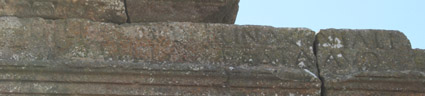
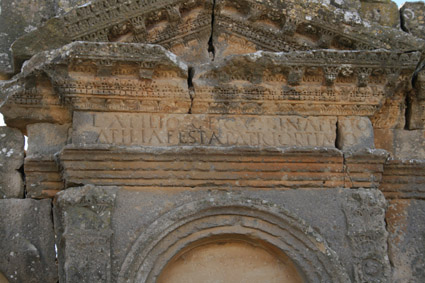
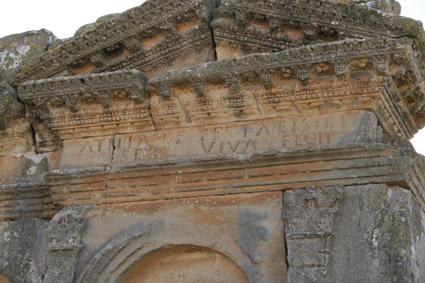
On the mausoleum there are preserved three inscriptions below the three tympanums or triangular pediments. In them the name of three members of the Atilii’ family appear: Caius Atilius Genialis, Lucius Atilius Festus –Caius’ son- and Atilia Festa –Lucius’ daughter and Caius’ granddaughter, who took charge of building the mausoleum-. |
|
|
Text of the inscription
C(aio) ATILIO L(ucii) F(ilio), QVIRINA (tribu) GENIALI / ATILIA FESTA AVO(lo)
|
|
(Photographies: Roberto Lérida Lafarga 3/11/2007) |
Our translation Atilia Festa to her grandfather Caius Atilius Genialis, Lucius' son, from the tribe Quirina |
|
|
Text of the inscription
L(ucio) ATILIO C(aii) F(ilio) QVIRINA (tribu) FESTO / ATILIA FESTA PATRI OPTIMO
|
|
(Photographies: Roberto Lérida Lafarga 3/11/2007) |
Our translation: Atilia Festa to her excelent father Lucius Atilius Festuso, Caius' son, from the tribe Quirina |
|
|
Text of the inscription
ATILIA L(ucii) F(ilia) FESTA ET SIBI / SE VIVA FECIT
|
|
(Photographies: Roberto Lérida Lafarga 3/11/2007) |
Our translation: Atilia Festa, Lucius' daughter, staying alive, didi it (the mausoleum) for herself too |
|
|
|
Sources: - ORTIZ PALOMAR, M.ª Esperanza y PAZ PERALTA, Juan Ángel: Los Bañales (Uncastillo). Los Atilios. La Sinagoga (Sádaba), Zaragoza, 2005 - ORTIZ PALOMAR, Esperanza: “Los Bañales (Uncastillo). El tiempo ausente del espacio vigente. Baños Romanos”, en AA. VV.: ArquEJEAlogía. Ejea de los Caballeros y las Cinco Villas, de la Prehistoria a la Antigüedad Tardía, Zaragoza, 2006 |