THE LEGION

|
|
THE LEGION |
|
|
The name that the recruited Roman army had at first was legion –in Latin legio, from the verb legere, “select”. This legio was composed by the contingents supplied by the Roman tribes and curiae. The legion was the heavy infantry in the Roman army. Rome was divided into three tribes (Ramnes, Tites y Luceres) and every tribe into 10 curiae; every curia provided 10 cavalrymen (decuria) and 100 infantrymen (centuria); so, the primitive Roman army was composed by 300 cavalrymen (celeres) and 3.000 infantry men (milites). During the Monarchy, the cavalry was rather the king’s personal guard and they usually fought on foot, while the infantry fought chaotically almost without battle order. |
|||||
|
|
|
|
|||
|
This military organization suffered some modifications along the Roman history: the original legio increased, because the Roman population increased little by little and, obviously, its military contingent. Before the V century b. C. it was allowed the entrance of the plebs in the army and a further reform –attributed to Servius Tullius- seemed to establish in an almost definitive way the real legion, instituting that the landowner had the obligations of leading and defending the Estate. Under Servius Tullius the legion had about 4.000 men divided into centuriae –hierarchy based on the census that allowed the recruitment of the soldiers; the census divided the population into different classes according to their wealth- and it was organized in this way: This organization lasted almost two centuries during the Republic, multiplying the structure according to the needs of new soldiers. |
|
CAVALRY |
The richers |
||
|
18 centuriae |
|||||
|
HEAVY INFANTRY: LEGION |
1.ª class |
||||
|
2.ª class |
|||||
|
3.ª class |
|||||
|
LIGHT INFANTRY: VELITES |
4.ª class |
||||
|
5.ª class |
|||||
|
ENGINEERS |
2 centuriae of fabri |
||||
|
MILITARY MUSICIANS |
2 centuriae of tibicines |
||||
|
|
|
|
|||
|
Camilus, known as “the second founder of Rome”, reorganized the army in the IV century b. C. in this way: In this organization, the legion became an infantry division, keeping the cavalry apart from this organization. The legion was divided into manipuli –tactical units similar to the modern companies- that in their turn were divided into centuriae, i. e., sections. Nevertheless, the ideal organization worked only few times: we know that the centuriae hardly ever had 100 men –in spite of their name-; in fact, during the Punic Wars, the legions were composed by 30 or 60 men, attended by the velites (light infantry men recruited among the youngest and poorest citizens, armed with javelins and slings; they used to camp outside de encampment to keep watch and they made the skirmish); so, a legion had not 6.000 men, but between 1.800 and 3.600 men and the velites. |
|
30 or 60 men attended by velites |
CENTURIA |
|
|
|
60 or 120 men attended by velites |
2 centuriae |
MANIPULUS |
|
||
|
1.800 or 3.600 men attended by velites |
60 centuriae |
30 manipuli |
LEGION |
||
|
|
|
|
|
|
|
|
The 60 centuriae of a legion had three kinds of soldiers: 20 centuriae of hastati (“spearer”, recruited soldiers armed with spears –hasta-; they occupied the first battle line in the legion) –every centuria had 60 hastati-; 20 centuriae of principes (“princes, the firsts, experienced soldiers who stayed in first line some time ago; they were armed like the hastati and they occupied the second battle line) –every centuria had 60 principes; and, finally, 20 centuriae of triarii (veteran soldiers with complete cuirass; they occupied the third battle line) –every centuria had 30 triarii. All these soldiers formed the legion, the heavy infantry of the Roman army; the light infantry was composed by the velites –Roman citizens- and the no Roman auxiliary troops (Italics or extra-Italics); every centuria had 20 velites, who usually fought even in front of the legion, in the real first battle line. |
|
TRIARII |
20 centuriae |
30 men |
600 triarii by legion |
|
PRINCIPES |
20 centuriae |
60 men |
1.200 principes by legion |
||
|
HASTATI |
20 centuriae |
60 men |
1.200 hastati by legion |
||
|
VELITES |
They did not form centuriae |
20 men by centuria |
1.200 velites by legion |
||
|
|
|
TOTAL |
4.200 men by legion |
||
|
|
|
|
|
|
|
|
Every legion was accompanied by a legionary cavalry, divided into turmae, i. e., squadrons of 3 decuriae.
|
|
10 men |
DECURIA |
|
|
|
30 men |
3 decuriae |
TURMA |
|
||
|
300 men |
30 decuriae |
10 turmae |
CAVALRY |
|
Caius Marius, at the end of the II century b. C., made another reform in the legions. His organization was made not according to the wealth of the Roman citizens, but according to their ages and their military value; so, in the legions there were recruits, soldiers, technicians and veterans. On the other hand, Marius replaced the manipulus as tactical unit by the cohorts –cohortes-, which assembled 3 manipuli (one of hastati, another of principes and another of triarii). The number of soldiers was increased in every legion.
|
|
100 men |
CENTURIA |
|
|
|
|
200 men |
2 centuriae |
MANIPULUS |
|
|
||
|
600 men |
6 centuriae |
3 manipuli |
COHORS |
|
||
|
6.000 men |
60 centuriae |
30 manipuli |
10 cohortes |
LEGION |
|
As Rome was expanding along the Italic Peninsula, it sheltered the new Italics allies in its army , but it never allowed them to take part in the legions during the Republic; they were auxiliary troops (auxilia), both as light infantry, attending the legions, and as cavalry, called alae equitum (“wings of the cavalry”). Afterwards, when Rome, still in the Republic, extended outside the Italic Peninsula, it sheltered even foreigner contingents in its troops, in most of the cases as especial corps: slingers from the Balearic islands (funditores), archers from the Crete island (sagitarii); horsemen from Numidia, Hispania, Gaul, Thracia, etc. The regular number of legions in the republican age was four, although in the 218 b. C. there were 6 legions and in the 211 b. C., 23 legions; at any case, these were not full legions with 6.000 men, but they probably did not reach the number of 4.000 soldiers per legion. At the end of the Republic, almost private armies started to be created, under the command of generals with prestige, like Cnaeus Pompeius or Iulius Caesar; so, private legions were developed at the same time as the official state legions. As example of this increasing number of legions, we know that in the battle of Actium Octavius Augustus had 50 legions against the Marcus Antonius’ legions. Then, at the beginning of the imperial age, Augustus decided the reorganization of the army, which became professional. He dissolved some legions, he joined some other legions into one only legion and the number of 50 legions was reduced into 28; under the emperor Marcus Aurelius the number was 30 legions. Most of these Aurelian legions lasted more than two centuries and some others like the V Macedonica existed still in the VI century a. C. In the imperial age the Marius’ organization of the legion hardly changed and the few changes were made by the emperor Octavius Augustus. One of these changes was the organization of the first cohort, now divided not in 6 centuriae, but only in 5. The auxiliary troops of native infantry became auxiliary cohorts –cohortes auxiliariae-, divided into centuriae with a number between 500 and 1.000 men per legion. The cavalry was divided into 4 corps: mixed cohorts –cohortes mixtae- with a horseman per every three infantrymen, fighting mixed; legionary cavalry, from 120 up to 300 horsemen per legion; wings cavalry, volunteers recruited both from the Roman citizens and from the provinces; corps of native horsemen that did not form a permanent cavalry. |
||
|
|
|
|
|
At the same time, the increment in the number of legions in a steady way made that all of them had a number, a name -frequently related to the province where they were established-and a nickname: y un sobrenombre (click here to see the web about the Roman legions http://www.legionesromanas.com/): |
||
|
I Germanica II Augusta III Augusta Pia Fidelis III Gallica III Cyrenaica IV Macedonica IV Scythia V Alaudae V Macedonica |
VI Victrix VI Ferrata Fidelis VII Macedonica VIII Augusta Mutinensis IX Hispana X Gemina -before Equestris- X Fretensis XI XII Fulminata |
XIII Gemina Pia Fidelis XIV Gemina Martia Victrix XV Apollinaris XVI Gallica XVII XVIII XIX XX Valeria Victrix XXI Rapax XXII Deiotariana |
|
In round numbers, the imperial Roman army had in a regular way 150.000 legionaries with a military service of 20 years; so, every year it was necessary to recruit only 10.000 new legionaries; on the other hand, the auxiliary troops were very numerous, but they served in the army for 25 years. At the end of the Empire, in the IV century a. C., the legions were divided according to their place of residence into four types: legiones palatinae, “palatial”, i. e., the nearest to the emperor; legiones comitatenses, in the interior; legiones pseudo-comitatenses, close to the frontiers; and legiones riparenses, “on the borders”, i. e., located in the frontiers and in the confines of the empire. |
||
|
|
|
|
|
Finally, we have to mention that the Roman army was the main vehicle of the Romanization in vast territories, especially in Western Europe and Africa; the army not only conquered the large Roman empire, but they built roads, aqueducts, bridges, amphitheatres, theatres, circus, etc., and, at the same time, when they stayed temporally or steadily in their camps and in the Roman cities newly conquered along the empire, they gave a new language to the conquered nations, the Latin, which became the common language in the empire. |
||
|
Organization of a centuria in the imperial age
|
|
Tesserarius |
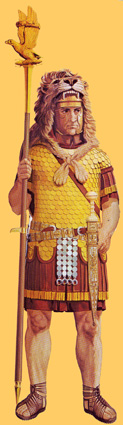
Aquilifer |
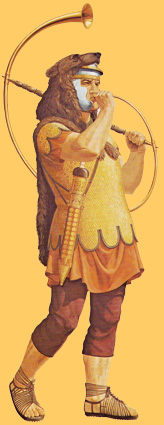
Tubicen |
|
|
|
|
|
Optio |
|
|||
|
|
|
|
|
|||
|
|
|
|
|
|||
|
|
|
|
|
|||
|
|
|
|
|
|||
|
|
|
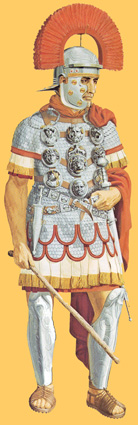
Centurio |
|
|||
|
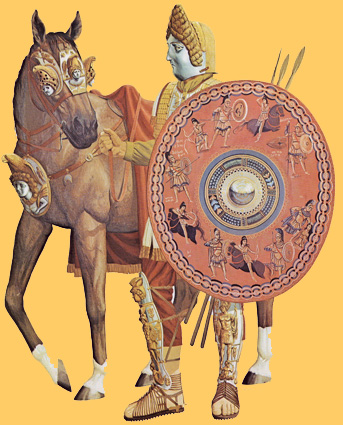
All the pictures from the different kinds of soldiers that appear in this web are taken from the reproductions of CONNOLLY, Peter: Greece and Rome at War, London, 2006 |
|
|
|
|
|
SOURCES: - BROCKLEHURST, Ruth: Roman Army, London, 2003 - CONNOLLY, Peter: Greece and Rome at War, London, 2006 - HACQUARD, Georges: Guía de la Roma Antigua, Madrid, 2003 |
|
|
WebQuest: Playmobil y el Ejército Romano |
|