INSULAE

|
|
INSULAE |
|
|
The classical sources, concretely the Regionarii –list of monuments, houses, baths, etc. made by civil servants charged to make the survey and the lists of building in the early IV century a. C.-, divided the Roman houses basically into two different types: 1.797 domus –private residences for an only family- and 46.602 insulae –block of flats-. |
||
|
|
|
|
|
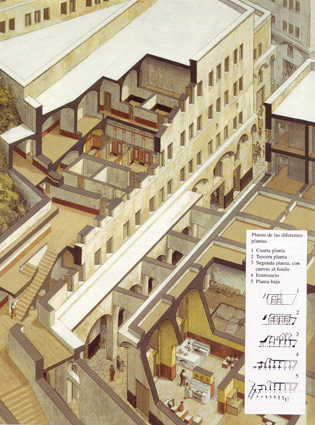
The insulae were the blocks of flats that occupied a complete block between streets. The houses in the insulae had windows to the street and, only if they had a large size and they had an interior square court, then they had windows and doors in the interior court. The different division of an insulae –the different flats- were called cenacula, i. e., independent houses with some rooms –like the flats of an present block of flats-; so the insulae were conceived in a vertical way. In the III century b. C. the Roman writers informed us that there were in Rome insulae with three floors (called tabulata, contabulationes or contignationes); Cicero, On the agrarian law 2, 96, said Romam ... cenaculis sublatam atque suspensam (“Rome submitted to the cenacula and suspended”). Due to the risk of the height of this kind of buildings, it was necessary a legal regulation of their height and it was forbidden to build insulae higher than 70 feet (=20 metres). So, we had testimonies from Roman writers like Martial or Juvenal about insulae with more than three floors, concretely five and six floors. |
||
|
|
|
|
|
However, the insulae were divided into two different types: first, the sumptuous insulae that reserved the ground floor to the residence of a wealthy family; this floor had prestige and advantages similar to a domus –in fact, this ground floor was called domus, while the rest of the floors were called cenacula-; second, the modest insulae, whose ground floor was reserved to tabernae, stores and shops.
|
|
|
|
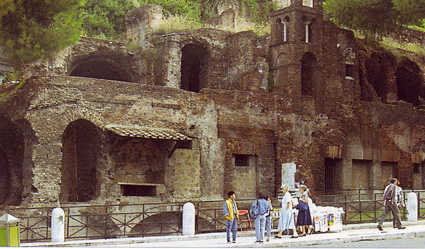
Remains of a insula in the Capitol hill, in Rome (II century a. C.). Photography and reconstruction from CONNOLLY, Peter y DODGE, Hazel: La Ciudad Antigua. La vida en la Atenas y Roma clásicas, Madrid, 1998. |
||
|
|
|
|
|
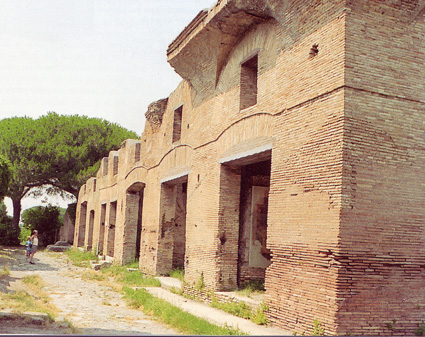
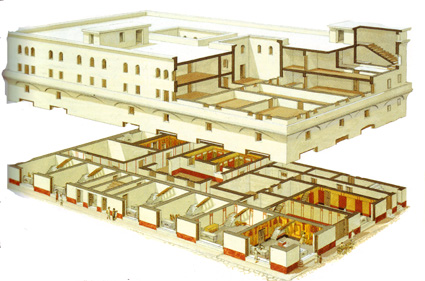
These tabernae were completely open to the exterior –wooden jambs allowed to open them in the morning and to close them in the evening- and they had a limited space to shelter a store, a handicraft workshop or a shop counter. In general, a small staircase at the back of the tabernae allowed an access to the apartment where the tenant of the taberna or the store guardians or the workers in the workshop lived; this apartment usually was an only room where they slept, cooked, worked, etc. |
||
|
|
|
|
|
Insula known like Diana’s House in Ostia, the port of Rome. The tabernae are preserved with their corresponding entresols –used as stores or apartments-; on the right, its reconstruction with the ground floor preserved and the upper floors. Photography and reconstruction from CONNOLLY, Peter y DODGE, Hazel: La Ciudad Antigua. La vida en la Atenas y Roma clásicas, Madrid, 1998. |
||
|
|
|
|
|
The insulae usually occupied a surface between 300 and 400 m2 and they had walls made with bricks or with the cheaper opus craticum –a wooden shell refilled with stone and mortar- with several and wide windows and doors. The façade line of the tabernae was protected by porches; at the same time in the wider streets the insulae could had loggias –called pergulae-, that were supported by the porches, or balconies –maeniana- made in wood or bricks; the pilasters of loggias and balconies were decorated with climber plants and the windows with flowerpots. In the sumptuous insulae the grounds were carpeted with mosaics and floor tiles, while the walls could be covered by pictures in rich colours. Only in the ground floor there were latrines and maybe running water; so the flats were miserable and unhealthy houses. In addition, the insulae used to have scarce hardness in their building, poverty of furniture and deficiencies in lighting, heating and hygiene. |
||
|
|
|
|
|
La desproporción entre la superficie y la altura de las insulae las hacía inseguras, siendo muy frecuentes sus derrumbamientos; así se legisló sobre el grosor de los muros para lograr una mayor base de apoyo para los distintos pisos (45 cms. en época de Vitruvio). Otro problema eran los frecuentes incendios. Las insulae eran construidas con vigas de madera, pero para cocinar y para calentarse se usaban infiernillos portátiles, velas, lámparas de aceite, antorchas, etc.; a ello se suma que el suministro de agua rara vez llegó a las insulae, de modo que los incendios estaban a la orden del día y su sofocamiento era una tarea bastante ardua, por cuanto se propagaban con gran rapidez a otros cenacula y a otras insulae.
|
||
|
The lack of proportion between the surface and the height in the insulae made them unsafe and their collapse was very frequent; so the Romans made a legal regulation about the thickness of the walls in order to reach a large support base to the several floors (45 centimetres in the age of Vitruvius). |
||
|
|
|
SOURCES: - CARCOPINO, Jerôme: La vida cotidiana en Roma en el apogeo del Imperio, Madrid, 1993 - CONNOLLY, Peter y DODGE, Hazel: La Ciudad Antigua. La vida en la Atenas y Roma clásicas, Madrid, 1998 - PAOLI, Ugo Enrico: URBS. La vida en la Roma Antigua, Barcelona, 1990 |