ROMAN HOUSES: Previous Aspects

|
|
ROMAN HOUSES: Previous Aspects |
|
|
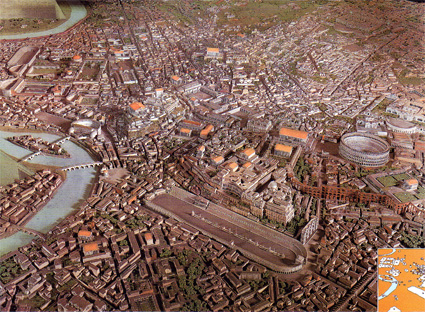
Rome reached probably more than 2.000 hectares (4.942.000 acres) where more than a million people –there is not an agreement on this number, that it would be between a million and even two million inhabitant- lived in an uncomfortable way. We have to think that there were a lot of no inhabitable zones: public buildings, temples, basilicae, stores, baths, theatres, circus, tabernae, the river Tiber bed, gardens and parks, zones reserved to the emperors and the Campus Martius, filled of temples, porches, graves, etc., where there was not possible to build houses So, the surface where the Romans, their liberti, their slaves and the foreigners lived was very reduced; in addition we have to say that there were no suitable and efficient means of transport, so it was relatively frequent that a man never went out of concrete territorial limits. In order to shelter so much population in a so relatively small surface the Romans resorted to two basic ways to make use of the terrain: narrow streets and blocks of flats. That gave to the city a lack of balance between the splendid and monumental public building and the narrow houses and the irregular blocks of buildings and flats that stood beside. |
||
|
|
|
|
|
Street plan of Rome under the emperor Constantine. We can see the colossal size of some public buildings and the net of narrow and chaotic streets. |
||
|
|
|
|
|
The classical sources, concretely the Regionarii –list of monuments, houses, baths, etc. made by civil servants charged to make the survey and the lists of building in the early IV century a. C.-, divided the Roman houses basically into two different types: 1.797 domus –private residences for an only family- and 46.602 insulae –block of flats-. |
||
|
|
|
|
|
|
|
SOURCES: - AA. VV.: Museo de Zaragoza. Guía, Zaragoza, 2003 - CARCOPINO, Jerôme: La vida cotidiana en Roma en el apogeo del Imperio, Madrid, 1993 - CONNOLLY, Peter y DODGE, Hazel: La Ciudad Antigua. La vida en la Atenas y Roma clásicas, Madrid, 1998 - PAOLI, Ugo Enrico: URBS. La vida en la Roma Antigua, Barcelona, 1990 |