DOMUS

|
|
DOMUS |
|
|
The classical sources, concretely the Regionarii –list of monuments, houses, baths, etc. made by civil servants charged to make the survey and the lists of building in the early IV century a. C.-, divided the Roman houses basically into two different types: 1.797 domus –private residences for an only family- and 46.602 insulae –block of flats-. |
||
|
|
|
|
|
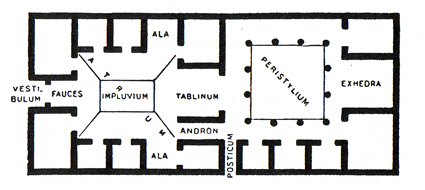
The domus were the residences of the patricii –people that belonged to the ancient, powerful, rich and noble Roman families- and the riches. The exterior wall are massive and blind –without windows-; these domus had all the rooms opened into an interior court –atrium- that very often was a porch with columns –then it was called perystilum-. This kind of building was conceived in horizontal way, because in general it had only a ground plan. The domus used to be divided in rooms with fixed proportions, especial uses and even an invariable order: vestibulum (like a vestibule or hall between the street and the entrance door to the house), atrium (square or rectangular court; it was the centre of the domus, where its aperture in the open air –impluvium- allowed that rain water was stored in a deposit –compluvium-), alae (wings of a building, two rooms that stood in two opposite sides of the atrium, used originally to the entrance of water and air and to communicate with the exterior), triclinium (dinning room where the guests and the owners ate, reclining on couches–triclinia-), tablinum (room used like a study where the owner welcomed to his clientela), peristylum (porch court or atrium with columns) and cubicula (bedrooms). The domus preserved in Pompeii had a surface between 800 and 900 m2.
|
|
Plan of a typical domus according to PAOLI, Ugo Enrico: URBS. La vida en la Roma Antigua, Barcelona, 1990 |
|
|
|
|
|
Historically, the domus derived from the Etruscan kind of houses with a central atrium, but thanks to the Greek –Hellenistic- influence they became into luxury buildings with gardens and peristyla –porches with columns-. The domus were organized in a series of bedrooms in three sides of the atrium with an entrance aisle between two front rooms from the exterior up to the atrium. The main rooms of the domus –the triclinium and the tablinum- were in the fourth side, in the opposite of the entrance, the kitchen and the ante-kitchen. Some times, especially in the urban domus, besides the room to slaves, there were rooms opened to the exterior and not communicated with the rest of the domus; these rooms were used like apartments to rent to workers in the domus or in the neighbourhood or like tabernae to rent to trades. |
|
Reconstruction of the triclinium of a domus in Añón street (I century a. C.), from Caesar Augusta. Museo Provincial de Zaragoza. (Photo: Roberto Lérida Lafarga 3/1/2008) |
|
|
|
|
|
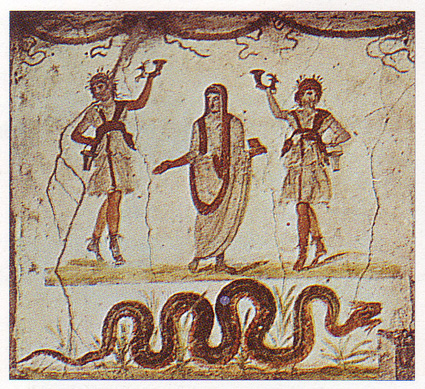
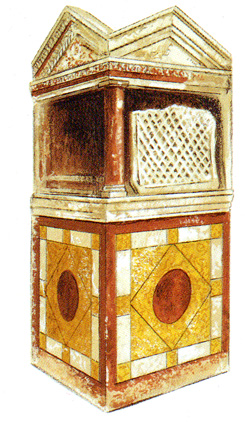
In the atrium, in the main entrance of the domus, there was the lararium –an altar dedicated to the home gods, lares (spirits of the family ancestors) and penates (guardians of the stock of food)-; these gods received every morning an offering. In general the lararium consisted in a niche or hollow or a wooden board with pictures or small statues of these spirits and some times it was represented by a temple in miniature. Here the Romans kept safe the documents of the family and the valuables.
Picture of a lararium representing lares and penates, from Pompeii (Italy). Photography from CONNOLLY, Peter y DODGE, Hazel: La Ciudad Antigua. La vida en la Atenas y Roma clásicas, Madrid, 1998. |
|
Lararium with wooden lattice in the so called Menander’s House in Pompeii (Italy). Photography from CONNOLLY, Peter y DODGE, Hazel: La Ciudad Antigua. La vida en la Atenas y Roma clásicas, Madrid, 1998. |
|
|
|
|
|
The palaces of the emperors in Rome were conceived like big domus with a large number of rooms, with all kind of luxuries in the decoration and in the building materials used, with colossal proportions in some cases, with gardens, libraries, baths and other private rooms, etc. In fact, these residences were called domus: the domus Aurea was the Nero’ palace, the domus Augustana was the Augustus’ palace, the domus Tiberiana was the Tiberius’ palace, the domus Flavia was the Vespasian’ palace. The complex of the imperial houses is located in the Palatine hill in Rome, between the Forum and the Circus Maximus. |
||
|
|
|
|
|
|
|
FUENTES: - AA. VV.: Museo de Zaragoza. Guía, Zaragoza, 2003 - CARCOPINO, Jerôme: La vida cotidiana en Roma en el apogeo del Imperio, Madrid, 1993 - CONNOLLY, Peter y DODGE, Hazel: La Ciudad Antigua. La vida en la Atenas y Roma clásicas, Madrid, 1998 - PAOLI, Ugo Enrico: URBS. La vida en la Roma Antigua, Barcelona, 1990 |