DECORATION

|
|
DECORATION |
|
|
To decorate the public buildings and the rich men’ houses, the Romans used marble, granite and porphyry. The white marble was generally imported from Greece until the year 35 b. C., but after that the Romans started to use the white marble from Carrara –in the north of Italy-; the coloured marbles came from the Aegean islands in Greece and from Africa. |
||||
|
|
|
|
||
|
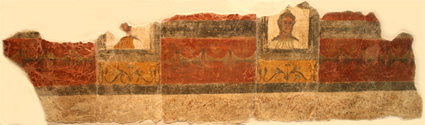
A decoration with frescos and murals was considered more modest; the Roman used normally rich colours and they represented in these pictures mythological scenes, landscapes, animal, portraits, geometrical figures, etc. Their preservation has been relatively scarce, because the fires, the materials –natural pigments that the water, the humidity, etc. demeaned them- and other factors have damaged and destroyed these pictures.
|
|
|
||
|
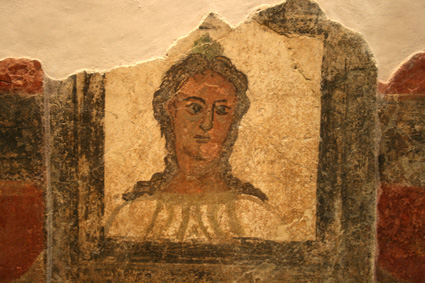
Mural from the north wall of a room whose utility is unknown (4,15 x 1,17 metres), from a domus of Caesar Augusta located in the present San Agustín street (in the age of Hadrian 114-138 a. C.). Only it is preserved the lower third of the wall where we can see a decoration that imitates the veined marble –at the bottom- and -at the top- framed busts of women –probably the Muses- (on the right, detail of one of them). Museo Provincial de Zaragoza. (Photography: Roberto Lérida Lafarga 3/1/2008) |
||||
|
|
|
|
||
|
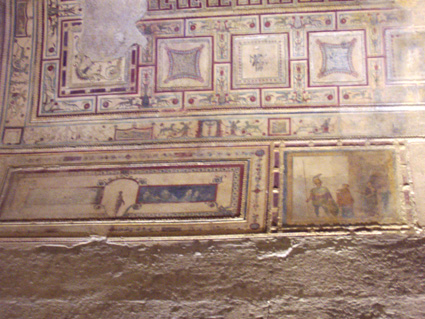
Fresco that decorated the vault of a room in the Nero's domus Aurea. (Photography: Roberto Lérida Lafarga 2/1/2005) |
|
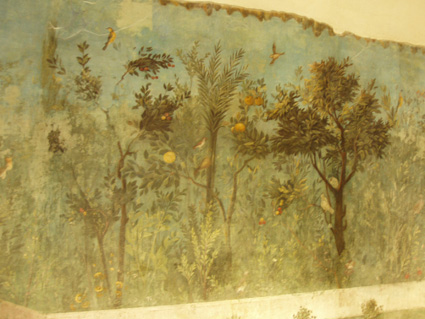
Fresco from the Livia's villa, Augustus' wife. The decoration reproduces a garden with fruit trees, fragant herbs and birds. Museo Palazzo Massimo in Rome (Photography: Roberto Lérida Lafarga 31/12/2004) |
||
|
|
|
|
||
|
In general the mosaics were used as pavement in rooms and fountains, and even in the walls of some rooms. A large number of mosaics is preserved along the Roman empire and in Aragon.
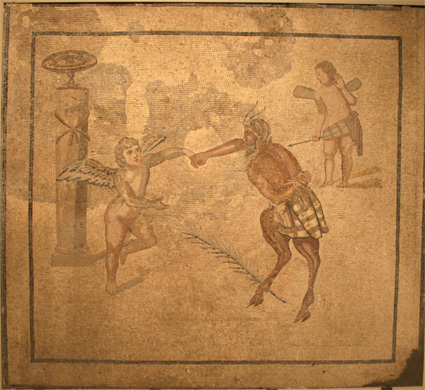
Mosaic of Eros and Pan (2,04 x 2,25 metres), from a room of a domus in Caesar Augusta located in the present Zuda street (late II century or early III century a. C.). In the mosaic Eros is represented with the hands entwined with Pan's hands and at the back Psyche hurt by an arrow in her thigh. Museo Provincial de Zaragoza. (Photography: Roberto Lérida Lafarga 3/1/2008) |
|
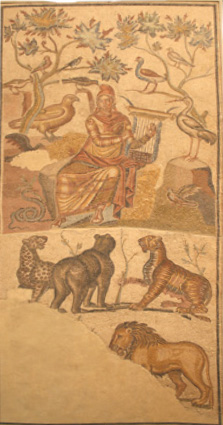
Mosaic of Orfeus (9,03 x 6,03 metros), from a room of a domus in Caesar Augusta located in the present Zuda street (late II century or early III century a. C.). In the mosaic Orfeus is represented playing a lyre in front of wild animals. Museo Provincial de Zaragoza. (Photography: Roberto Lérida Lafarga 3/1/2008) |
||
|
|
|
|
||
|
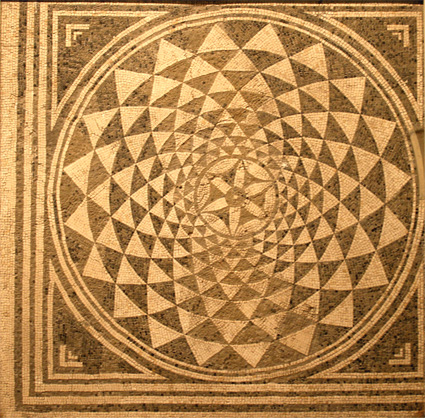
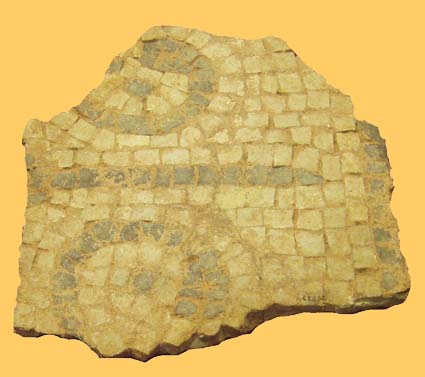
Two-colour geometric mosaic (1,45 x 1,42 metres), probably from the pavement of a triclinium in a domus of Caesar Augusta (late I or early II century a. C.). In the mosaic it is represented a rosette in curvilinear triangules with a small rosette of six petals in the centre. Museo Provincial de Zaragoza. (Photography: Roberto Lérida Lafarga 3/1/2008) |
|
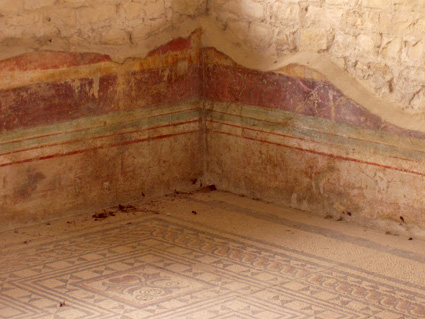
Decoration of a room; detail of a corner with frescos in rich colours in the skirting board of the wall and pavement of geometric mosaic and flowers, from a villa in Vasio (nowadays Vaison la Romaine, Provence, France). (Photography: Roberto Lérida Lafarga 6/8/2007) |
||
|
|
|
|
||
|
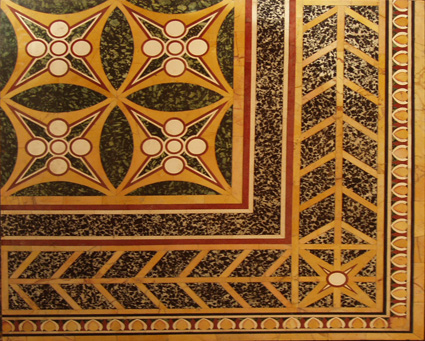
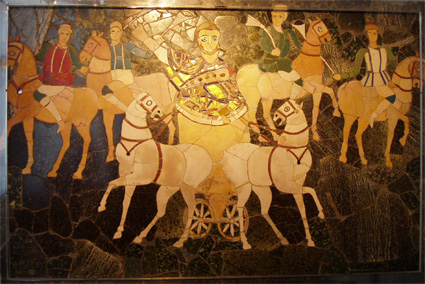
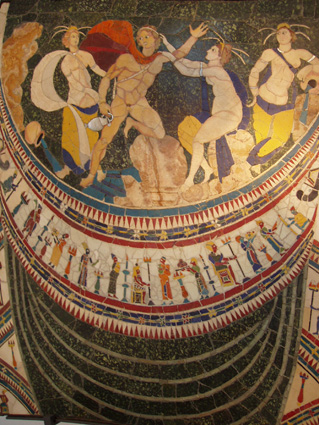
Marble pavements and walls were less frequent, due to their prize and the fragility of this material; we are talking not about marble in floor tiles or paving stone or carpet tile, but marble mixed and combined in different colours to create pictures and scenes in the style of the mosaics. Of course, we are accustomed to see Roman public buildings and the big villae and domus, all of them decorated with Travertine or Carrarian marble in their façades and their walls, but undoubtedly the mixed marble pavements and walls are luxury works only available to the big fortunes. |
|
Wall with combinated marbles in geometric figures (I century a. C.) from an imperial residence im the Palatine hill, maybe the domus Tiberiana. Museum of the Palatine, Rome. (Photography: Roberto Lérida Lafarga 28/12/2004) |
||
|
|
|
|
||
|
Wall with combinated marbles in human figures and horses (I century a. C.). Museo Palazzo Massimo, Rome. (Photography: Roberto Lérida Lafarga 31/12/2004) |
|
Wall with combinated marbles in human figures (I century a. C.). Museo Palazzo Massimo, Rome. (Photography: Roberto Lérida Lafarga 31/12/2004) |
||
|
|
|
 |
|
|
|
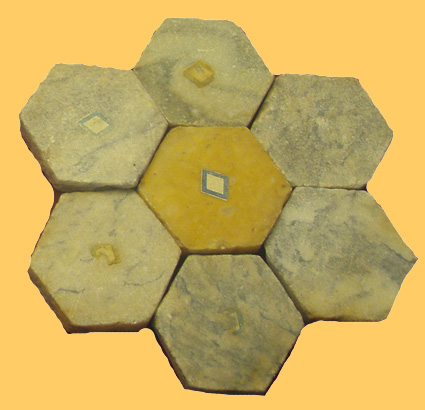
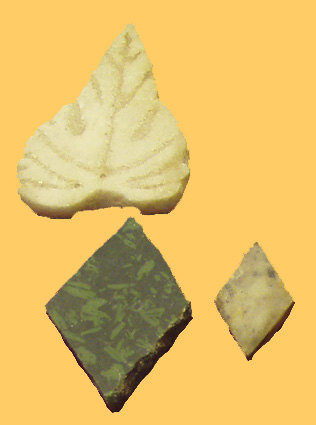
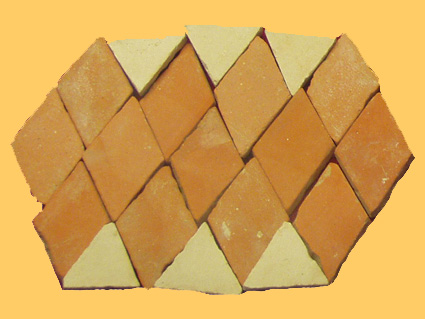
Four types of pavements: mosaic, marble carpet tile, clay carpet tile and marble carpet tile with different colours and geometrical and vegetal shapes. Museo Arqueológico Nacional (Madrid, Spain). (Photo: Roberto Lérida Lafarga 10/07/2007) |
||||
|
|
|
SOURCES: - AA. VV.: Museo de Zaragoza. Guía, Zaragoza, 2003 - CARCOPINO, Jerôme: La vida cotidiana en Roma en el apogeo del Imperio, Madrid, 1993 - CONNOLLY, Peter y DODGE, Hazel: La Ciudad Antigua. La vida en la Atenas y Roma clásicas, Madrid, 1998 - PAOLI, Ugo Enrico: URBS. La vida en la Roma Antigua, Barcelona, 1990 |
||