MUSEUM OF THE RIVER PORT OF
CAESAR AUGUSTA
|
|
MUSEUM OF THE RIVER PORT OF CAESAR AUGUSTA |
|
NOTE: THE BUILDING AND THE ARTISTIC PIECES EXPOSED IN IT BELONG TO THE TOWNHALL OF SARAGOSSA (AYUNTAMIENTO DE ZARAGOZA)
|
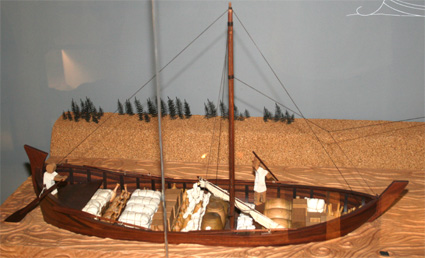
The navigable character of the Ebro river in the Roman age up to Vareia (the modern Logroño), the size of the city of Caesar Augusta, its strategic position and importance in the routes from Tarraco (now Tarragona) up to Asturica Augusta (nowadays Astorga) and Emerita Augusta (the modern Mérida), and the fact that Caesar Augusta was political and administrative centre as capital of the conventus iuridicus Caesaragusutanus were weighty reasons to the fact that the city had trade establishments and a river port. |
|
Reconstruction of a ship in one of the showcases in the museum. (Photo: Roberto Lérida Lafarga 28/04/2008) |
|
|
|
|
|
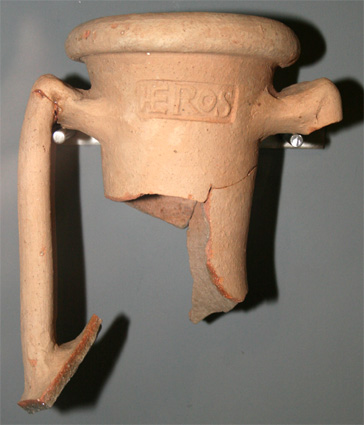
In fact in the Roman age it is testified a intensive and rich trade through the Ebro river with three important harbours: one mixed, river and sea port, near its mouth, in Dertosa (the modern Tortosa), another port in the final point of the navigation along the river in Vareia (Logroño) and another intermediate port in a big Roman city, Caesar Augusta. Thanks to these ports the Romans distributed along the Ebro valley imported products like pottery, marble, wines, salted food, jewels, glasses, etc., and they exported other products to the whole empire like wool, leather, linen, salt, wheat, wood, etc. |
|
Rest of a wine amphora with inscription (HEROS) that probably indicated the name of the wine producer. (Photo: Roberto Lérida Lafarga 28/04/2008) |
|
|
|
|
|
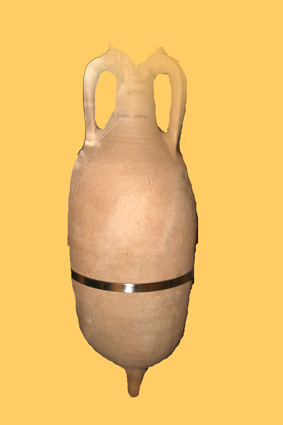
So, the area from the mouth of the Orba river (the modern Huerva) up to the Roman bridge (where it is now the bridge of Piedra –Stone bridge- dated in the medieval age) was conditioned with the draining of the natural terrace that descended to the Ebro river; in this way a large number of empty amphorae were disposed inclined and face downward in the corner of the modern Echegaray y Caballero parade and the Tenerías square to drain the terrain and to raise up the level of this area; at the same time a series of dikes parallel to the river restrained the action of possible floods of the river in the trade area. In this zone the water, after going across a meander, flows mildly and the river bed is straight and even partially protected. |
|
Amphora from the showcases of the museum similar to those used in the terrace of the port area. (Photo: Roberto Lérida Lafarga 28/04/2008) |
|
|
|
|
|
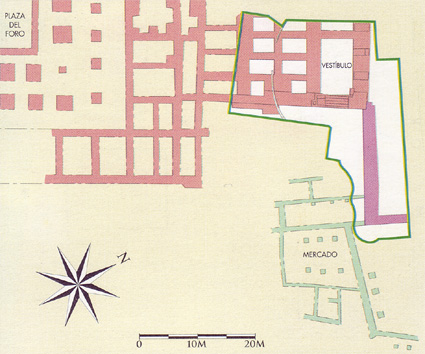
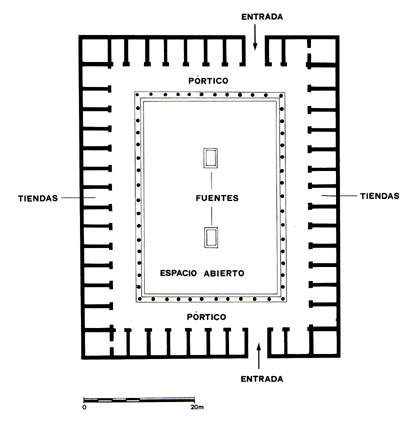
In the La Seo square it was created a forum and a zone to shops and taverns, near the river port and the main street from north to south –cardo maximus-. Here there was the market –macellum- of Augustus, rectangular shaped with one of its sides almost 40 metres long and divided in shops –tabernae-. The macellum of Caesar Augusta should have the typical aspect of any Roman market: rectangular or square structure, with a large central courtyard on the open air with some fountain in the central area and with shops organized around the central courtyard; in general, these markets were located near the forum and in the most important area of the cities. En the case of Caesar Augusta it was near the forum and near the river port, through which most part of the products that were sold in the marked arrived to the city.
Plan of the archaeological remains of the river port and location of the rest of the macellum and the forum, from the pamphlet of tourist information and explanatory panels of the Museum of the river port of Caesaraugusta. |
|
Plan of an ideal macellum, from AGUAROD OTAL, Carmen (coord.): Foro de Caesaraugusta. Programa didáctico. Libro del Profesor y Fichas para los alumnos, Zaragoza, 1996 |
|
|
|
|
|
In the age of the emperor Tiberius it is dated also the definitive construction of this large area for the trade and the store of wheat in Caesar Augusta, dependent and attached to the forum. This zone was located under the modern San Bruno square, part of the Echegaray y Caballero parade and the Sepulcro street.
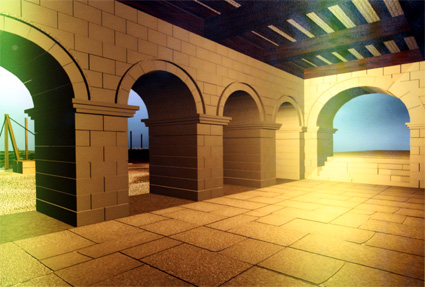
Reconstruction of the inner hall of the building of the river port near the Ebro river. (Photo: Roberto Lérida Lafarga 28/04/2008) |
|
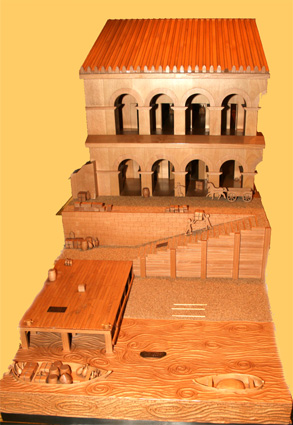
Scale model-reconstruction of the building of the river port near the Ebro river. (Photo: Roberto Lérida Lafarga 28/04/2008) |
|
|
|
|
|
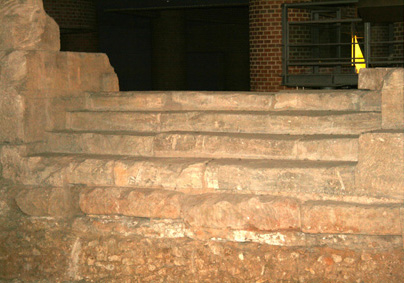
The trade and storage complex had a monumental gate that should connect it to the forum; this gate had a triple access and an outside staircase that overcame the unevenness between the floor of the forum and those of the port. This staircase has been perfectly preserved together with part of a wall with big block of stone well squared.
Outside staircase of the building to access to the river port; view from up above. (Photo: Roberto Lérida Lafarga 28/04/2008) |
|
Outside staircase of the building to access to the river port; frontal view. (Photo: Roberto Lérida Lafarga 28/04/2008) |
|
|
|
|
|
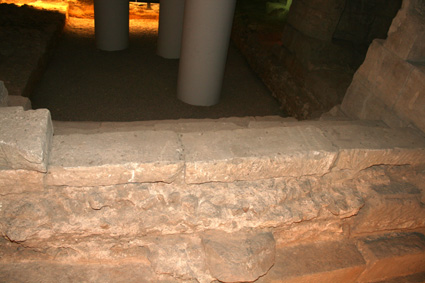
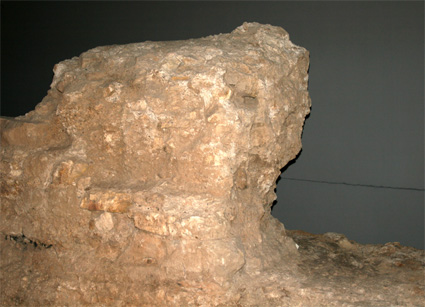
In the Museum of the River Port of Caesaraugusta it is preserved part of the northwest side of the trade building that connected the forum to the river port; concretely from this building we can see the foundations in mortar –opus caementicium- and part of the first floor in big blocks of stone with the outside staircase where we can see some quarrymen’ marks that indicated the number and the name of the legions that took part in the construction of the building and part of the city (X for the Legion X Gemina and VI for the Legion VI Victrix). The preserved part seems to be a porch of transition and access to both structures; the foundations seem to indicate that in the porch there were some round arches on the façade to the Ebro river, so that the building had a monumental character as a symbol of propaganda for those who visited the city. |
|
Wall made of mortar with stones in the river port. (Photo: Roberto Lérida Lafarga 28/04/2008) |
|
|
|
|
|
Anagram of the Museum of the River Port of Caesaraugusta
The Museum is completed by some explanatory dioramas, some scale models and reconstructions and the exhibition of some amphorae with inscriptions. Click here to visit the web of the Museum of the River Port of Caesaraugusta. Click here to know more about the Roman ports and their communication routes. |
|
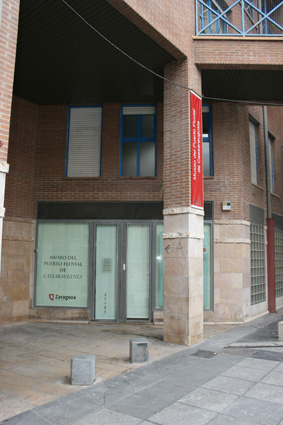
Façade of the Museum of the River Port of Caesaraugusta. (Photo: Roberto Lérida Lafarga) |
|
|
|
|
|
|
|
|
|
|
|
FUENTES: - AGUAROD OTAL, Carmen (coord.): Foro de Caesaraugusta. Programa didáctico. Libro del Profesor y Fichas para los alumnos, Zaragoza, 1996 - BELTRÁN LLORIS, Miguel y FATÁS CABEZA, Guillermo: Historia de Zaragoza 2: César Augusta, ciudad romana, Zaragoza, 1998 - Pamphlet of tourist information and explanatory panels of the Museum of the river port of Caesaraugusta |