THE CAMP

|
|
THE CAMP |
|
|
The camp –castra- is the place where the soldiers had their residence, where they stayed for the night, where they had a rest, where they recovered from their wounds, where they spent the winter and even where they lived; in Spanish, from the Latin word castra it is derived the adjective “castrense”, which denoted anything related to the camp and to the military. If the army were marching –agmen-, every evening the camp was put up, in general well organized. The organization, of course, was complete if the camp was put up to pass the winter –castra hiberna o hibernacula- or if the camp became a permanent camp –castra stativa-, which very often became cities, due to the agglomeration of population around the camp; this is the case of the Spanish city of Leon –the ancient camp of the Legion VII Gemina,; its name came from the legion- or the British cities whose names end in –chester (Manchester, Leicester, Gloucester, etc.), where the suffix came from the Latin word castra. |
||
|
|
|
|
|
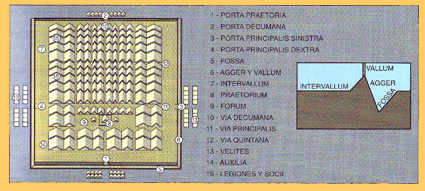
A camp had to be near water and near grazing where the Romans could nourish their horses and their beast of burden that transported all the necessary things for the correct working of the army. In the case of regular camps, their foundation used to be made in a ritual way by one of the augures, main priests who predicted the future and who used to attend the legions; they traced the camp perimeter, the main street from the north to the south –cardo or via principalis- and the main street from east to west –decumanus or via praetoriana or via decumana-; at the end of these streets four gates to entrance to the camp were built; afterwards, the camp was basically organized in minor streets parallel and perpendicular to these two main streets. The perimeter, in general square or rectangular shaped, was dug to make a fosse –fossa- and with the dug ground it was made a rampart –agger-; over the rampart a palisade –vallum- was built; finally, the Roman used to leave a space up to 70 metres between the palisade and the tents of the soldiers called intervallum. The centre of the camp, where the two main streets joined, was occupied by the forum, an open place for an altar, for the general’s harangue, for the shops and for the general’s residence. The dimensions of a camp could change, but Hacquard indicated that a camp for two legions occupied 45 hectares, with these measures: 550 x 800 metres. |
|
Plan of a camp, from VIÑAS, Antonio et alii, Latín, Valencia, 1997
|
|
|
|
|
|
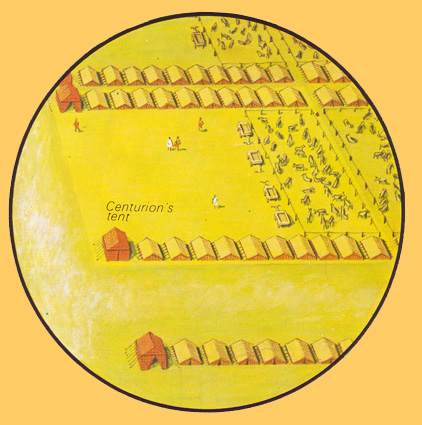
In every camp the forum, the tribunal and the soldiers’ living quarters –tabernacula- were always in the same place in order to improve and to speed up the organization of the camp; in the tents, grouped in large rectangles –strigae- the soldiers were organized, keeping their battle order and their ranks.
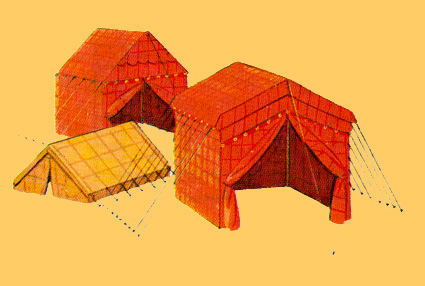
Details of the tents for soldiers in the camp. The red tents belonged to centurions, from CONNOLLY, Peter: Greece and Rome at War, Londres, 2006. |
|
Detail ot the zone where the tents for the soldiers were instaled in a camp, from CONNOLLY, Peter: Greece and Rome at War, Londres, 2006. |
|
|
|
|
|
|
|
SOURCES: - BROCKLEHURST, Ruth: Roman Army, London, 2003 - CONNOLLY, Peter: Greece and Rome at War, London, 2006 - HACQUARD, Georges: Guía de la Roma Antigua, Madrid, 2003 |
|
|
WebQuest: Playmobil y el Ejército Romano |
|