BUILDING MATERIALS

|
|
BUILDING MATERIALS |
|
|
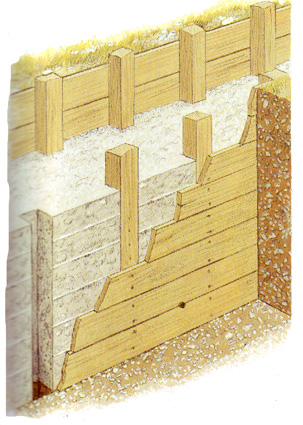
The building materials usually used in the Roman buildings were relatively assorted. The Romans used the opus caementicium –concrete or mortar obtained from a mix of sand, water and small rolling stones or brick fragments-; however there were varieties of opus caementicium, according to use puzzolana –a stronger volcanic sand that even hardened under the water-, very suitable to the foundations of a building, or volcanic stone –a volcanic stone that produce a lighter sand like pumice stone, very suitable to make vaults-; the opus caementicium was necessary to build big and solid buildings, like the public. |
|
Skull of opus caementicium. Reconstruction from CONNOLLY, Peter y DODGE, Hazel: La Ciudad Antigua. La vida en la Atenas y Roma clásicas, Madrid, 1998. |
|
|
|
|
|
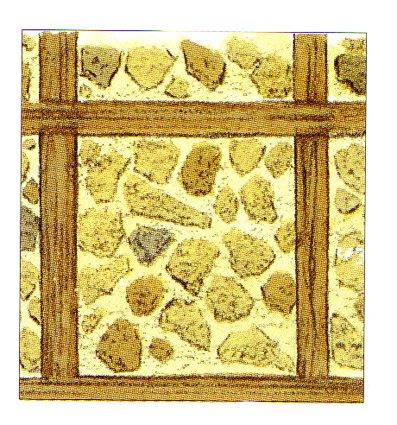
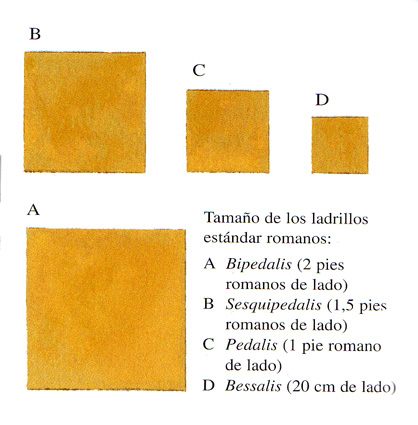
When economic resources were scarce or it was a private building, then the Roman used to resort to cheaper materials, like the opus craticum –a wooden skull refilled with crushing stones and mortar-; bricks were frequent in the Roman buildings too, with different types: : bipedalis –two feet long, 59 cms.-, sesquipedalis –a foot and a half long, 44 cms.-, pedalis –a foot long, 29,5 cms- and bessalis –20cms. long-.
Opus craticum. Reconstruction from CONNOLLY, Peter y DODGE, Hazel: La Ciudad Antigua. La vida en la Atenas y Roma clásicas, Madrid, 1998. |
|
Roman bricks. Reconstruction from CONNOLLY, Peter y DODGE, Hazel: La Ciudad Antigua. La vida en la Atenas y Roma clásicas, Madrid, 1998. |
|
|
|
|
|
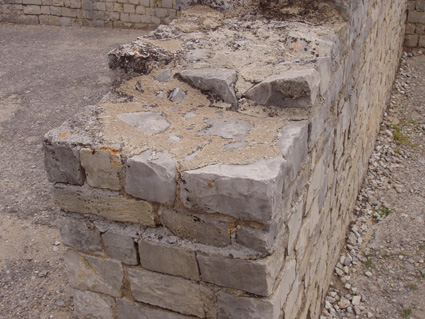
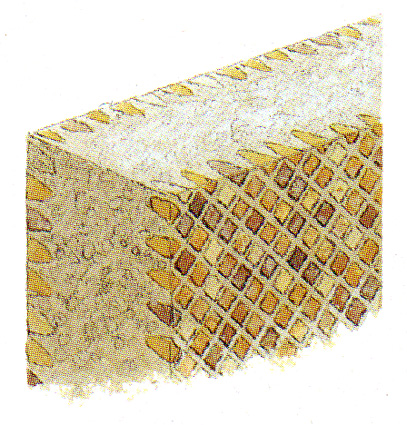
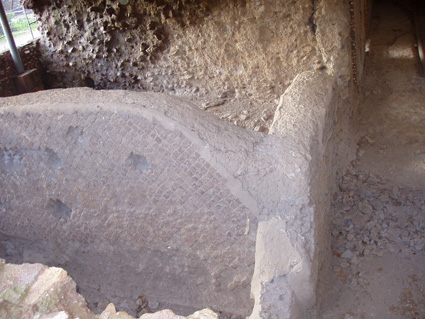
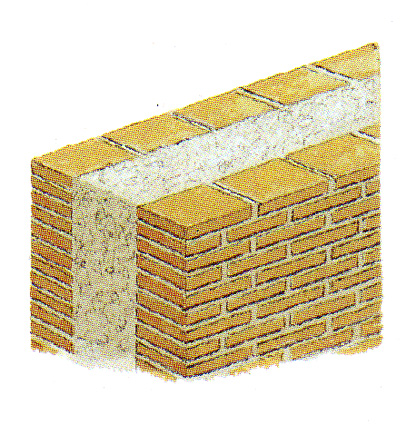
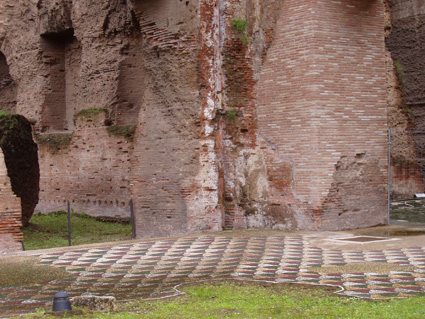
In the buildings the walls used to have a concrete or mortar layer inside that was recovered with other materials: opus incertum –small rough and irregular stones, but with a similar size-; since the II century b. C. the Romans used the opus reticulatum –small blocks of stone in pyramidal shape put in such a way that they formed a reticule-; under the emperor Nero it was general and it was in fashion the opus testaceum –a coating with square and triangular cooked bricks to stick better to the concrete-; under the emperors Trajan and Hadrian it was very frequent the use of opus mixtum –a mix of opus reticulatum and opus testaceum-. In some occasions the walls could be recovered with opus vittatum –bunting, i. e., decked or adorned or disposed in strips- with regular middle-sized stones.
Opus vittatum. In the walls of some houses in Vasio (Vaison la Romaine, Provence, France). (Photography: Roberto Lérida Lafarga 6/8/2007) |
|
Opus incertum. Reconstruction from CONNOLLY, Peter y DODGE, Hazel: La Ciudad Antigua. La vida en la Atenas y Roma clásicas, Madrid, 1998. |
|
|
|
|
|
Opus reticulatum. Reconstruction from CONNOLLY, Peter y DODGE, Hazel: La Ciudad Antigua. La vida en la Atenas y Roma clásicas, Madrid, 1998. |
|
Muros con opus reticulatum conservado en las casas imperiales del Palatino, en Roma (Foto: Roberto Lérida Lafarga 28/12/2004) |
|
|
|
|
|
Opus testaceum. Reconstruction from CONNOLLY, Peter y DODGE, Hazel: La Ciudad Antigua. La vida en la Atenas y Roma clásicas, Madrid, 1998. |
|
Walls in opus testaceum preserved in the thermae of Caracalla, in Rome (Photography: Roberto Lérida Lafarga 29/12/2004) |
|
|
|
|
|
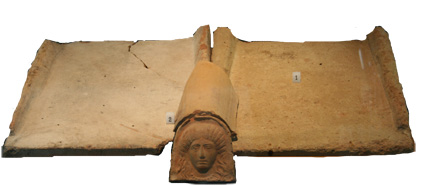
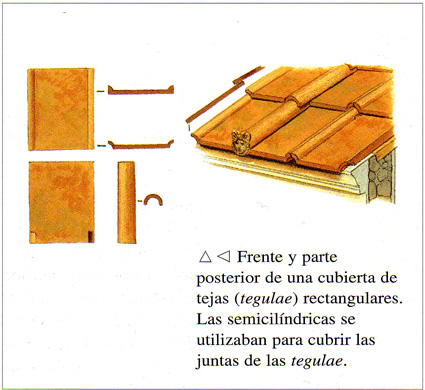
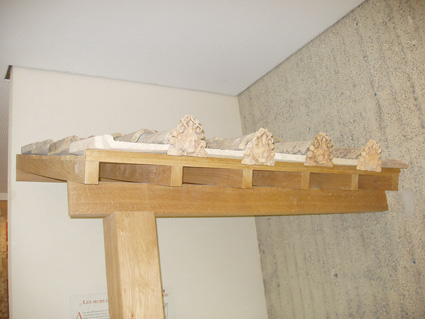
The roofs were made in wood and they were covered with plane square tiles made in terracotta –tegulae-, in general in a size 45 x 60 centimetres; the tiles were connected by semi-cylindrical tiles –imbrices- to avoid water filtrations; decoratively, the junction of the tegulae and the imbrices were covered by some tiles called antefixi, that represented human heads, animals, etc. |
|
Plane tiles –tegulae- from Caesar Augusta (I century a. C.), semi-cyllindrical tile –imbrex- (I century a. C.) from Colonia Celsa (nowadays Velilla de Ebro, Zaragoza) and decorative tile –antefixus- (I century a. C.) from El Convento (Mallén, Zaragoza). Museo Provincial de Zaragoza. (Photography: Roberto Lérida Lafarga 3/1/2008) |
|
|
|
|
|
Reconstruction of tiles -tegulae- and a roof from CONNOLLY, Peter y DODGE, Hazel: La Ciudad Antigua. La vida en la Atenas y Roma clásicas, Madrid, 1998. |
|
Disposition of tegulae, imbrices y antefixi in the reconstruction of a roof. Museo of Vasio (nowadays Vaison la Romaine, Provence, France). (Photography: Roberto Lérida Lafarga 6/8/2007) |
|
|
|
|
|
To decorate the public buildings and the rich men’ houses, the Romans used marble, granite and porphyry. The white marble was generally imported from Greece until the year 35 b. C., but after that the Romans started to use the white marble from Carrara –in the north of Italy-; the coloured marbles came from the Aegean islands in Greece and from Africa. In general the mosaics were used as pavement in rooms and fountains, and even in the walls of some rooms. A large number of mosaics is preserved along the Roman empire and in Aragon. |
||
|
|
|
|
|
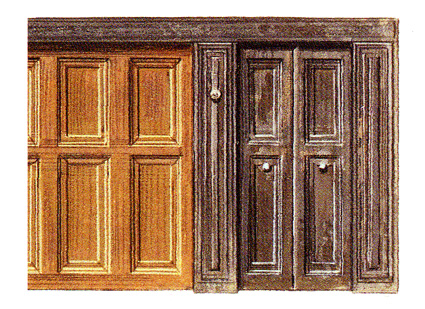
To divide rooms the Romans could make party walls with concrete that were recovered with gypsum and were painted with rich colours; however, we have evidences of the use of wooden thin walls or even wooden lattices –similar to the lattices used in the windows-; these wooden lattices like our folding screens were movable and they had hinges.
|
|
Wooden thin wall found in the House of the Wooden Thin Wall in Herculanus (Italy). Photography from CONNOLLY, Peter y DODGE, Hazel: La Ciudad Antigua. La vida en la Atenas y Roma clásicas, Madrid, 1998 |
|
|
|
|
|
|
|
FUENTES: - AA. VV.: Museo de Zaragoza. Guía, Zaragoza, 2003 - CARCOPINO, Jerôme: La vida cotidiana en Roma en el apogeo del Imperio, Madrid, 1993 - CONNOLLY, Peter y DODGE, Hazel: La Ciudad Antigua. La vida en la Atenas y Roma clásicas, Madrid, 1998 |