BILBILIS AUGUSTA: THEATRE

|
|
BILBILIS AUGUSTA: THEATRE |
|
|
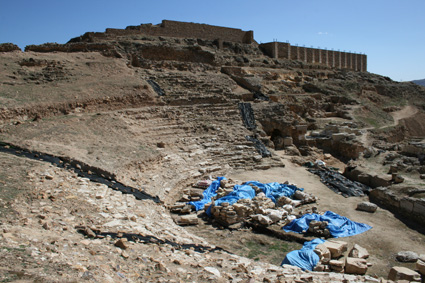
The theatre is probably the most representative building in a Roman city. In the case of Bilbilis, its theatre is contemporaneous to its forum and it had a large proportions related to the size of the city, because it could shelter about 4.500 people; in fact, its size exceeded the needs of the city, so that its conception was the construction of a building that gave a social and playful service not only to the Bilbilitans, but to all the population in the zone that joined together for festivities, theatre performance or other kind of activities that took place in the city. |
|
View of the theatre and the forum of Bilbilis. (Photo: Roberto Lérida Lafarga 16/03/2008) |
|
|
|
|
|
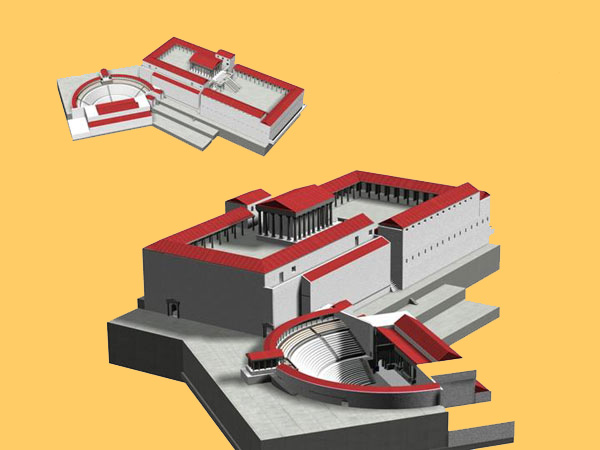
The theatre, situated on the gully between Santa Barbara hill and Bambola Hill, was built in two phases, coinciding the first phase with the time of the building of the forum, and it was built on the Greek style, i. e., making use of the gully between hills to make and support directly the rows over the natural terrain –so the construction is easier- and not on the Roman style, like the theatre in Caesar Augusta, i. e., building the theatre completely from its foundations and supporting the rows over them and over thick pilasters and walls. The adaptation to the gully supposed a hard work, because it was necessary to sculpt the rocks on the hill, refill the natural hollows of the terrain, drain the area of the rows, canalize the water to bring it to the back of the building, etc. The gully was closed with a wall 7 metres high and 5 metres wide that, in addition, was used as support to the frons scaenae. |
|
Reconstruction of the forum and the theatre of Bilbilis, from MARTÍN BUENO, Manuel y SÁENZ PRECIADO, Juan Carlos: Bilbilis, Calatayud, Zaragoza, 2005 |
|
|
|
|
|
Architecturally and town-planningly the theatre formed a monumental whole together with the forum that was connected to it through porches and passageways. The architect that designed the whole planned to give to the city a monumental centre that dominated the civic activities. Although it is partially excavated and it was made of not good materials, the fact that this theatre is preserved is considered as a proof that it was consolidated and partially restored for a social and recreative use along the history of the city. |
|
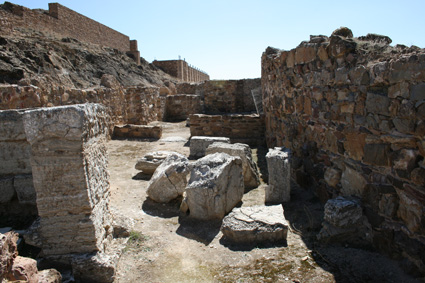
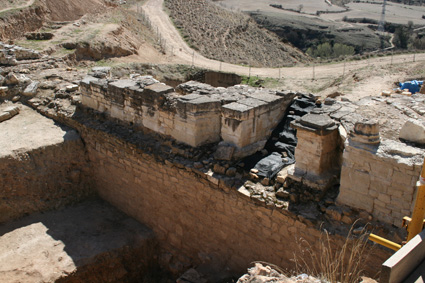
Rooms leaned against the theatre and the forum. (Photo: Roberto Lérida Lafarga 16/03/2008) |
|
|
|
|
|
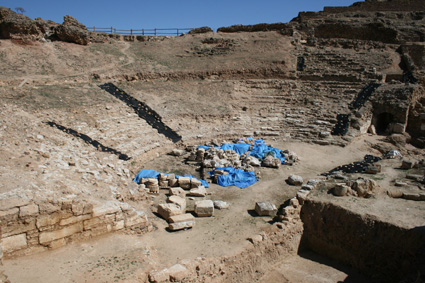
The theatre of Bilbilis had a scaenae –scene- with three valvae –doors- in two floors and a sacellum –small sanctuary- in the high part of the summa cavea –upper rows-. Only the upper part of this summa cavea was supported not over the hill, but over walls and pilasters, so that under it there was a ring-shaped aisle with two vomitoria –accesses from outside into the inner side of the theatre-. To access to the theatre there were also in its sides some parascaenia –accesses that were parallel to the scene- or some entries to the media cavea –middle rows- through accesses over the parascaenia where people came through inside staircases. The archaeologists sized the different parts of the theatre and so we know that the orchestra –round space for the musicians, actors, dancers, chorus, etc.- had 20 metres in its diameter and the cavea 73 metres diameter (78 metres if we count the development of a outer crypta up to its façade), reached 180 degrees; nevertheless, in the media cavea the rows were taken back 21 degrees because the side porches of the forum overlapped it. |
|
View of the cavea in the theatre of Bilbilis. (Photo: Roberto Lérida Lafarga 16/03/2008) |
|
|
|
|
|
The scene had a sinuous plan, composed of right sections that alternated with curved exedrae –semicircular benches or apses- to shelter the valvae; it had two floors and 22 columns with Corinthian capitals on all of them. |
|
View of the lower part of the scaena of the theatre of Bilbilis. (Photo: Roberto Lérida Lafarga 16/03/2008) |
|
|
|
|
|
In the central part of the summa cavea there was a small temple in antis –with pilasters at both sides of the door- with a podium; this fact gives to the theatre a special value, because it followed the model of the theatre of Pompeius in Rome. According to sculptural remains the scholars think that this temple was dedicated to the imperial family. The temple should be pseudoperipterum –when the columns lean against the walls and are projected only partially- and diastylum –when the space between columns is equivalent to three diameters of the columns-, with a size of 11,5 metres high and 7,5 metres wide and with peristasis –porch with columns- of six columns in the large sides and four in the short sides. |
|
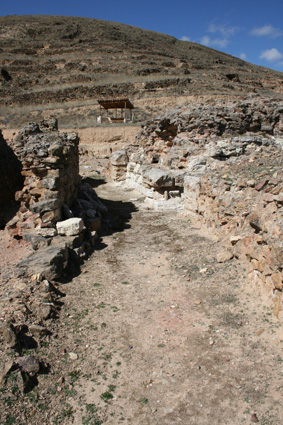
Ring-shaped aisle that separated the part of the theatre -of the summa cavea- sculptured on the hillsides and the part that was supported by the foundations; in this zone there should be the sacellum that crowned the theatre. (Photo: Roberto Lérida Lafarga 16/03/2008) |
|
|
|
|
|
|
|
Sources: - MARTÍN BUENO, Manuel y SÁENZ PRECIADO, Juan Carlos: Bilbilis, Calatayud, Zaragoza, 2005 - MARTÍN BUENO, Manuel y MAGALLÓN BOTAYA, M.ª Ángeles: Cuaderno de campo Grupo URBS: Bilbilis y Labitolosa, Zaragoza, 2006 |