BILBILIS AUGUSTA: HOUSES

|
|
BILBILIS AUGUSTA: HOUSES |
|
|
Among the houses found in Bilbilis we can visit houses on the Hellenistic style, with a courtyard, or more modest houses, among other reasons due to their adaptation to the terrain and its ramparts. So, there are many houses terraced in different heights, using the unevenness and setting on contiguous terraces. Anyway, the inclination of the terrain and the terraces did not make easy to build the kind of houses with large peristylum –colonnade that surrounded a large inner courtyard-, but rather the Italic style of houses, with a tetrastylum –with four columns- courtyard not too large. The richer houses were located in the zones closest to the big public buildings and to the monumental zone of the city, while, as the buildings were far away from this monumental centre, the houses were more modest. |
|
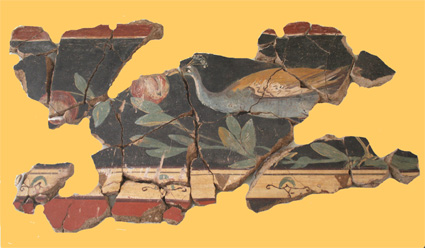
Fresco of the peacock, from the room 29 of the domus 3 of the insula I in Bilbilis, dated in the first half of the I century a. C. Museum of Calatayud. (Photo: Roberto Lérida Lafarga 16/03/2008) |
|
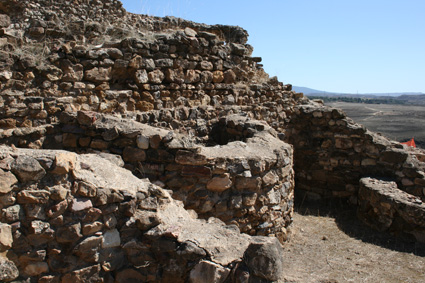
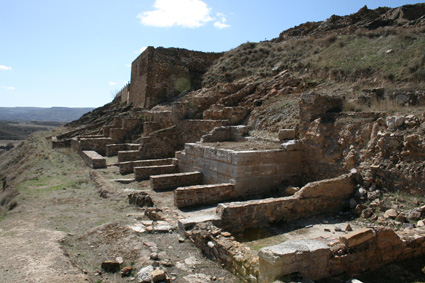
A house from which it is preserved a large structure is the domus of the nymphaeum, so called because a series of rooms are directly related to a fountain or nymphaeum; so, the whole is composed by a double cistern and three semicircular basins, one in the centre and two in its sides, from which only it is preserved their foundations. Close to the nymphaeum it was located the structure of a terraced domus, although only some parts belonging to the ground floor are preserved. |
|
Cisterns and nymphaeum from the so called domus of the nymphaeum. (Photo: Roberto Lérida Lafarga 16/03/2008) |
|
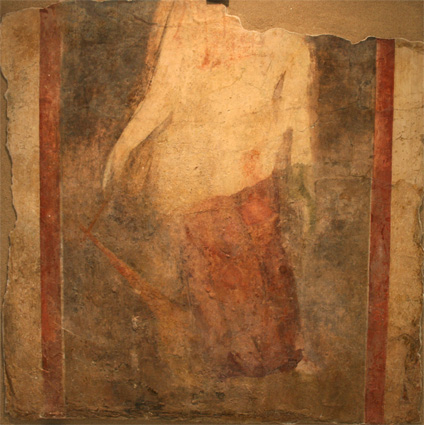
Other located domus is the so called domus of the Fortuna, because in it there was found a mural picture of the goddess Isis-Fortuna in a room that seems to be an altar similar to a lararium –altar dedicated to the domestic gods, the lares-; the house shows three phases: a house, later abandoned, was built at the beginning of the I century a. C.; in the middle of the I century d. C. it was built a house whose remains are preserved; in the first decades of the II century this house was modified. In fact, two different structures have been located: a domus and a collector of urban residues with a cistern a probably with a temple from which some Ionic capitals and some fragments of columns are preserved. |
|
Fresco of the goddess Isis-Fortuna found in the domus that receives her name. Museum of Calatayud. (Photo: Roberto Lérida Lafarga 16/03/2008) |
|
Near the thermae, an area called the Quarter of the Thermae, there were located the remains of a complete insulae, formed by four houses, and the trade front of another insula with the rooms of its domus. These insulae were built on primitive Celtiberian houses in the I century a. C. and they occupy two terraces with powerful walls to contain the hillsides of the Bambola hill. It seems that these insulae had tabernae in the ground floor and two heights on in, so that the higher floor had also access to the street in a higher terrace. We can remember that Martial called pendula … tecta –“hanging houses”- to the houses of Bilbilis. These insulae were flanked by terraced streets or ramparts, which separated them from the thermae, to have access to the main streets; one of these streets had an unevenness of 8 metres. From the houses of this complete insulae there were found tabernae under the domus 2 and 3; on the other hand, the so called domus 1 was organized around a tetrastylum courtyard that was abandoned in the half of the I century a. C. yet; in addition, it had a balneum –bath- with heating –hypocaustum-, bathtub and latrine; finally, in some of its rooms there are preserved the decorated walls; these domus kept inhabited until the first decades of the III century a. C. |
|
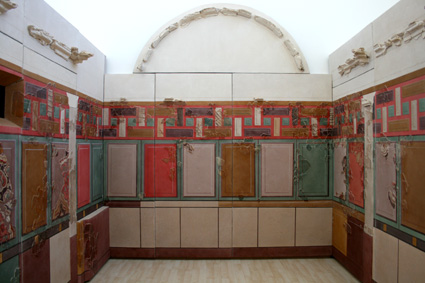
Cubiculum -bedroom- from the domus 2 of the insula I in Bilbilis, dated in the year 50 a. C. Museum of Calatayud. (Photo: Roberto Lérida Lafarga 16/03/2008) |
|
Craft places have been found near the forum and the thermae, in their outsider; these craft workshops were dedicated to work metal, glass, textiles, etc., according to the testimony of the excavations. Near the thermae some tabernae have been found; under the domus I of the insula in the Quarter of the Thermae a popina –restaurant of house of food-, which kept in use until the half of the II century a. C., have been located. Parallel, the sources and the location of Bilbilis give us evidence that there were agricultural exploitations on the banks of the Jalon and Ribota rivers. |
|
Possible trade places at the foot of the forum of Bilbilis. (Photo: Roberto Lérida Lafarga 16/03/2008) |
|
|
|
Sources: - MARTÍN BUENO, Manuel y SÁENZ PRECIADO, Juan Carlos: Bilbilis, Calatayud, Zaragoza, 2005 - MARTÍN BUENO, Manuel y MAGALLÓN BOTAYA, M.ª Ángeles: Cuaderno de campo Grupo URBS: Bilbilis y Labitolosa, Zaragoza, 2006 |