WAR MACHINES : THE ARTILLERY

|
|
WAR MACHINES : THE ARTILLERY |
|
|
The Romans inherited from the Hellenistic Greeks and afterwards developed and perfected most of the war machines that the Greeks used in their wars and sieges to enemy cities. Their use was reserved to fight against hostile armies or to besiege cities. One of the advantages of the Roman artillery was the fact that during many centuries only a few of their enemies had and used war machines. Basically, the artillery was divided into two types of machines: those that threw stones and those that threw arrows or spears. |
||
|
|
|
|
|
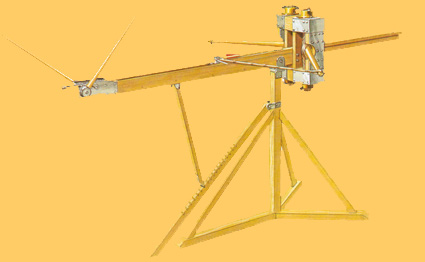
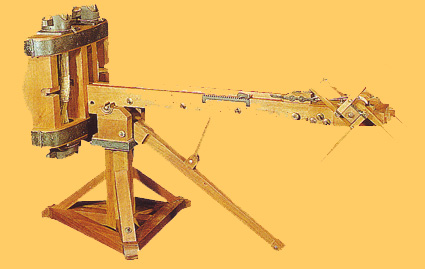
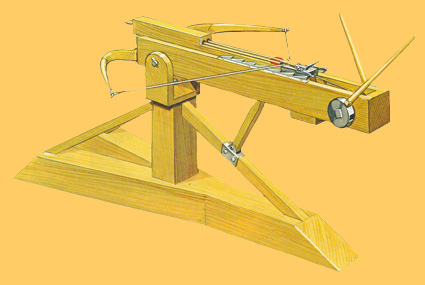
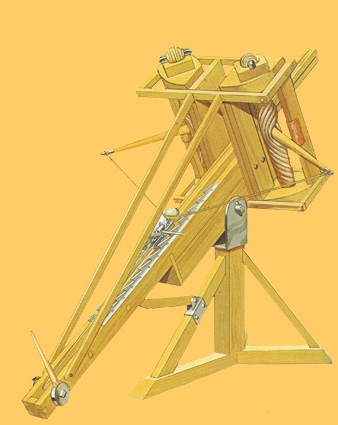
The kind of machine that threw arrows was the catapult –from the Greek καταπάλτης "that throws" -; probably the most usual type of catapults was the scorpion -scorpio-; every centuria had one of these artefacts that threw arrows less than 70 centimetres long with a maximum range of 350 metres; the arrows could be greased with pitch and covered with straw, becoming incendiary projectiles. |
||
|
|
|
|
|
Catapult; type scorpio |
|
Other scorpio Reconstruction from AA. VV.: Atlas ilustrado de la Antigua Roma: de los orígenes a la caída del imperio, Madrid, 2002 |
|
|
|
|
|
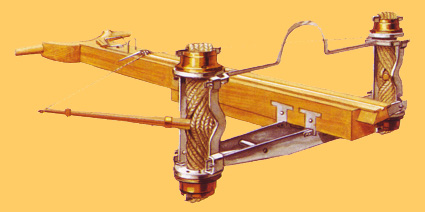
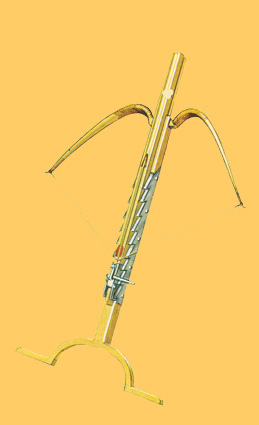
There was a version for individual use with the hands, called chiroballista –from the Greek χειροβάλλιστρα "hand thrower"-, predecessors of the medieval hand crossbows. An especial type of hand crossbows was the gastrophetes –from the Greek γαστραφέτης, "stomach crossbow"-, so called because one of its extremes was leaned on the ground and the other on the stomach to draw the bowstring; from this type it is derived a more complex weapon that could throw two arrows, but due to its weight it should be leaned on the ground to throw the arrows. Under the emperor Trajan other kind of catapults, the carroballistae, were developed; these carroballistae threw arrows and spears, but they were assembled on a chariot with two mules, so they had a big mobility; it was necessary up to 8 soldiers to use them in the battle; every legion had between 50 and 60 carroballistae. This kind of artillery did not damage the walls, except the incendiary projectiles; they were used to attack the enemy army. |
|
Chiroballista Reconstruction from AA. VV.: Atlas ilustrado de la Antigua Roma: de los orígenes a la caída del imperio, Madrid, 2002 |
|
|
|
|
|
Hand gastraphetes |
|
Double ground gastraphetes |
|
|
|
|
|
The war machines that threw stone had an effective function in the attack against all kind of fortifications. The Roman artillery had some artefacts like the ballista –from the Greek verb βάλλω, "throw"-; every cohort had one (10 per legion); 10 men were necessary to its working and it threw stones in a relatively horizontal trajectory (projectiles with a weight between 500 and 800 grams and with a range up to 180 metres; we know projectiles with a weight of 6,4 kilograms up to 7,5 kilograms, although some researchers think that the big ballistae could throw projectiles with a weight 20 kilograms with a range of 400 metres). |
|
Ballista to throw stones |
|
|
|
|
|
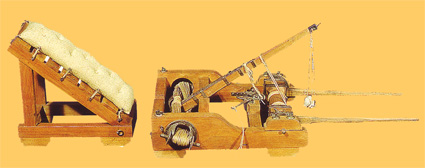
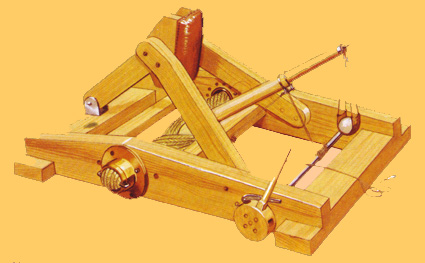
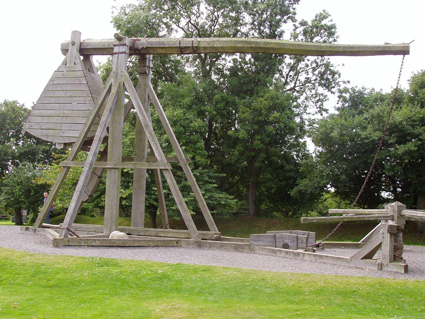
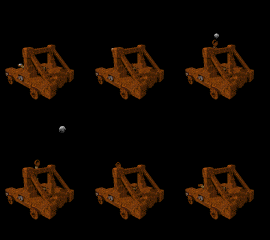
A more sophisticated and efficient artefact to throw stones was the onager –its name came from a kind of wild donkeys that threw stones kicking them with the rear hoofs -; every legion had 3 onagri; it was a siege weapon more than a battle-field weapon; the projectile made a trajectory similar to those of a modern mortar, with a range of 30 metres. It started to be used in the Roman army at the beginning of the imperial age. Sometimes the onager had in front a padded wooden chassis that braked the strength of the onager’s arm.
Onager with chassis as shock absorber of the onager's arm Reconstruction from AA. VV.: Atlas ilustrado de la Antigua Roma: de los orígenes a la caída del imperio, Madrid, 2002 |
|
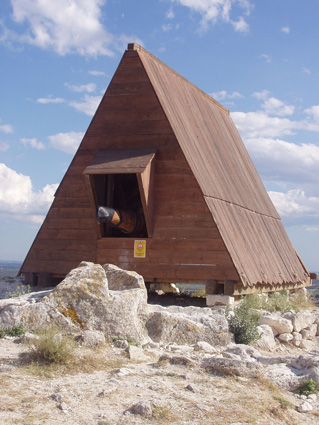
Reproduction of a medieval catapult , developed from the Roman catapults (Les Baux de Provence, France) (Photo: Roberto Lérida Lafarga 08/05/2007) |
|
|
|
|
|
|
|
|
|
Onager |
|
Reproduction of a medieval catapult , developed from the Roman catapults (Caerlaverock Castle, Scotland, United Kingdom) (Photo: Roberto Lérida Lafarga 22/07/2004) |
|
|
|
|
|
In addition to the artillery, the Romans inherited from the Greeks some machines to siege cities –the Greeks developed the art of besieging cities, called poliorcetica, in Greek πολιορκητική-, and even defensive buildings in case of being besieged. |
||
|
|
|
|
|
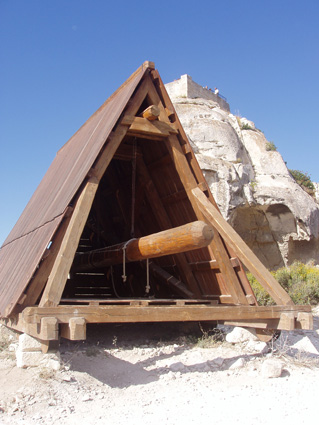
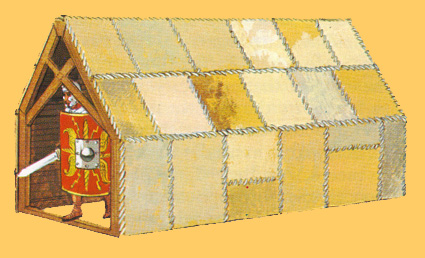
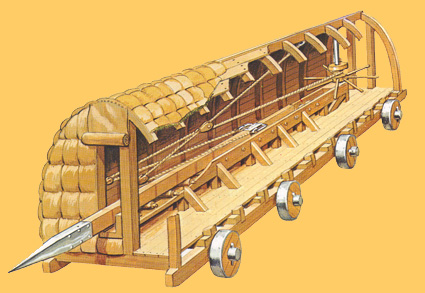
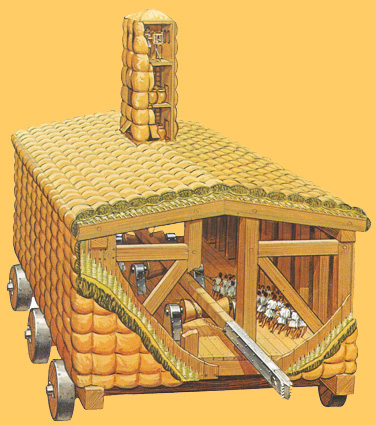
To besiege cities, the Roman used to build a rampart –agger- on the foot of the enemy walls and then they made the combat and assault towers advance –turres mobiles-, full of soldiers and machines; from these towers or more usually from the ground they used their mechanical engines, based on the tension and torsion of ropes. In addition to the towers they had battering rams –aries “ram”-, a wooden trunk with an iron point so called because a ram’s head was represented in the point; this artefact was put into a covered gallery and the soldiers pushed it again and again against the enemy walls until it opened a breach in them or it demolished them. The Roman developed covered galleries on wheels, like armoured vehicles, called turtles –testudo- that were used as refuge for the soldiers who approached to the enemy walls; and they developed other kind of galleries –vineae- covered with wood and fresh leather to repel incendiary products. Finally, they developed a group of sappers who could dig tunnels –called cuniculi, “rabbit dens”- to enter into a besieged city through underground passages. |
|
Battering ram
|
|
|
|
|
|
Reproduction of a medieval battering ram and its covered gallery (Les Baux de Provence, France) (Photo: Roberto Lérida Lafarga 08/08/2007) |
|
Vinea: covered gallery |
|
|
|
|
|
Covered gallery with drill |
|
Gallery testudo with battering ram |
|
|
|
|
|
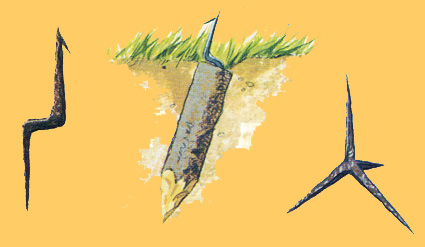
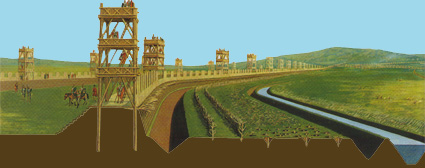
When the Romans were besieged or sometimes as preventive measures against possible enemies, they organized different recourses against the besiegers: in front of the walls they put stimuli –stakes with iron points stuck in the ground like spikes-, strobes –funnels in the ground with a pointed stake at the bottom-, lilia –wooden obstacles full of iron points-, cippi –pointed stakes that simulated bushes-; after these obstacles, they used to make a fosse –fossa- that they filled with water, becoming a marsh that avoided the besiegers to pass; after that, a rampart –agger- full of thorny bushes; finally, a wall reinforced with battlements and defensive towers. |
|
Iron point to stimuli and lilia found ien Alesia (nowadays Alise-Sainte-Reine, France), used by the Romans in their auto-siege. |
|
Reconstruction of the double lilne of wooden walls that the Romans built in Alesia (nowadays Alise-Sainte-Reine, Francia) with different defensive lines. |
||
|
|
|
|
|
All the pictures that appear in this webpage are taken from the reproductions of CONNOLLY, Peter: Greece and Rome at War, Londres, 2006, salvo los que se indican en concreto. |
|
|
|
|
|
SOURCES: - BROCKLEHURST, Ruth: Roman Army, London, 2003 - CONNOLLY, Peter: Greece and Rome at War, London, 2006 - HACQUARD, Georges: Guía de la Roma Antigua, Madrid, 2003 - WILKES, John: El ejército Romano, Madrid, 1990 |
|
|
WebQuest: Playmobil y el Ejército Romano |
|