PREVIOUS ASPECTS

|
|
PREVIOUS ASPECTS |
|
|
The Roman army was created as a “national guard composed by small landowners”, according to G. Hacquard. The ancient ideal in Rome from the age of the Monarchy was “cives and miles” –i. e., “citizens and soldiers”- and for many centuries its army was fed by men who belonged to the patrician families and to their clientelae, and in general to landowners. During the most part of the Republican time, the army was only operative in the good time –spring and summer-; the soldiers came back home to collect their harvests, to spend the winter with their families and to sow the new harvests; its activity was generally limited to the Italic Peninsula; it was an army of Roman citizens and the military service was one of their civil and civic obligations. However, after the Punic Wars, when Rome extended outside Italy – to Hispania, Greece- and, especially, in the last century of the Republic, with the Civil Wars and the military activities of Iulius Caesar and Cnaeus Pompeius in Asia Minor, Africa, Hispania, Gaul and Greece, it was evident that neither the Roman soldiers could come back home every year –because they kept camped in the frontiers of the newly conquered provinces-, nor the Roman citizens could reach a number of soldiers enough to defend all these territories. So, very soon in the age of the Empire, the Roman army sheltered not only Italic troops, but extra-Italic troops as auxiliary troops and finally as legionaries; at first only Roman citizens could be legionaries, but the Roman citizenship was progressively conceded first to some towns, afterward to some zones and finally to all the empire. However, the concession of the Roman citizenship to all the empire by the emperor Caracalla, in his famous edict in the year 212 a. C. had a fulminating effect in the Roman army: many people in the provinces considered that the army was a way of life and a way to progress, because with the military service the soldier reached privileges –e. g., the Roman citizenship- and they earned a good pay; the Caracalla’s edict deprived the soldiers of the greatest privilege; as a consequence, a lack of interest in enlisting in the army happened. Due to this lack of volunteers, it was necessary a recruitment; in this situation most of rich people paid to others in order to occupy their place in the army; so, a large number of mercenaries entered into the Roman troops, and, at the same time, the auxiliary troops formed by barbarians started to have more importance inside the Roman army. |
|||
|
|
|
|
|
|
Etymologically it is necessary to differentiate between three words frequently used in the classical text about the Roman army: exercitus, acies and agmen. Exercitus is the army, the whole troops; these troops are called copiae; acies is the army in battle order in the battle field; agmen is the army in movement, when the troops are moving from one point to other. The cavalry is called equitatus, because it is composed by cavalrymen or horsemen –knights- (equites) who had horses (equi). The infantry is called peditatus, because it is composed by soldiers (pedites) who went on foot (pes, pedis). The fleet is called classis. The battle is denominated proelium or pugna and, if it is a minor battle with scarce importance, it is called certamen; on the other hand the war is called bellum, from which English terms are derived, like “bellicose”, “bellicosity”, “belligerence” o “belligerent”. |
|||
|
|
|
|
|
|
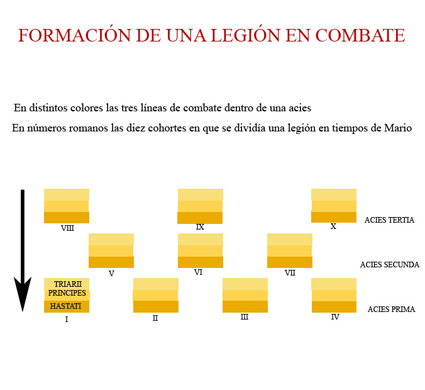
In the first times of Rome –e. g. under Servius Tullius- the army in battle order –acies- was organized in the so called phalanx, i. e., all the troops are ordered in masse, divided into six lines of combat. Under Camilus the battle order was more pragmatically organized: the legionaries fought closely, flanked by auxiliary troops that were flanked in their turn by the two cavalry wings –cornua-; beyond all of them the light infantry –velites- fought first. Then the legion normally formed up in chequered order, which is called tresbillo; this disposition allowed that the soldiers in the rear rows could replace and help to the front rows if these latter rows yielded, occupying the free spaces; in this order there were a triple line of combat –triplex acies-; the first line –prima acies- was usually composed by three cohorts –cohortes-, the second one -secunda acies-, by four cohorts and the third line –tertia acies- by three cohorts. Under Marius, the chequered battle order kept on, but the disposition of the cohort and the soldiers were reorganized in the lines of combat: the first line –prima acies- was composed now by four cohorts, but the second -secunda acies- and the third line –tertia acies- had three cohorts every one. Every acies was divided into different lines according to the kind of soldiers –hastati, principes and triarii-; in general, beyond the legion the auxiliary troops –velites- fought as first line of combat. |
|
|
|
|
|
|
|
|
|
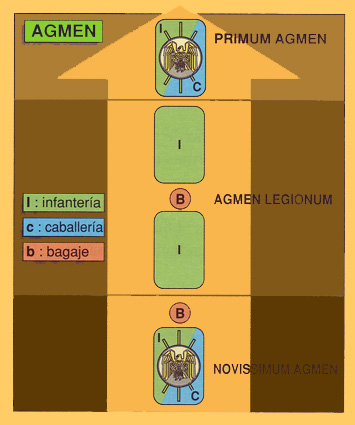
The marching army –agmen- went over a normal journey of 25 kms. every day; this was called iustum iter –adequate journey-, that could be increased up to 30 kms. or more if they advanced in forced marches or with all speed –magnis itineribus-. We have to value exactly this march, because the legionaries went on foot, loaded with their weapons and their impedimenta –sleeping bag, set of cutlery, personal effects, tool for digging and food for17 days-; if, for any reason, they were not loaded, they were expediti, i. e. without impedimenta. In its advance, the officers sent in front patrols of trackers –exploratores- and spies –speculatores-; in the regular disposition they placed in the first position, in the vanguard –primum agmen-, part of the cavalry and part of the infantry; in the centre –agmen legionum- they placed the main body of the infantry with the impedimenta –everything that the army needed for its supplying, installation, etc.-; finally they placed the rear –novissimum agmen- with the same troops as in the vanguard. So, the agmen followed in general an almost fixed and inalterable order –ordo agminis-. |
|
Outline of the normal march of the Roman army -agmen-, from VIÑAS, Antonio et alii, Latín, Valencia, 1997 |
|
|
|
|
|
|
|
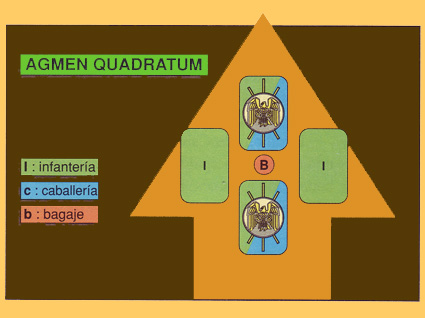
If the army crossed a hostile territory, it used to adopt a defensive square-shaped formation –agmen quadratum-, with the impedimenta in the centre, the min body of the infantry flanking the impedimenta and the vanguard and the rear with the same troops than the ordo agminis. |
|
Outline of the march of the Roman army through hostile territory -agmen quadratum-, from VIÑAS, Antonio et alii, Latín, Valencia, 1997 |
|
|
|
|
|
|
|
The number of soldiers in the Roman army was evidently variable and until the apogee of the empire it was always increasing. We cannot know exactly the quantity, but there are some calculations. On the right we offer the approximate number and the division of the troops in the Roman army in the age of the emperor Trajan, 97-117 a. C., according to a number of 30 legion and 5.300 soldiers per legion. |
|
30 legions x 5.300 men |
159.000 legionaries |
|
Emperor's Guard (pretorians) |
10.000 guards |
||
|
Auxiliar cavalry |
80.000 auxiliars |
||
|
AuxiliarInfantry |
140.000 auxiliars |
||
|
Other irregular and allied troops |
11.000 soldiers |
||
|
TOTAL |
400.000 men |
||
|
|
|
|
|
|
|
|
SOURCES: - BROCKLEHURST, Ruth: Roman Army, London, 2003 - CONNOLLY, Peter: Greece and Rome at War, London, 2006 - HACQUARD, Georges: Guía de la Roma Antigua, Madrid, 2003 - WILKES, John: El ejército Romano, Madrid, 1990 |
|
|
|
WebQuest: Playmobil y el Ejército Romano |
|