COPY OF THE STATUE OF
AUGUSTUS FROM PRIMA PORTA

|
|
COPY OF THE STATUE OF AUGUSTUS FROM PRIMA PORTA |
|
|
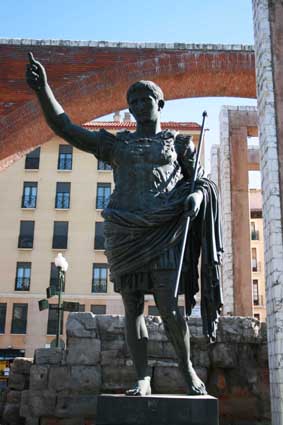
Near the remains of the Roman walls in Caesar Augusta we can see a present bronze copy of the famous marble statue known as Augustus from Prima Porta. The original statue, that nowadays it is in the Vatican Museums in Rome, was discovered in the Livia’s Villa, the Augustus’ wife, in the village of Prima Porta. We make stand out its decoration in the cuirass, where there is represented the return of the military Roman badges lost by thr Roman general Crassus in the year 53 b. C. in his campaigns against the Parthians and recovered by the Augustus’ army. The original statue seems to be dated in the year 8 b. C.; it symbolized the emperor as guaranteeing of a new political order and, at the same time, it tried for glorifying the Tiberius’ military enterprise in the service of Augustus and probably for justifying the Tiberius’, the Augustus’ stepson, right to the succession. The bronze copies that exist in some cities as Emerita Augusta (nowadays Mérida) or, in our case, in Caesar Augusta (Zaragoza) were given as a present by the Italian dictator Benito Mussolini to commemorate the foundation of these cities by Augustus. To other cities founded by the Romans, he gave as a present a statue of the Lupa Capitolina (Capitolinian She-wolf) with the twins Romulus and Remus. |
|
(Photo: Roberto Lérida Lafarga 1/11/2007) |
|
|
|
|
|
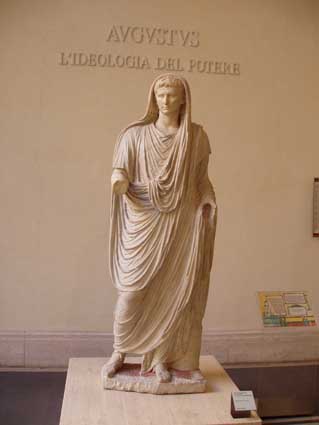
In order to give prestige to his activities and to be recognized as ruler of the Romans, Octavius Augustus made a propaganda campaign empire based on the power of the image. For this, he gave a big impulse to the great public works inside and outside Rome and he founded a large number of cities all around his, most of the times called with the title of Augusta in his honour; he flooded Rome and the rest of the cities in the empire with statues of himself, sometimes dressed as a pontifex maximus (highest priest) in order to show his roll as guaranteeing the Roman religion and as a symbol of his pietas (prayer of the glory with regard to the gods and the ancestors), sometimes dressed as a Roman general –this is the case of the Augustus of Prima Porta-, because the imperator (emperor ) held the imperium (the military authority over all the Roman troops). Augustus, following the sculptoric Greek canons, wanted to be represented in his statues with an idealized figure, the divinus adulescens (“the divine adolescent”, according to how he was called by Cicero, Philippicae V 16, 42); in his official portrait all around his empire, it was taken an image from the first years of his Principatum (charge as princeps) and the faces of the statues of Augustus always showed harmonic features, expressing a quiet, sublime and timeless beauty. So, his statues show a unmistakable character marked by a distinguished, hieratic and cold aspect, undoubtedly as the reflect of a semi-divine and almost monarchical condition. |
|
Statue of Augustus as pontifex maximus (highest priest) Museo Nazionale Romano Palazzo Máximo alle Terme, Rome (Photo: Roberto Lérida Lafarga 31/12/2004) |
|
|
|
|
|
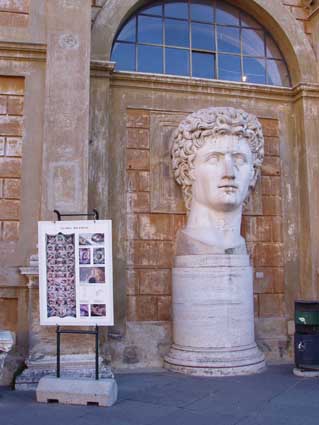
The ancient chronicles say that only in Rome were erected about eighty statues of Augustus during his mandate, some of them with a colossal size. |
|
Statue of Augustus in the Pigna Courtyard in the Vatican Museums, Rome (Photo: Roberto Lérida Lafarga 30/12/2004) |
|
|
|
|
|
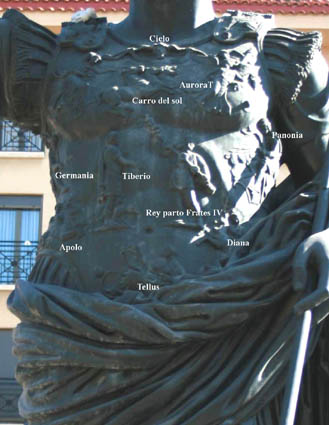
The statue of Augustus from Prima Porta, -its original was made in marble-, is a master piece due to the treatment in the reproduction of the metal from the cuirass. Augustus appears dressed with cuirass and with a cloak that relies on his hip and on his left arm, where he holds a spear; his pose remembers to a general that it is going to harangue his soldiers. His naked feet approach the statue to the pattern of the statues of Greek gods and heroes, while the little Eros on his feet should symbolize the supposed origin from the goddess Venus from whom the Iulia family, Iulius Caesar and Octavius Augustus presumed to descent. In the centre of the cuirass we can see the Parthian King, Frates IV, giving to Tiberius the Roman badges wrested by the Parthian from the Roman army and his general Crassus in the year 53 b. C.; the Parthian King is flanked by the personifications of Germania and Pannonia, the two Roman provinces freed and wrested to the Barbarians by Tiberius, the Augustus’ stepson, in his military campaigns in the years 12 and 8 b. C. respectively. At the top of the cuirass we can see the personification of the Sky under whom the god Sun’ cuadriga (wagon carted by four horses), guided by Aurora (the Dawn) and by Phosphorus; we can see too at the bottom the images of Tellus (the Earth), of Apollo on a gryphus (fabulous animal) on the left and of the Diana on a hind on the right. Click here if you want to see another explanation about the cuirass of this statue. The statue of Augustus from Prima Porta has as direct antecedent the Doriforos (literally “who brings a spear”), an original Greek statue made by the Athenian sculptor Polyclitus in the V century b. C., also known as the Canon, because it is a perfect example of the use of the idealized proportions in the human figure. In both statues the personages lean their weight on the right leg and move the left foot backwards, leaning only the toes as if they are walking –they seem statues with “timeless crystallization of the movement”-; the torso and the head are lightly turned. The perfection and the beauty of this statue of Augustus lie in the wise, balanced and delicate combination of artistic Greek aspects –the idealization of the portrait, the naked feet, the allegorical and mythological motifs and its antecedent, Polyclitus- with artistic properly Roman elements –the cuirass, the historical scene, the pose of the general haranguing his soldiers. |
|
(Photo: Roberto Lérida Lafarga 1/11/2007) |
|
|
|
SOURCES: - BELTRÁN LLORÍS, Francisco: Lo mejor del arte romano 2, Madrid, 1997 - BUSSAGLI, Marco (ed.): Roma: Arte y Arquitectura, Colonia, 2000 - LIBERATI, Anna Maria y BOURBON, Fabio: Roma antigua, Barcelona, 2005 - ROBERTSON, Martin: El arte griego, Madrid, 1985 |